
Our Short List of 3

- Best for: Beginners, hikers, and anyone who wants a light, trustworthy camp knife without spending much.
- Blade length 4.1 inches; Sandvik 12C27 stainless steel; Scandi grind; blade thickness 2.5 mm; weight 4.1 oz with sheath; high-friction rubber handle; polymer sheath with belt clip; made in Sweden.
- Outstanding value, with performance well above its price class
- Stainless Scandi blade is easy to sharpen and resists rust
- Very light at 4.1 ounces carried, so it suits long hikes
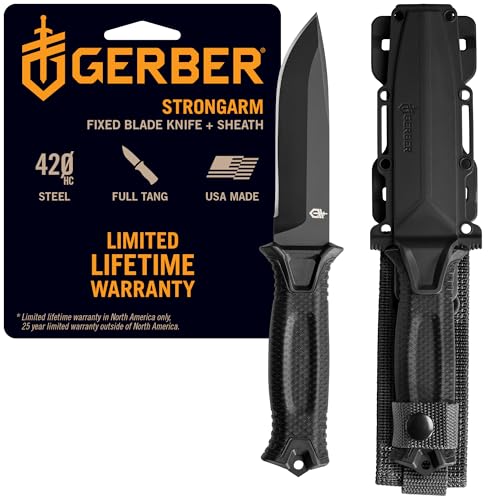
- Best for: Campers and bushcrafters who want a tough, full-tang knife for batoning, chopping, and hard outdoor work.
- Blade length 4.8 inches; overall length 9.8 inches; 420HC stainless steel with black ceramic coating; full tang; weight 7.2 oz; rubberised diamond-texture handle; striking pommel; multi-mount sheath; made in USA; model 30-001038N.
- Full-tang construction built for batoning and hard use
- Versatile multi-mount sheath carries vertically, horizontally, or on MOLLE
- Grippy rubberised handle and striking pommel add utility
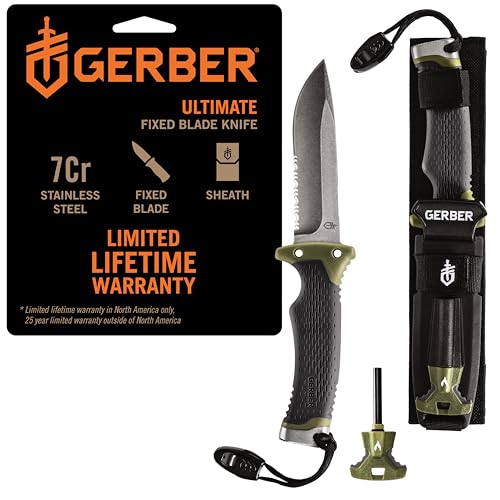
- Best for: Anyone building a first survival kit or an emergency bag who wants fire tools with the knife.
- Blade length 4.75 inches; combo edge; textured rubber handle; fire starter edge on spine; ferro rod included; emergency whistle; sheath with integrated sharpener; model 31-003941.
- Ferro rod, whistle, and sharpener built into the sheath
- Combo edge handles cord, rope, and slicing in one blade
- Textured rubber grip stays secure when wet
All 3 Picks at a Glance
| Product | Specs | Action |
|---|---|---|
| 1. Morakniv Companion Fixed Blade |
| Check price on Amazon |
| 2. Gerber StrongArm Fixed Blade |
| Check price on Amazon |
| 3. Gerber Ultimate Survival Knife |
| Check price on Amazon |
Our Top Picks
Introduction
The best affordable survival knife proves that a capable fixed blade does not need a premium price tag. A good survival knife handles the core jobs of camp life: cutting cord, carving feather sticks, preparing food, batoning small firewood, and striking a ferro rod. The knives in this guide do those jobs with proven steels, full-tang construction, and sheaths that carry safely, while staying within reach of a modest gear budget.
Affordable does not mean disposable. The three picks below are all fixed blades from established makers, listed on Amazon US with ASINs and specifications taken from the listings. One is the lightest route into a trustworthy camp knife, one is a tough all-rounder built for hard use, and one packs fire-starting tools into the sheath itself.
What Makes a Survival Knife
A survival knife is a fixed-blade tool designed for hard outdoor use. Unlike a folding pocket knife, it has no pivot to fail, no lock to gum up with dirt, and no weak point at the hinge. The blade, handle, and tang form one continuous piece of steel in the best designs, which is why full-tang construction matters so much in this category.
The blade should be long enough to baton small wood and carve comfortably, usually around four to five inches, but short enough to control for fine work like food prep and carving. A drop-point shape is the most versatile: a strong tip for piercing, a curved belly for slicing, and a straight spine that can strike a ferro rod or scrape bark.
The sheath matters as much as the blade. A survival knife spends most of its life carried, not cutting, so the sheath must hold the knife securely, protect the edge, and attach to a belt or pack without shifting. A sheath with a drain hole is a bonus, since a wet knife stored damp will rust, even a stainless one, if left for days.
How to Choose an Affordable Survival Knife
Steel Type
Steel decides how the edge behaves. Stainless steel, such as the Sandvik 12C27 in the Morakniv below, resists rust and needs little care, which suits damp climates and beginners. Carbon steel holds an edge well and sharpens easily, but it rusts if neglected, so it needs a thin coat of oil after use. The 420HC stainless in the Gerber picks balances toughness, corrosion resistance, and ease of sharpening, which is why it appears so often in this price range.
Blade Length and Thickness
A blade between four and five inches covers most survival tasks. Shorter blades are easier to control for carving and food prep; longer blades baton better but add weight. Thickness matters too: a blade around 0.1 inches thick slices and carves cleanly, while a thicker blade around 0.2 inches handles batoning and prying with more confidence. The picks below span that range so you can match thickness to your priorities.
Tang and Handle
Full tang means the steel runs the whole length of the handle, which is the strongest construction and the one to insist on for hard use. A partial tang can fail under batoning or prying. The handle should fill your hand without hot spots, stay grippy when wet, and have a guard or flare that stops your hand sliding onto the edge. Rubberised and textured polymer handles do this well in cold, wet conditions, when bare hands lose grip.
Sheath and Carry
A good sheath clicks or straps the knife in place, covers the edge fully, and offers more than one carry option, such as a belt loop and a MOLLE-compatible mount. Check that the knife draws smoothly and seats firmly; a sheath that is too tight slows access, while one that is too loose risks losing the knife on the trail.
Fire-Starting Features
A ferro rod, a sharp spine, and a whistle add real value in a survival kit. A square, uncoated spine strikes sparks from a ferro rod far better than a rounded or coated one, and some sheaths carry a ferro rod and a sharpener so fire tools stay with the knife.
Weight
Weight is a trade-off. A light knife around four ounces disappears on a belt and suits hikers who count every gram. A heavier knife around seven or eight ounces chops and batons with more authority but adds up over a long day. Decide based on how far you carry it and how much wood processing you expect to do.
Top Picks
1. Morakniv Companion Fixed Blade
- Best for: Beginners, hikers, and anyone who wants a light, trustworthy camp knife without spending much.
- Blade length 4.1 inches; Sandvik 12C27 stainless steel; Scandi grind; blade thickness 2.5 mm; weight 4.1 oz with sheath; high-friction rubber handle; polymer sheath with belt clip; made in Sweden.
- Outstanding value, with performance well above its price class
- Stainless Scandi blade is easy to sharpen and resists rust
- Very light at 4.1 ounces carried, so it suits long hikes
Beginners, hikers, and anyone who wants a light, trustworthy camp knife without spending much.
The Morakniv Companion is the value pick in this guide and the best affordable survival knife for most people. It is a simple, honest fixed blade from Sweden, with a 4.1-inch blade in Sandvik 12C27 stainless steel. That steel takes a keen edge, holds it well, and resists rust, which makes the Companion forgiving for beginners and reliable in wet conditions.
The blade uses a Scandi grind, a single bevel that runs to the edge without a secondary bevel. A Scandi grind is easy to sharpen in the field, because the wide bevel sits flat on a stone and shows you the angle. It also bites into wood cleanly, which makes the Companion excellent for carving feather sticks, shaping tent pegs, and whittling. The blade is 2.5 mm thick, so it slices and carves with control rather than wedging.
The handle is a patterned, high-friction rubber grip that stays secure in wet and cold hands, with a finger guard that keeps your hand off the edge. The knife weighs 4.1 ounces in its sheath, so it is easy to carry all day. The polymer sheath clicks the knife in place and has a belt clip, and the whole package is backed by a limited lifetime warranty.
Pros:
Cons:
2. Gerber StrongArm Fixed Blade
- Best for: Campers and bushcrafters who want a tough, full-tang knife for batoning, chopping, and hard outdoor work.
- Blade length 4.8 inches; overall length 9.8 inches; 420HC stainless steel with black ceramic coating; full tang; weight 7.2 oz; rubberised diamond-texture handle; striking pommel; multi-mount sheath; made in USA; model 30-001038N.
- Full-tang construction built for batoning and hard use
- Versatile multi-mount sheath carries vertically, horizontally, or on MOLLE
- Grippy rubberised handle and striking pommel add utility
Campers and bushcrafters who want a tough, full-tang knife for batoning, chopping, and hard outdoor work.
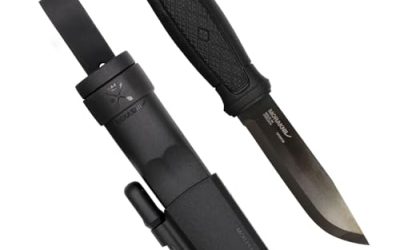
The Gerber StrongArm is the hard-use pick in this guide, for anyone who wants a knife that can take real punishment. It is a full-tang fixed blade with a 4.8-inch drop-point blade in 420HC stainless steel, finished with a black ceramic coating for corrosion resistance. At 9.8 inches overall and 7.2 ounces, it has the heft to baton firewood and chop with authority, while still being short enough to control for camp kitchen work.
The handle is rubberised with a diamond texture that grips well even when wet or bloody from field dressing, and the design includes a striking pommel that doubles as a glass breaker and a lanyard hole. The sheath is a standout: a multi-mount design that attaches to a belt, a pack, or MOLLE webbing, and can be mounted vertically or horizontally. That flexibility matters when you want the knife accessible but out of the way while moving through brush.
The StrongArm is made in the USA, and its 420HC steel is a practical choice for a survival knife: tough rather than brittle, easy to sharpen in the field, and resistant to corrosion under the ceramic coating.
Pros:
Cons:
3. Gerber Ultimate Survival Knife
- Best for: Anyone building a first survival kit or an emergency bag who wants fire tools with the knife.
- Blade length 4.75 inches; combo edge; textured rubber handle; fire starter edge on spine; ferro rod included; emergency whistle; sheath with integrated sharpener; model 31-003941.
- Ferro rod, whistle, and sharpener built into the sheath
- Combo edge handles cord, rope, and slicing in one blade
- Textured rubber grip stays secure when wet
Anyone building a first survival kit or an emergency bag who wants fire tools with the knife.
The Gerber Ultimate Survival Knife is the kit pick in this guide, for anyone who wants fire-starting tools built into the knife itself. It is a fixed blade with a combo edge, a 4.75-inch blade, and a sheath that carries a ferro rod, a whistle, and an integrated sharpener. That means the core of a survival kit travels with the knife rather than in a separate pouch that can be forgotten.
The blade has a partial serration near the handle for cutting cord and fibrous material, with a plain edge toward the tip for slicing and carving. The spine includes a fire starter edge designed to throw sparks from the included ferro rod, and the textured rubber handle gives a secure grip in wet conditions. The sheath is the centrepiece: it holds the ferro rod, a sharpener for touching up the edge in the field, and an emergency whistle, so the essentials are always on your belt.
This knife suits a grab-and-go kit, a car emergency bag, or a first survival knife for someone building their gear from scratch. It is not as refined a carver as the Morakniv, nor as heavy-duty as the StrongArm, but it covers the most situations on its own, and that completeness is its strength.
Pros:
Cons:
Comparison Table
| Knife | Blade | Steel | Tang | Weight | Standout Feature |
|---|---|---|---|---|---|
| Morakniv Companion | 4.1 in, Scandi | Sandvik 12C27 stainless | Three-quarter | 4.1 oz with sheath | Lightest, easiest to sharpen |
| Gerber StrongArm | 4.8 in, drop point | 420HC stainless, ceramic coat | Full | 7.2 oz | Toughest, best sheath mounting |
| Gerber Ultimate Survival Knife | 4.75 in, combo edge | Stainless | Full | Heavier kit build | Ferro rod, whistle, sharpener in sheath |
How to Use a Survival Knife Safely
A survival knife is a tool, and it deserves the same respect as an axe or a saw. Always cut away from your body and away from the hand holding the work. When carving, brace the piece against a solid surface or hold it with the knife hand moving away from the fingers. Never use a knife as a pry bar for heavy work unless the maker rates it for that; even full-tang blades can snap at the tip if levered sideways in a knot.
Keep the knife sheathed whenever you are not cutting, and re-sheath it deliberately rather than rushing.
Check the laws where you live and where you travel. Fixed-blade carry rules vary by country, state, and park, and some areas restrict blade length or require a legitimate purpose for carrying. Carry responsibly, keep the knife out of reach of children, and store it in its sheath when it is not in use.
Batoning deserves a technique note. Place the blade across the end grain of a small log, then tap the spine with a baton of hardwood to drive the blade through. Use wood, not rock or metal, as the baton, and keep your fingers clear of the blade path. Do not baton through knots or logs wider than the blade is long; split smaller pieces instead. The StrongArm handles this work best of the three picks, while the Morakniv is better kept to lighter splitting and carving.
Maintaining an Affordable Survival Knife
Clean the blade after every trip. Wash it with mild soap and water, dry it fully, and apply a thin coat of oil to carbon steel or any uncoated edge before storage. Even stainless blades benefit from drying, since moisture trapped in a sheath causes corrosion over time. Store the knife in its sheath in a dry place, and check the sheath for grit that could dull the edge.
Sharpening is a skill worth learning. A Scandi grind like the Morakniv is the easiest to maintain: lay the bevel flat on a stone and work it until a burr forms, then flip and repeat. The Gerber blades sharpen well on a whetstone or a guided system, and the sharpener in the Ultimate’s sheath handles touch-ups in the field. A dull knife is more dangerous than a sharp one, because it needs more force and is more likely to slip.
FAQ
What is the best affordable survival knife for beginners?
The Morakniv Companion is the best affordable survival knife for most beginners. It is light, easy to sharpen thanks to its Scandi grind, resistant to rust, and proven over many years of camp use. It teaches good knife habits without a large investment.
Is a fixed blade better than a folding knife for survival?
Yes, for survival use a fixed blade is generally better. It has no pivot or lock to fail, it is stronger for batoning and prying, and it is easier to clean in the field. A folding knife is more convenient for everyday carry, but a fixed blade is the right tool when the knife has to work hard.
Can an affordable survival knife handle batoning?
It depends on the knife. A full-tang blade like the Gerber StrongArm handles batoning small firewood well. A lighter knife with a three-quarter tang, such as the Morakniv Companion, is better for carving and light splitting rather than heavy batoning. Match the task to the knife.
What blade length is best for a survival knife?
A blade between four and five inches is the most versatile for survival tasks. It is long enough to baton small wood and process kindling, yet short enough for controlled carving and food preparation. Longer blades add weight and reduce control for fine work.
Do I need a ferro rod with my survival knife?
A ferro rod is one of the most reliable ways to start a fire in wet conditions, and carrying one with the knife keeps it at hand. The Gerber Ultimate Survival Knife includes one in the sheath, while the Morakniv and StrongArm can be paired with a separate ferro rod. Either way, practise using it before you need it.
Conclusion
The best affordable survival knife is the one that matches how you actually use it. The Morakniv Companion is the lightest and easiest to live with, and the right first survival knife for most people. The Gerber StrongArm is the toughest of the three, built for batoning and hard camp work with a sheath that carries anywhere. The Gerber Ultimate Survival Knife is the most complete kit, with fire-starting tools built into the sheath for emergencies.
Choose the knife that fits your trips, learn to sharpen it, practise with it before you rely on it, and carry it safely. A modest knife used well will serve you far better than an expensive one left at home.
Disclosure: As an Amazon Associate, we earn from qualifying purchases.
More from Amazon
Programs that pair well with the guide above. Offers and eligibility are set by Amazon and may change.
Set up recurring deliveries of everyday items on eligible products. Terms and savings are set by Amazon.
Explore Subscribe & SaveCollect the home and kitchen items you want in one registry that guests can shop from.
Create a wedding registryFree shipping on eligible items, Prime Video and more. Eligible new members can start with a free trial.
Start a Prime free trialAudiobooks and podcasts to listen to on the go. Eligible new members can start with a free trial.
Try Audible freeAs an Amazon Associate we earn from qualifying purchases.
Write Your Review
No reviews yet. Be the first to share your experience!