
Key takeaways
- Find the best vegetable chopping knife for clean, fast prep. Compare chef, santoku, and nakiri blades by length, steel, handle, care, and fit for home cooks.
The best vegetable chopping knife is the one that cuts cleanly through onions, carrots, peppers, and leafy greens without crushing them, wedging in dense roots, or tiring your hand halfway through dinner prep. A good vegetable knife should feel balanced, stay sharp through a full board of produce, and suit the way you actually cut, whether you rock-chop herbs, push-cut potatoes, or slice tomatoes paper thin.

Quick answer: for most home cooks, a 7-inch or 8-inch santoku or chef knife is the safest starting point. The Victorinox Fibrox Pro 8-Inch Chef Knife is the most practical all-round pick in this guide, while the Tojiro DP Nakiri is the strongest choice if vegetables are almost all you chop. If you want a lighter Japanese blade for precise slicing, look closely at the MAC Professional Santoku and the Shun Classic Santoku. The Amazon Basics Classic Chef Knife rounds out the list as a straightforward, low-cost starting knife.
Vegetables are not all the same to cut. A soft tomato needs a keen edge that bites without pressure. A dense sweet potato needs a thin blade that does not wedge and split. Cabbage needs length and height, while herbs need a flat edge and a steady motion so they cut rather than bruise. That is why blade shape matters as much as sharpness, and why this guide compares chef knives, santoku knives, and one true nakiri side by side.
Quick Picks
Our Short List of 3
All 5 Picks at a Glance
| Product | Specs | Action |
|---|---|---|
| Victorinox Fibrox Pro 8-Inch Chef Knife | Check price on Amazon | |
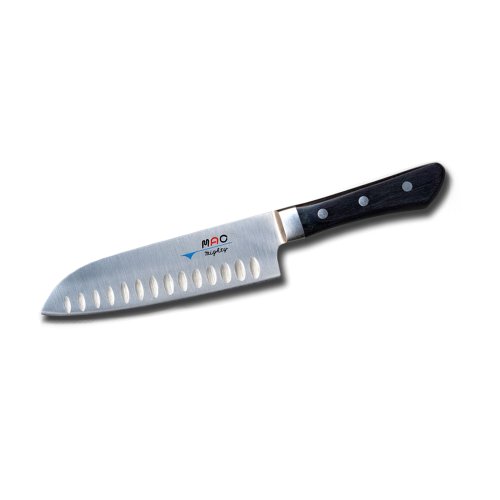
| MAC Professional 6.5-Inch Santoku Knife | Check price on Amazon | |
 Shun Classic 7-Inch Santoku Knife | Check price on Amazon | |
 Tojiro DP 6.5-Inch Nakiri Knife | Check price on Amazon | |
 Amazon Basics Classic 8-Inch Chef Knife | Check price on Amazon |
How to Choose
Choosing a vegetable knife starts with how you cut, how much produce you prepare, and how much care you will give a blade.
Blade Shape: Chef, Santoku, or Nakiri
A chef knife has a curved edge and a pointed tip, so it suits rocking cuts, mincing herbs, and mixed boards. A santoku has a flatter edge, a taller blade, and a rounded tip, so it suits straight push cuts and dicing. A nakiri has a straight edge and a rectangular blade with no point, so it is built for straight up-and-down vegetable chopping and scooping cut pieces off the board. For one knife, choose a chef knife or santoku. For a dedicated vegetable tool, choose a nakiri as a second knife.
Blade Length
A 6.5-inch santoku or nakiri feels nimble, suits smaller hands and boards, and gives precise control for dicing. A 7-inch santoku is a useful middle ground. An 8-inch chef knife covers large cabbage heads and big piles of onions in fewer strokes, but it needs more board space. Cooks who prepare large batches usually prefer 8 inches, while cooks in a compact kitchen often prefer 6.5 or 7 inches.
Blade Thickness and Edge Geometry
Thin blades cut dense vegetables with less resistance. A thick blade can wedge in a carrot or sweet potato and split the piece. A thin edge glides through, but it needs more care and should not be used on bones, frozen food, or very hard rinds. Hollow-ground santoku blades, with small dimples along the face, can help food release when slicing potatoes and cucumbers.
Steel and Edge Retention
Stainless steel resists staining from acidic foods such as tomatoes and onions. High-carbon stainless steel holds an edge longer than softer stainless steel, but it can be harder to sharpen at home. Japanese steels in this guide are generally harder and sharper out of the box, while Swiss and German-style steels are generally tougher and more forgiving. Avoid a knife that cannot be honed or sharpened, because a dull vegetable knife crushes produce and slips more easily than a sharp one.
Handle Comfort and Grip
You will hold this knife for long stretches, often with wet hands, so the handle matters as much as the blade. A handle should fill your palm and stay secure when wet. Textured synthetic handles, such as the Fibrox handle on the Victorinox knife, give reliable grip with wet hands. Smooth Pakkawood handles, found on the Shun and MAC knives, feel warm but can feel slicker when wet. Hold the knife in a pinch grip and check that the balance point sits near the handle rather than far out toward the tip.
Weight and Balance
A light knife is easier to control for fine dicing and long prep sessions, and it reduces wrist fatigue. A heavier knife can help on dense roots, but it can feel clumsy for herbs and delicate slicing. Most cooks do best with a light to medium knife, with the weight centred near the handle. If a knife feels tip-heavy, it will tire your wrist.
Care and Maintenance
Vegetable knives last longest when they are washed by hand, dried at once, and stored safely. Dishwasher cycles can dull edges and cause blades to knock against other utensils. A wooden board or a soft plastic board protects the edge far better than glass, stone, or ceramic. Honing keeps the edge aligned, while periodic sharpening restores a truly dull edge. Some Japanese blades need gentler handling and should never go in a dishwasher.
The Best Best Vegetable Chopping Knife Reviewed
Victorinox Fibrox Pro 8-Inch Chef Knife
The Victorinox Fibrox Pro is a practical, all-round chef knife with an 8-inch blade, and it is the most versatile pick in this guide for cooks who chop vegetables alongside other foods. The high-carbon stainless steel blade is laser-tested for sharpness, and the extra-wide blade gives knuckle clearance when you dice onions or chop cabbage. The textured Fibrox handle stays secure even when your hands are wet, and the knife is dishwasher safe, although hand washing will keep the edge in better condition.
At 8 inches, this blade covers long cucumbers and piles of peppers in steady strokes. The curved edge suits a rocking motion for mincing garlic and herbs, while the flat section near the heel suits push cuts through potatoes and carrots. It is a stamped blade, so it feels lighter than many German chef knives, and that lightness helps during long prep sessions.
Partial-fit note: this is a general-purpose chef knife, not a dedicated vegetable knife. It does everything well, but a santoku or nakiri will give cleaner straight cuts and easier food release for cooks who chop vegetables almost exclusively. If you want one knife for the whole kitchen, that breadth is a strength. If you want a specialist vegetable blade, pair this with the nakiri below or choose a santoku instead.
MAC Professional 6.5-Inch Santoku Knife
The MAC Professional Santoku, model MSK-65, is a 6.5-inch Japanese santoku built for precise vegetable work. Its hollow edge, with small dimples along the blade face, helps slices of potato, cucumber, and onion release cleanly. The blade is thin, hard, and sharp out of the box, so it moves through tomatoes with little pressure and dices onions into even pieces without crushing them.
The 6.5-inch length suits smaller hands and boards, and it gives excellent control for mincing shallots, slicing mushrooms, and cutting peppers into neat strips. The Pakkawood handle feels warm and balanced. This is a knife for cooks who mostly push-cut rather than rock-chop, because the flatter santoku edge rewards a straight forward-and-down stroke.
Partial-fit note: the thin, hard edge that makes this knife so precise also makes it less forgiving than a softer Western blade. Do not use it to chop through bones, frozen food, or very hard squash rinds, and hand wash and dry it promptly. Cooks who want a tougher, more forgiving blade for heavy chopping may prefer the Victorinox chef knife above.
Shun Classic 7-Inch Santoku Knife
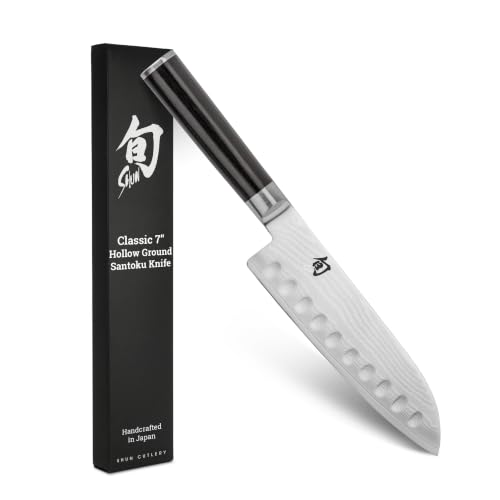
The Shun Classic Santoku, model DM0702, is a 7-inch Japanese santoku with a VG-MAX steel core clad in Damascus stainless steel. The layered cladding gives the blade its distinctive wavy pattern, and the 7-inch length is a comfortable middle ground between a compact santoku and a full chef knife. The hollow-ground edge helps with food release, and the flatter profile suits clean push cuts.
This knife excels at slicing cucumbers, tomatoes, and mushrooms into even, thin pieces, and at dicing onions, peppers, and potatoes without tearing the flesh. The Pakkawood handle has a D profile that suits a right-handed grip, and the balance sits close to the handle. Handcrafted in Japan, it is a refined choice for cooks who value a keen edge and a light, precise feel.
Partial-fit note: this is a premium Japanese blade that needs hand washing and careful storage. The D-shaped handle is made for right-handed use, so left-handed cooks should check the fit before buying. Like other thin Japanese blades, it is not made for bones, frozen food, or prying, and it needs regular honing and occasional sharpening to keep its fine edge.
Tojiro DP 6.5-Inch Nakiri Knife
The Tojiro DP Nakiri, model F-502, is the only true vegetable specialist in this guide. Its 6.5-inch rectangular blade has a straight edge and no pointed tip, so every part of the edge contacts the board in a clean up-and-down chop. That shape is ideal for cabbage, leafy greens, leeks, and root vegetables, and the tall blade also works as a scoop for moving cut pieces from board to pan.
The blade is made from VG10 stainless steel with layered cladding, so it is thin, hard, and very sharp, and it resists wedging in dense carrots and sweet potatoes. The Western-style handle feels familiar to cooks who are new to Japanese knives. Because the edge is straight, cuts stay even across the full length of the blade.
Partial-fit note: a nakiri is a specialist, not an all-purpose knife. It has no point for trimming, piercing, or detail work, and its straight edge does not suit a rocking motion for mincing herbs. If you buy only one knife, choose a chef knife or santoku first. If vegetables are the main job and you already own a general-purpose knife, this nakiri is the strongest dedicated vegetable chopper in this guide.
Amazon Basics Classic 8-Inch Chef Knife
The Amazon Basics Classic Chef Knife is a straightforward 8-inch chef knife with a full-tang, high-carbon stainless steel blade and a forged construction. It is a simple starting point for cooks who want a full-size vegetable knife without the care demands of a premium Japanese blade. The 8-inch length covers large vegetables and big batches, and the curved edge suits both rocking cuts and push cuts.
Three rivets secure the handle to the full tang, and the semi-bolster gives a solid feel without adding the weight of a full bolster. The blade is suited to everyday chopping, slicing, dicing, and mincing of vegetables, fruit, and boneless foods. For a first kitchen knife, or for a second knife kept at a holiday home, it covers the basics well.
Partial-fit note: this knife is hand wash only, so it needs the same prompt washing and drying as the premium blades in this guide. It is also a general-purpose chef knife rather than a dedicated vegetable knife, so cooks who chop vegetables all day may get cleaner straight cuts from a santoku or nakiri. Check the edge on arrival and hone it regularly, because a budget blade needs more frequent maintenance to stay keen.
What to Check Before You Buy
Before you order, check the listing carefully against the knife you intend to buy. Confirm the blade length, because the same model name is often sold in several lengths. Confirm that the listing is for a single knife, not a set, and that the model number matches the one in this guide, such as MSK-65 for the MAC santoku, DM0702 for the Shun santoku, or F-502 for the Tojiro nakiri. Check the handle shape and whether it is made for right-handed use, especially for Japanese D-shaped handles. Plan for hand washing, prompt drying, and safe storage in a block, on a magnetic strip, or in a blade guard. Finally, measure your main cutting board before you choose an 8-inch blade.
Also check the seller and listing details on Amazon before you buy, because availability and sellers can change. If the listing you open does not match the blade length and model in this guide, do not assume it is the same knife.
FAQ
What is the best vegetable chopping knife for beginners?
For beginners, an 8-inch chef knife such as the Victorinox Fibrox Pro is a good starting point because it handles vegetables, fruit, and other everyday foods with one familiar shape. A 7-inch santoku is a good alternative if you prefer a shorter, lighter blade. Start with one versatile knife, learn a safe pinch grip, and add a nakiri later if you chop vegetables every day.
Is a santoku or a nakiri better for vegetables?
A santoku is better if you want one versatile knife, because its rounded tip and flatter edge handle slicing, dicing, and push-cutting across many foods. A nakiri is better if you want a dedicated vegetable chopper, because its straight edge gives even, clean chops through leafy greens, cabbage, and root vegetables.
What blade length is best for chopping vegetables?
For most home cooks, 7 inches is a useful middle ground, while 6.5 inches suits smaller hands and smaller boards and 8 inches suits large batches and large vegetables. If you often chop cabbage, long cucumbers, or big piles of onions, the extra length of an 8-inch blade saves strokes. If you work in a compact kitchen or do a lot of fine dicing, a 6.5-inch or 7-inch blade gives more control.
Can I use a vegetable knife for meat?
Chef knives and santoku knives in this guide can cut boneless meat, fish, and poultry as well as vegetables, because they are general-purpose shapes. A nakiri is less suited to meat because it has no point and is made for straight vegetable chopping. None of the knives in this guide should be used to chop through bones, frozen food, or hard shells, because thin, hard edges can chip.
How do I keep a vegetable knife sharp?
Wash the knife by hand with mild soap, dry it at once, and store it so the edge does not knock against other utensils. Use a wooden or soft plastic board, not glass or stone. Hone the edge lightly with a honing rod or ceramic rod between uses to keep it aligned, and sharpen it on a whetstone or have it sharpened professionally when honing no longer restores a clean cut through a tomato. A sharp knife is safer and gives cleaner cuts than a dull one, because it needs less force and is less likely to slip.
Bottom Line
The best vegetable chopping knife depends on how you cut and how much produce you prepare. Choose the Victorinox Fibrox Pro if you want one practical knife for everyday prep. Choose the MAC Professional Santoku or the Shun Classic Santoku if you want a lighter, sharper Japanese blade for precise slicing. Choose the Tojiro DP Nakiri if vegetables are your main job and you want a dedicated chopper. Choose the Amazon Basics Classic Chef Knife if you want a simple, full-size starting knife. Whichever blade you pick, keep it sharp, use a kind board, wash it by hand, and store it safely.
Disclosure: As an Amazon Associate, we may earn from qualifying purchases.
More from Amazon
Programs that pair well with the guide above. Offers and eligibility are set by Amazon and may change.
Set up recurring deliveries of everyday items on eligible products. Terms and savings are set by Amazon.
Explore Subscribe & SaveCollect the home and kitchen items you want in one registry that guests can shop from.
Create a wedding registryFree shipping on eligible items, Prime Video and more. Eligible new members can start with a free trial.
Start a Prime free trialAudiobooks and podcasts to listen to on the go. Eligible new members can start with a free trial.
Try Audible freeAs an Amazon Associate we earn from qualifying purchases.
Write Your Review
No reviews yet. Be the first to share your experience!