
Key takeaways
- What knife do Navy SEALs use? The Ontario Mk 3 Mod 0 answer, the SRK of BUD/S training, the SEAL Pup and Ka-Bar patterns, and the marketing myths.
As an Amazon Associate we earn from qualifying purchases.


The short answer is the Ontario Mk 3 Mod 0 — the fixed-blade knife designed for United States Navy divers and issued through the Navy supply system to special warfare sailors for decades. The complete answer is longer and more interesting: there is no single knife that every SEAL carries on every mission. The Mk 3 is the documented issue pattern most closely associated with the SEAL Teams, but SEALs also train with the Cold Steel SRK, have been issued the compact SOG SEAL Pup, carry the older Ka-Bar fighting and utility pattern that the Navy knows as the Mark 2, and frequently choose personal knives — fixed and folding — on top of whatever the supply system hands them.
This guide separates the documented record from the marketing. Many knives are sold with the word SEAL in the name or in the advertising, and very few of those claims mean what a casual reader assumes they mean. Below is what the published record actually supports, knife by knife, followed by the civilian versions a buyer can still purchase today.
Why There Is No Single “SEAL Knife”
Three different things get mixed together whenever this question is asked. The first is an issued knife: a pattern bought by the Navy under contract, given a National Stock Number, and handed to sailors through supply channels. The second is a training knife: the blade candidates use during BUD/S, the Basic Underwater Demolition/SEAL course, which is chosen for durability and cost across hundreds of trainees rather than for operations. The third is a personally chosen knife: SEALs, like most special operations personnel, have latitude to carry blades they buy themselves or that their team purchases in small numbers, and those choices vary by platoon, mission and individual taste.
A knife can belong to one of those categories without belonging to the others. The SRK’s documented role is in training. The Mk 3’s documented role is issue. A famous folding knife’s documented role may be nothing more than that individual SEALs bought and carried it. Keeping those lanes separate is the whole secret to answering this question accurately.
The Issued Answer: Ontario Mk 3 Mod 0
The Mark 3 knife, in its Mod 0 form, was designed as a Navy dive and utility knife — a tool for the unglamorous work of maritime operations: cutting line and webbing, prying, and surviving constant immersion in salt water. Ontario Knife Company, the New York maker founded in the nineteenth century, became its best-known manufacturer, and the pattern is documented as standard issue for Navy SEALs in multiple published references, with an issue history commonly dated to the early nineteen-eighties.
Its published specifications explain the design brief:
- Blade: 6-inch fixed blade in 440A stainless steel, with a black oxide finish to cut glare
- A serrated section along the spine for sawing through rope and line
- Hardness in the high-forties to mid-fifties on the Rockwell scale — soft by modern knife standards, deliberately so, favoring toughness and easy sharpening over edge life
- Handle: molded synthetic material shaped for a wet grip, with a lanyard hole
- Sheath: molded plastic with a belt hanger, designed to drain and to resist the rot that destroys leather at sea
- Overall length: about 10.75 inches
Every choice there points at the ocean. Stainless steel and synthetic furniture because leather and carbon steel corrode in a maritime kit bag. A comparatively soft blade because a dive knife is levered, twisted and used as an improvised tool, and a blade that chips or snaps underwater is worse than a blade that dulls. Serrations because wet rope is exactly what a diver may need to cut in a hurry.
One buying reality matters: Ontario Knife Company changed ownership in recent years, its original factory closed, and production of the Mk 3 has been paused during the transition, according to knife-industry reporting. No current Amazon US listing for the genuine Ontario Mk 3 could be verified for this guide, so the Mk 3 is presented here from manufacturer and reference specifications, without a purchase link. Surplus, new-old-stock and used examples circulate through specialist dealers; buyers hunting one should check for the Mk 3 Mod 0 markings and the maker’s cage code stamped on the blade, and should expect genuine issue examples to be government-pattern knives rather than polished collector pieces.
The Training Answer: Cold Steel SRK
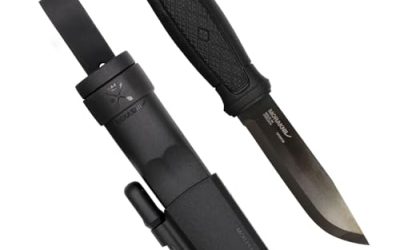
Ask what knife a SEAL candidate uses, and the documented answer changes. The Cold Steel SRK — the name shortens Survival Rescue Knife — is widely reported as the standard-issue knife of BUD/S training, the long selection course every SEAL completes before joining a team. It is a six-inch fixed blade with a thick spine, a clip point and a deeply textured synthetic handle, built to be abused by trainees, lost, recovered and abused again.
The SRK remains in production and on sale, in more than one steel. The version listed below is the premium CPM 3V variant; the same model is also catalogued in a plainer carbon steel, which is the configuration associated with the training role. For a civilian buyer, either is the same basic tool: a heavy-duty fixed blade shaped by the same requirements that made it a training staple.
Cold Steel SRK, CPM 3V
- Link: https://www.amazon.com/dp/B09DLDV6KT
- Blade: 6-inch clip point in CPM 3V steel, 5 mm thick
- Handle: 4.75-inch Kray-Ex, textured for wet grip
- Overall length: 10.75 inches
- Weight: 8.8 ounces
- Sheath: Secure-Ex molded sheath
- Construction: full tang
The Compact Issue Answer: SOG SEAL Pup
The SOG SEAL Pup is the smaller half of SOG’s SEAL knife line — a compact fixed blade that published references describe as issued to SEALs, carrying its own National Stock Number, for situations where the full-size patterns are more knife than the kit has room for. At nine inches overall with a blade under five inches, it rides on a vest or belt without the leverage and snag profile of a seven-inch fighting knife.
SOG SEAL Pup (M37N-CP)
- Link: https://www.amazon.com/dp/B00007E1M2
- Blade: 4.75-inch partially serrated clip point in AUS-8 stainless steel, powder coated
- Handle: glass-reinforced nylon with a textured grip
- Overall length: 9 inches
- Sheath: MOLLE-compatible nylon sheath with an accessory pouch
A note on names: SOG built the line around the SEAL name with the Navy’s special warfare community in mind, and the Pup’s bigger sibling, the SEAL Team Elite, stretches the same concept to a seven-inch blade. The Pup is the one with the documented issue connection at compact size, which is why it, rather than its larger relative, is the model listed here.
The Older Pattern: Ka-Bar and the Navy Mark 2
Before the Mk 3, the Navy’s fighting and utility pattern was the Mark 2 — the knife the Marine Corps made famous as the Ka-Bar. Designed during the Second World War as a combined fighting and utility tool, the pattern served Navy personnel, including the underwater demolition teams that preceded the SEALs, and it never entirely left naval service. Accounts of SEAL tradition also describe presentation Ka-Bars connected with graduation from training, engraved and kept rather than carried — a reminder that a knife can be part of a unit’s culture without being its field tool.
The civilian 1217 is the same pattern still in production, and it is the most historically important American military knife a buyer can simply order:
KA-BAR Full Size US Marine Corps Fighting Knife, Straight Edge (1217)
- Link: https://www.amazon.com/dp/B001H53Q6M
- Blade: 7-inch straight edge in 1095 Cro-Van carbon steel, epoxy powder coated
- Handle: stacked leather washers
- Overall length: 11.87 inches
- Weight: 317.5 grams
- Sheath: leather USMC sheath
- Origin: knife made in the USA
Its one maritime weakness is the flip side of the Mk 3’s design: carbon steel and leather are exactly the materials salt water attacks, which is why the Navy eventually specified a stainless, synthetic-handled successor for divers — while the Ka-Bar pattern carried on everywhere the environment was less corrosive.
Personally Chosen Knives
Beyond issue and training blades, the record is a scatter of documented individual choices rather than a list. Folding knives from makers such as Emerson have been carried by individual SEALs — one Emerson CQC-7 gained fame through its reported connection to the raid that killed Osama bin Laden, a story attached to a single knife and a single operator, not an issue contract. Other operators have chosen heavy fixed blades from small American makers, multi-tools for the work knives actually do most of the time, and compact backups that never appear in any catalogue copy.
The honest summary is that personal choice expands with experience and mission: a maritime assault, a jungle patrol and a vehicle-borne deployment each reward different blades, and the Teams’ culture has generally allowed operators to match the tool to the job. Any article claiming one definitive personal knife for all SEALs is selling certainty the record does not contain.
How to Read “Used by Navy SEALs” Claims
Knife marketing leans hard on this question, so a few reading rules help:
- “Issued” is the strongest claim and the rarest. It should come with a contract history or a National Stock Number, as the Mk 3 and SEAL Pup have.
- “Standard issue for BUD/S” describes training, as with the SRK — a real credential, but a different one from operational issue.
- “Designed for SEALs” usually means designed for the civilian market with SEAL requirements in mind. It may still be a fine knife; it is not an issue claim.
- A SEAL in an advertisement is an endorsement, not a supply record. Individual operators endorse and carry many products.
- Government-issue examples are government property. What a civilian buys is the commercial version of the pattern — the same design, honestly labeled by reputable makers, without the cage codes and history of a specific issued knife.
Buying the Patterns Today
For a buyer who wants the closest thing to the documented answer, the practical routes are these. The SRK is the easiest: current production, verifiable listings, and a direct line to the training pipeline. The SEAL Pup offers the compact issued pattern in a size most civilians will carry more comfortably. The Ka-Bar 1217 offers the historic pattern with the longest service story, at the cost of carbon-steel and leather maintenance — oil the blade, keep the sheath dry, and it will outlast its owner. The Mk 3 itself is, for now, a surplus-market hunt rather than a retail purchase, and patience plus attention to markings is the price of a genuine one.
Whichever pattern appeals, match the knife to your own version of the mission. Divers and boaters should weight corrosion resistance the way the Navy did. Campers and hikers should weight cutting geometry and comfort. Collectors should weight markings, provenance and originality. The SEALs’ documented choices make most sense once they are read that way — not as a single legendary blade, but as a set of practical answers to specific, wet, demanding work.
The Bottom Line
What knife do Navy SEALs use? The issued fixed blade most firmly documented in the role is the Ontario Mk 3 Mod 0. The knife placed in trainees’ hands at BUD/S is the Cold Steel SRK. The compact issued option is the SOG SEAL Pup, and the historic pattern underneath the whole story is the Ka-Bar Mark 2. Around those four documented answers orbits a wide field of personal choices that no single product can claim. That layered answer is less tidy than the marketing version — and considerably more true.
More from Amazon
Programs that pair well with the guide above. Offers and eligibility are set by Amazon and may change.
Set up recurring deliveries of everyday items on eligible products. Terms and savings are set by Amazon.
Explore Subscribe & SaveCollect the home and kitchen items you want in one registry that guests can shop from.
Create a wedding registryFree shipping on eligible items, Prime Video and more. Eligible new members can start with a free trial.
Start a Prime free trialAudiobooks and podcasts to listen to on the go. Eligible new members can start with a free trial.
Try Audible freeAs an Amazon Associate we earn from qualifying purchases.
Write Your Review
No reviews yet. Be the first to share your experience!