
Key takeaways
- Elk Ridge ER-555 review: a full-tang 3Cr13 bushcraft knife with a hidden survival kit, fire starter and sharpening stone, plus its real limits.
As an Amazon Associate we earn from qualifying purchases.

The Elk Ridge ER-555 is one of those knives that raises an immediate question: how much knife and how much kit can one package honestly contain? On paper, the ER-555 is a full-tang fixed blade with a drop point profile, a handle that hides a small survival kit, a fire starter and a sharpening stone, all carried in a nylon sheath. That is a lot of promise attached to a single model number from Elk Ridge, a brand owned by Master Cutlery that sells large numbers of affordable outdoor knives through mainstream retailers.
This review works through the ER-555 the way a careful buyer should: what the manufacturer actually specifies, what each part of the design is meant to do, where the design makes sense for camping, hunting camps and emergency kits, and where its limits sit. The ER-555 is not a premium bushcraft tool, and pretending otherwise would help nobody. It is a budget survival-style knife with a genuinely interesting kit concept, and the interesting question is whether that concept survives contact with the published specifications.
The ER-555 at a Glance
Elk Ridge ER-555 Fixed Blade Knife
- Link: https://www.amazon.com/dp/B01768CCUO
- Overall length: 10.5 inches
- Blade: 5.5-inch drop point, fine edge
- Blade material: 3Cr13 stainless steel, two-tone black and satin finish
- Construction: full tang
- Handle: injection-molded nylon fiber (black version) with a hidden compartment; a brown pakkawood version is also catalogued
- Hidden compartment contents: sharpening stone, fire starter and a small survival kit
- Sheath: nylon
- Manufacturer: Master Cutlery LLC
Those figures come from the manufacturer’s own product pages and the Amazon listing for the ER-555 series. Note that listings describe the blade at 5.5 inches while some secondary sources round or restate it slightly differently; the manufacturer’s dimension of a 5.5-inch blade, a 5-inch handle and 10.5 inches overall is the consistent set, and it is the set used throughout this review.
First, What Kind of Knife Is This?
Terminology matters here, because the ER-555 is marketed with several overlapping labels: bushcraft, survival, hunting and outdoors. Strictly speaking, classic bushcraft knives tend to share a recognizable formula — a blade of roughly four to five inches, a simple and comfortable handle with no finger grooves that force one grip, a grind that carves wood willingly, and steel chosen for easy field sharpening. Survival knives lean a different way: they add emergency features, tougher tips and sometimes hollow or compartment handles meant to carry small essentials.
The ER-555 sits closer to the survival end of that spectrum. Its blade is longer than the classic bushcraft pattern, its handle carries a compartment of emergency extras, and its sheath carries support gear rather than aiming for minimalism. That does not disqualify it from camp and woodland use — a drop point fixed blade of this size can feather sticks, prepare kindling, cut cordage and handle food preparation around a camp kitchen. It does mean buyers should judge it as a kit knife first and a dedicated wood-carving tool second.
Elk Ridge, as a brand, is an importer line rather than a forge with a single workshop identity. Master Cutlery catalogues hundreds of models under the Elk Ridge name, from traditional folding patterns to hunting sets and machetes. The practical consequence for a buyer is that model-by-model specifications matter far more than brand reputation. The ER-555 should be assessed on its own published numbers, which is exactly what the next sections do.
The Blade: 3Cr13 Stainless and a Drop Point Profile
The blade is the heart of any fixed blade, and the ER-555’s blade is a 5.5-inch drop point in 3Cr13 stainless steel with a two-tone black and satin finish and a fine, plain edge. The drop point shape — where the spine curves down gently to meet the point — is a sensible choice for a general outdoor knife. It keeps a useful point for detail work while leaving plenty of belly for slicing, and the tip is less delicate than a clip point of similar thickness when it meets knots, bone or frozen ground.
The steel deserves an honest discussion. 3Cr13 is an entry-level stainless grade. Its strengths are real: it resists corrosion well for a budget blade, it is tough rather than brittle, and it sharpens easily on almost any stone, including the small stone included in this knife’s own kit. Its weakness is equally real: edge retention is modest. A 3Cr13 edge will roll or dull faster under sustained wood work than the edges of mid-range carbon or stainless steels, which means the ER-555 asks its owner to sharpen more often. For a knife that ships with its own sharpening stone, that trade-off is at least coherent — the kit anticipates the maintenance the steel requires.
Buyers who plan long trips built around heavy wood processing should weigh that carefully. Splitting thick rounds by striking the spine of the knife with a wooden baton, often called batoning, is the hardest common use a bushcraft knife faces. A full-tang knife of this size can handle light kindling work, but 3Cr13 is a comparatively soft steel, and treating the ER-555 as a splitting tool for large, knotty wood is asking more of it than its specification supports. Used as a cutting tool — carving, slicing, shaving tinder, preparing food — it stays within its design brief.
Full Tang Construction and the Handle Compartment
The ER-555 is built on a full tang: the steel of the blade continues through the full length of the handle rather than narrowing to a thin rod. On a budget survival knife this matters more than almost any other construction detail, because the historical weakness of compartment-handle survival knives is the hollow handle itself. Hollow-handle designs of past decades often joined a separate handle tube to a short tang, creating a failure point exactly where leverage is greatest.
Elk Ridge’s approach is different. The tang runs full length, and the compartment is formed within the handle scales — on the black version, injection-molded nylon fiber; on the brown version, pakkawood. Inside sits a small kit: a sharpening stone, a fire starter and a small survival kit. The honest way to value those contents is as emergency backups rather than primary tools. A compact fire starter that is always with the knife is genuinely useful if a main kit is lost or soaked. A small stone will restore a working edge in the field. Neither replaces a full-size fire kit or a proper bench stone, and the survival kit’s contents are the kind of minimal assortment meant to bridge an emergency, not equip an expedition.
The handle shape itself is a straightforward outdoor grip of about five inches, long enough for a full four-finger hold with gloves. Nylon fiber handles shrug off water, cold and the solvents that damage natural materials, while the pakkawood version trades some of that indifference for a traditional look and feel. Neither version offers the heavily sculpted ergonomics of premium bushcraft handles, so extended carving sessions are where owners are most likely to notice the budget origins of the design.
The Sheath and the Kit Idea
The ER-555 arrives with a nylon sheath. Nylon sheaths are the budget standard for good reasons: they are light, quiet, inexpensive and tolerant of wet conditions. They are also, generally, the least precise part of any budget knife package — retention depends on straps and fit rather than the positive click of a molded polymer sheath, and long-term durability at the stitching is a known wear point across the category, not just on this model.
Within the ER-555’s kit concept, though, the sheath is part of a system: knife, stone, fire starter and survival contents traveling as one unit. For a vehicle emergency kit, a cabin drawer, a camp box or a first knife for a supervised young camper learning basic skills, that self-contained quality is the product’s real argument. Everything is present, nothing needs to be assembled from three different purchases, and the whole package stores flat and light.
What the ER-555 Does Well
Summarizing the strengths that follow directly from the specification:
- A complete, self-contained kit. Fire starting, edge maintenance and a cutting tool in one package is a coherent idea, executed with a full tang rather than a fragile hollow handle.
- Corrosion-resistant, easy-sharpening steel. 3Cr13 will not reward neglect with rust the way a plain carbon blade can, and it responds quickly to a basic stone — a forgiving combination for beginners.
- A versatile blade shape and size. The 5.5-inch drop point covers camp kitchen work, cordage, kindling preparation and general utility without the fragility of a needle point.
- Full-tang confidence at a budget tier. Construction is where cheap survival knives historically fail; on paper, this one uses the right architecture.
Where the ER-555 Falls Short
The limitations follow from the same specification sheet:
- Edge retention is modest. Expect frequent touch-ups during heavy use. Owners who dislike sharpening will feel this steel’s limits quickly.
- It is a kit knife, not a specialist bushcraft tool. The blade length, handle and grind are generalist choices. Dedicated carvers will prefer a shorter blade with a Scandinavian grind.
- The extras are backups, not primaries. The stone, fire starter and survival contents are small. They add resilience to a kit; they do not replace one.
- Sheath quality is functional, not premium. Nylon carries the knife safely, but buyers wanting rigid retention and multiple mounting options will be shopping for an upgrade or a different knife.
None of these points are hidden flaws; they are the normal physics of a budget package that spreads its cost across a knife and a kit instead of concentrating it in blade steel. The ER-555 makes sense when bought with that understanding.
A Same-Type Alternative Worth Comparing
Buyers cross-shopping fixed blades in a similar working size may also look at a more conventional single-purpose design:
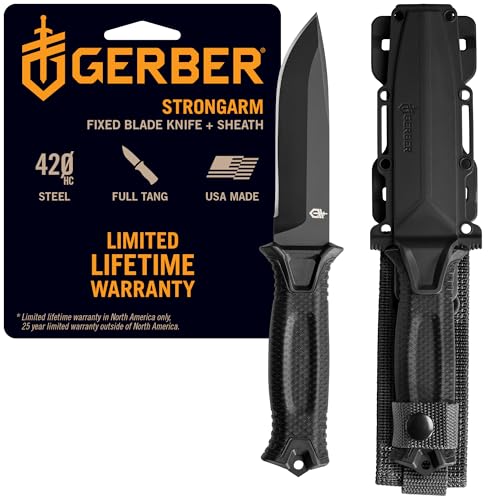
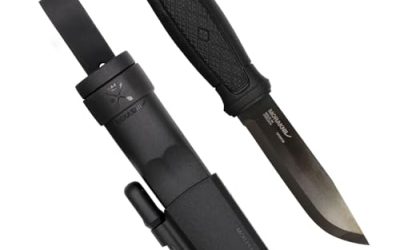
Gerber StrongArm Fixed Blade Knife (Black, Plain Edge)
- Link: https://www.amazon.com/dp/B00U0ILXGC
- Blade: 4.8-inch plain edge, 420HC stainless steel, ceramic-coated
- Construction: full tang
- Overall length: 9.8 inches
- Handle: rubberized diamond-texture grip with a striking pommel at the base
- Sheath: molded sheath with snap-in retention and multiple mounting options, including horizontal belt carry and MOLLE compatibility
- Origin: made in the USA
The contrast is instructive. The StrongArm spends everything on the knife itself — a slightly shorter blade in 420HC, a molded sheath system and a glass-breaker-style pommel — and includes no survival extras. The ER-555 spends part of its budget on the kit around the knife. Neither allocation is wrong; they serve different buyers. Someone building a layered kit with separate fire and sharpening gear will usually prefer the single-purpose tool. Someone who wants one grab-and-go package has a clearer reason to choose the Elk Ridge.
Care and Maintenance Notes
A 3Cr13 blade asks little of its owner beyond frequency. Rinse or wipe the blade after food preparation and after any contact with salt water, dry it before sheathing, and store the knife out of its sheath for long periods so moisture is not trapped against the edge. Touch the edge up on the included stone before it becomes truly dull; maintaining an edge on this steel takes a fraction of the effort of restoring one. A drop of food-safe oil on the edge before long storage is cheap insurance even for stainless steel, and the nylon sheath should be allowed to dry fully after wet trips to protect both stitching and blade.
The fire starter and survival contents deserve a check once or twice a year. Seals age, small items migrate, and a kit that is never opened tends to be a kit with surprises. Part of owning a kit knife is treating its compartment as equipment to be inspected, not a feature to be forgotten.
Who Should Buy the ER-555 — and Who Should Not
The ER-555 fits a defined set of buyers well: a camper assembling a first fixed blade and wanting the supporting extras in the same purchase; a driver or homeowner building emergency kits for a vehicle, cabin or workshop drawer; a gift buyer choosing a complete, presentable outdoor package for a new enthusiast; and a hunter wanting an inexpensive camp knife whose loss or hard use would not sting.
It fits other buyers poorly: an experienced bushcraft practitioner who carves daily and judges knives by grind geometry and steel; a backpacker counting every gram who would rather carry a lighter knife and a separate, better fire kit; and anyone planning sustained batoning or prying work, which calls for thicker stock and tougher steel than this specification offers.
Verdict
The Elk Ridge ER-555 is best understood as a small survival system built around an honest budget blade. The full-tang construction, corrosion-resistant 3Cr13 drop point and genuinely useful hidden extras make a coherent package for camp, vehicle and emergency-kit duty, while the modest edge retention and basic nylon sheath mark the boundaries of what it is. Buy it as a kit and judge it as a kit, and the ER-555 is a sensible, self-contained tool. Buy it expecting a premium bushcraft instrument, and the specification sheet — read carefully, as this review has tried to do — already contains the reasons to choose something else.
More from Amazon
Programs that pair well with the guide above. Offers and eligibility are set by Amazon and may change.
Set up recurring deliveries of everyday items on eligible products. Terms and savings are set by Amazon.
Explore Subscribe & SaveCollect the home and kitchen items you want in one registry that guests can shop from.
Create a wedding registryFree shipping on eligible items, Prime Video and more. Eligible new members can start with a free trial.
Start a Prime free trialAudiobooks and podcasts to listen to on the go. Eligible new members can start with a free trial.
Try Audible freeAs an Amazon Associate we earn from qualifying purchases.
Write Your Review
No reviews yet. Be the first to share your experience!