
Key takeaways
- The best floating knife for fishing and boating: a cork-handled Morakniv that floats if dropped overboard, with full specs, sizing help and care tips.
A knife dropped over the side of a boat is normally gone for good, sinking out of reach in seconds. A floating knife solves that one specific problem: its handle carries enough buoyancy to keep the whole tool on the surface, visible and retrievable, instead of on the bottom. The real decision is not whether flotation works, but whether the knife behind the floating handle still cuts well, grips securely when wet, and suits the work you actually do on the water.
This guide is for anglers who clean panfish at the rail, kayakers who cut line and rope in a cramped cockpit, and boat owners who keep one safety cutter within reach. Every candidate was checked against its Amazon listing, and only knives genuinely built to float qualified. Just one model cleared that bar with a verifiable in-stock listing, so this guide covers that single knife in depth rather than padding the list with ordinary fillet knives that would sink.
Quick Picks
As an Amazon Associate we earn from qualifying purchases
| Product | Best for | Key spec from title |
|---|---|---|
| Morakniv Floating Knife, Fine Edged | Anglers and boaters who work over open water | 3.8-inch Swedish stainless blade with natural cork handle |
How to Choose
Buoyancy Has to Come From the Handle Design
A floating knife stays up because its handle displaces more water than the blade weighs, so handle construction is the first thing to check. Natural cork over a polymer core is the proven approach: cork is mostly air pockets, stays light even after years of use, and keeps the knife floating with the sheath on or off. Sealed hollow plastic handles can also work, but a cracked shell that fills with water loses its buoyancy silently. Whatever the material, the listing should state plainly that the finished knife floats, not merely that the handle material is buoyant on its own.
Blade Length and Edge for Work on the Water
Most floating knives carry short blades around four inches, because a long, heavy blade fights the handle’s buoyancy. That length suits the jobs these knives actually do: trimming line, cutting rope and net, slicing bait, and cleaning small to medium fish at the rail. Edge choice matters more than length. A fine, plain edge slices cleanly and sharpens easily on a basic stone, while a serrated edge saws through rope and fibrous material faster but is harder to maintain. Pick the edge that matches your dominant task instead of buying both jobs in one compromised blade.
Grip Security When Hands Are Wet and Slimy
On a boat, the grip question is not comfort, it is whether the knife stays in your hand during a cut. Look for a barrel-shaped or contoured handle that fills the palm, a soft friction surface that does not turn slick when wet, and a finger guard that stops your hand sliding forward onto the edge when you push through a cut. Cork performs well here because it stays grippy in water and does not feel cold early in the morning. Slim, smooth plastic handles are the ones to avoid for work over the side.
Sheath Visibility and Carry Options
A floating knife only helps if you can spot it in the chop and reach it quickly in the first place. A high-visibility sheath in lime green or orange is far easier to see on the surface than a black one, and the same colour helps you find the knife in a cluttered tackle bag. Check how the sheath carries: a belt clip suits anglers who move around the deck, while a button or loop system that links to other gear keeps the knife fixed to a vest or pack. Drainage matters too, since a sheath that traps water against the blade invites corrosion.
The 1 Best Options
Morakniv Floating Knife, Fine Edged (M-13686)

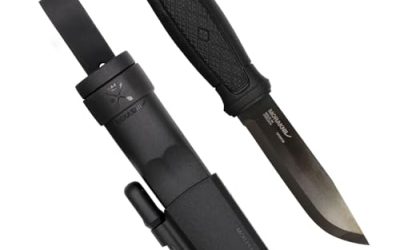
This is the floating knife built for people who work over open water and cannot afford to watch a tool sink. Its natural cork handle keeps the whole knife afloat, and the lime green sheath makes it easy to spot on the surface while you circle back for it. The fine-edged 3.8-inch blade handles the everyday cutting that happens on a fishing boat: trimming line, slicing bait, opening packaging, and cleaning panfish at the rail. At only 49 grams it rides on a belt or vest without pulling, and the barrel-shaped handle with its finger guard stays secure in wet hands.
Specs
- Blade length: 3.8 inches
- Blade material: Swedish stainless steel (Sandvik 12C27)
- Blade edge: Fine, straight edge
- Blade thickness: 1.4 mm, thin and flexible
- Handle: Natural cork over a polymer core, barrel-shaped with soft friction grip and finger guard
- Weight: 49 grams
- Sheath: Lime green polymer with Smart Button System and belt clip
- Model number: M-13686
Best for: Anglers, kayakers and boaters who want one lightweight knife that floats if it goes overboard.
Watch out for: The thin blade is made for line, bait and light fish work, not prying or heavy rope under load; cork also dents over time where the sheath’s retaining bump grips it.
ASIN: B085R8HL9M
Which One Fits Your Situation
You Fish From a Small Boat or Kayak
Space is tight, everything sits within arm’s reach of the water, and a dropped tool is gone in a second. The Morakniv Floating Knife fits this life because it weighs almost nothing, clips to a vest or belt through its sheath, and floats high enough to grab before the current takes it. Its short blade is also safer to manage in a rocking cockpit than a long fillet knife, and the rounded working style suits line, bait and small fish.
You Clean Panfish and Eat What You Catch
For bluegill, perch and similar panfish, a short fine-edged blade gives you control around small rib cages where a long, floppy fillet blade feels clumsy. The Morakniv’s 3.8-inch straight edge handles that work and the bait cutting and line trimming that comes before it, all with one tool that lives on your belt. If your catch regularly runs to large filleting jobs, treat this as your on-water knife and keep a full-size fillet knife at the cleaning station on shore.
You Want a Safety Cutter Within Reach on Deck
A knife kept for cutting away tangled line or freeing a snagged net needs to be reachable, visible and impossible to lose overboard during the scramble. This Morakniv covers all three: the lime green sheath stands out against deck clutter, the clip keeps it in one fixed place, and if it does go over the side during the struggle, the cork handle brings it back to the surface instead of sending it to the bottom with the tangle.
You Work Around Water but Rarely Fish
Dock hands, sailors and paddlers who mostly cut rope, webbing and packaging still benefit from a knife that cannot sink. The fine edge on this model slices cordage and straps cleanly, and its stainless blade shrugs off the constant wetting that would spot a carbon steel tool left in a damp locker. The light weight means it can live permanently in a life vest pocket or dry bag as the knife you forget about until the day you need it.
Common Mistakes
- Buying a regular fillet knife with a foam or hollow handle and assuming it floats. Buoyancy is a whole-knife calculation, not a handle feature: if the maker’s listing does not state that the finished knife floats, the blade’s weight will take it straight down the first time it leaves your hand over deep water.
- Choosing a long blade for a floating knife. Every extra inch of steel adds weight the handle must offset, so genuinely buoyant models stay near four inches. Expecting one tool to float and to break down large fish leads to disappointment on both counts; pair a short floating knife with a separate shore-side fillet knife instead.
- Ignoring sheath colour and carry. A black sheath on dark water is nearly invisible, which defeats the point of a knife designed to be recovered. Bright lime or orange sheaths, plus a clip or button mount that fixes the knife to your vest or belt, are what turn flotation from a spec into an actual recovery.
- Storing the knife wet in a sealed sheath for weeks. Stainless steel resists corrosion rather than ignoring it, and a blade put away wet against trapped moisture will eventually spot or pit. Rinse after saltwater use, dry the blade before sheathing, and let a ventilated or open sheath design do its job between trips.
- Treating the cork handle like plastic. Cork is what makes the knife float and grip well, but it can dent where the sheath’s retaining bump presses on it and it slowly degrades if left baking in direct sun on a hot deck. Store it out of constant sunlight and check the sheath fit now and then.
Frequently Asked Questions
Does the Morakniv Floating Knife float with its sheath on?
Yes. The knife is light enough, at 49 grams, that the cork handle keeps it on the surface, and the bright lime green polymer sheath is part of the system you are meant to spot and retrieve. Flotation is the entire design brief of this model, which Morakniv developed for work on and around water, from fishing boats to kayaks and canoes.
Is a 3.8-inch blade long enough for cleaning fish?
For panfish and smaller catches, yes: the short, thin blade gives good control around rib cages and makes tidy work of bait cutting and line trimming as well. It is not the tool for breaking down large fish with thick backbones, where a longer, flexible fillet knife at a shore cleaning station remains the better choice. Think of this as the on-water knife, not the whole fish kit.
How do I care for the cork handle?
Rinse the knife after use, especially after saltwater trips, and let the cork dry fully before long storage. Cork is a natural material that slowly breaks down over years of service, and the area where the sheath’s retaining bump grips it can wear or dent first. Keep it out of prolonged direct sunlight on hot decks, and the handle should hold its shape and buoyancy for a long working life.
Can I use this knife for cutting rope in an emergency?
The fine edge cuts line, cordage and webbing cleanly for everyday tasks, and the finger guard helps keep your hand safe during a hurried cut. For dedicated rescue work where sawing through thick, loaded rope is the main job, a serrated blade is the faster tool. This model’s strength is being the knife that is actually on your belt, and still floating, when something needs cutting on the water.
More from Amazon
Programs that pair well with the guide above. Offers and eligibility are set by Amazon and may change.
Set up recurring deliveries of everyday items on eligible products. Terms and savings are set by Amazon.
Explore Subscribe & SaveCollect the home and kitchen items you want in one registry that guests can shop from.
Create a wedding registryFree shipping on eligible items, Prime Video and more. Eligible new members can start with a free trial.
Start a Prime free trialAudiobooks and podcasts to listen to on the go. Eligible new members can start with a free trial.
Try Audible freeAs an Amazon Associate we earn from qualifying purchases.
Write Your Review
No reviews yet. Be the first to share your experience!