
Our Short List of 3

- Best for: Cooks who want a durable 150mm Japanese utility knife for daily board prep.
- Blade length: 150mm (5.9 inches)
- Model: F-802
- Blade construction: Cobalt alloy steel core with 13 chrome stainless steel sides
- Handle: Laminated reinforcement material
- Best for: Cooks who want a refined 6-inch Japanese utility knife for slicing meats, cheeses and vegetables.
- Blade length: 6 inches
- Blade material: VG-MAX steel core
- Cladding: 68 layers of Damascus stainless steel
- Handle: D-shaped Pakkawood

- Best for: In-hand peeling, hulling and garnish work where a short, controlled blade matters most.
- Blade length: 120mm (4.7 inches)
- Model: AB5461
- Blade material: Molybdenum vanadium stainless steel
- Finish: Hammered pattern, single-layer construction
All 4 Picks at a Glance
| Product | Specs | Action |
|---|---|---|
| Tojiro DP Petty/Utility Knife |
| Check price on Amazon |
| Shun Classic 6″ Utility Knife |
| Check price on Amazon |
| Kai Seki Magoroku Petty Knife AB5461 |
| Check price on Amazon |
 Takayuki Sakai 15004 Petty Knife |
| Check price on Amazon |
Key takeaways
- Compare Japanese utility and petty knives from Tojiro, Shun, Kai and Sakai Takayuki by blade length, steel and handle, and pick the right size for prep.
A Japanese utility knife, usually sold as a petty knife, has to earn the space between your paring knife and your main chef knife. Too short and it struggles on the board; too tall or thick and it loses the control that makes in-hand trimming, hulling and garnish work easy. The real decision is length first, then steel, cladding and handle shape, because those three details decide how the knife feels during a full session of prep work.
This guide is for cooks who prep small produce daily, for owners of a larger Japanese chef knife who need a matching smaller blade, and for buyers who want a single Japanese-made utility knife rather than a general block set. Every pick below is a Japanese petty or utility knife chosen from its listing name and specifications.
Quick Picks
As an Amazon Associate we earn from qualifying purchases.
| Product | Best for | Key spec from title |
|---|---|---|
| Tojiro DP Petty/Utility Knife | Everyday board prep at 150mm | 5.9-inch cobalt alloy blade |
| Shun Classic 6″ Utility Knife | Layered Damascus finish and fine slicing | 6-inch VG-MAX core |
| Kai Seki Magoroku Petty Knife AB5461 | Compact in-hand work at 120mm | 4.7-inch hammered blade, made in Japan |
| Takayuki Sakai 15004 Petty Knife | A plain, classic 150mm petty profile | 5.9-inch Japanese steel blade |
How to Choose
Blade Length: 120mm or 150mm
Length changes how a petty knife behaves more than any finish does. A 120mm blade, like the Kai Seki Magoroku AB5461, stays close to the hand for peeling, hulling strawberries and trimming fat while food is held above the board. A 150mm blade, like the Tojiro DP or the Takayuki Sakai 15004, adds enough edge for board work on shallots, mushrooms and small tomatoes without swapping to a chef knife. Choose 120mm for mostly in-hand jobs and 150mm if the knife will also slice on a board every day.
Steel and Cladding
Japanese utility knives use several stainless approaches, and the listing tells you which one you are getting. The Tojiro DP pairs a cobalt alloy steel core with 13 chrome stainless steel sides, a layered build meant to combine a keen core with easier-care sides. The Shun Classic names a VG-MAX core under Damascus cladding. The Kai AB5461 instead uses a single layer of molybdenum vanadium stainless steel with a hammered pattern. None of these needs carbon-steel drying rituals, but each still rewards prompt washing and drying after acidic foods such as citrus and tomato.
Handle Shape and Bolster
Handle design decides whether a small knife feels secure during wet, repetitive prep. Western-style laminated handles, as on the Tojiro DP and the Kai AB5461, give a familiar, filled grip and resist ageing well according to their listings. The Shun Classic uses a D-shaped Pakkawood handle, a profile shaped to sit in the palm during a pinch grip. A bolster or ferrule at the blade junction also matters: the Tojiro listing highlights a hygienic ferrule that keeps dirt from collecting where blade meets handle, which simplifies cleaning after raw produce and proteins.
Edge, Care and What to Check
A petty knife lives on fine work, so edge care matters more than brute strength. Keep these blades off bone, frozen food and hard squash rinds, and use a wood or soft plastic board rather than glass or stone. Check the listing for dishwasher guidance before buying: the Takayuki Sakai 15004 listing states it is not dishwasher safe, and hand washing is the safer default for every knife here. Finally, confirm the stated blade length is the edge length you expect, because some listings mix overall length and blade length in the same description.
The 4 Best Options
Tojiro DP Petty/Utility Knife
- Best for: Cooks who want a durable 150mm Japanese utility knife for daily board prep.
- Blade length: 150mm (5.9 inches)
- Model: F-802
- Blade construction: Cobalt alloy steel core with 13 chrome stainless steel sides
- Handle: Laminated reinforcement material
Cooks who want a durable 150mm Japanese utility knife for daily board prep.
Confirm you are ordering the 150mm F-802, because the smaller 120mm F-801 is a different knife sold under a similar name.
The Tojiro DP in the 150mm size, model F-802, is the straightforward workhorse in this group. Its listing describes a cobalt alloy steel core with 13 chrome stainless steel sides, giving a layered construction aimed at sharpness with easier maintenance, and a laminated handle built for long-term durability. That combination suits cooks who want one Japanese utility knife for daily board prep, from slicing mushrooms and shallots to trimming chicken, without a decorative finish to protect. The hygienic ferrule at the handle junction is a practical detail for busy home kitchens.
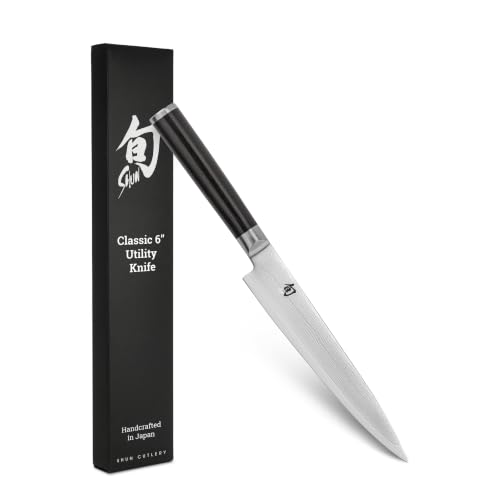
Shun Classic 6″ Utility Knife
- Best for: Cooks who want a refined 6-inch Japanese utility knife for slicing meats, cheeses and vegetables.
- Blade length: 6 inches
- Blade material: VG-MAX steel core
- Cladding: 68 layers of Damascus stainless steel
- Handle: D-shaped Pakkawood
Cooks who want a refined 6-inch Japanese utility knife for slicing meats, cheeses and vegetables.
Hand wash and dry it promptly, and keep it away from bone and frozen food, as the maker guidance reproduced on the listing directs.
The Shun Classic utility knife is the layered, finished option for cooks who value a fine edge on mid-size slicing. Its listing names a VG-MAX steel core with 68 layers of Damascus cladding and a D-shaped Pakkawood handle, and describes the knife as handcrafted in Japan for trimming vegetables and slicing meats and cheeses. At six inches it sits at the longer end of the utility range, which helps with sandwiches, melon wedges and portioning cooked proteins, while the narrow profile keeps it more precise than a chef knife for those same jobs.
Kai Seki Magoroku Petty Knife AB5461
- Best for: In-hand peeling, hulling and garnish work where a short, controlled blade matters most.
- Blade length: 120mm (4.7 inches)
- Model: AB5461
- Blade material: Molybdenum vanadium stainless steel
- Finish: Hammered pattern, single-layer construction
In-hand peeling, hulling and garnish work where a short, controlled blade matters most.
At 120mm it will feel short for sandwiches and larger board work, so pair it with a larger knife for those jobs.
The Kai AB5461 is the compact choice, a 120mm petty knife made in Japan with a hammered blade pattern. Its listing states a single layer of molybdenum vanadium stainless steel, a stainless steel base and a laminated reinforced wood handle, with a three-step blade finish intended to smooth the corners and reduce cutting resistance. That shorter length suits in-hand work above the board: peeling apples, segmenting citrus, hulling berries and trimming herbs. Cooks with smaller hands, or anyone who finds a 150mm petty clumsy for garnish work, will likely prefer this size.
Takayuki Sakai 15004 Petty Knife
- Best for: Cooks who want a plain, classic 150mm Sakai petty knife for repetitive produce prep.
- Blade length: 150mm (5.9 inches)
- Model: 15004
- Blade material: Alloy steel, described on the listing as Japanese steel
- Blade edge: Plain
Cooks who want a plain, classic 150mm Sakai petty knife for repetitive produce prep.
The listing mixes blade and overall length figures, so check the 150mm blade length on the live page before ordering.
The Takayuki Sakai 15004 offers the classic Sakai petty shape without layered cladding or a patterned finish. Its Amazon listing describes a 150mm blade made with Japanese steel, a plain edge and forged construction, at a listed weight of 100 grams. That plain profile suits cooks who want a traditional 150mm petty for peeling a bag of carrots, trimming green beans or slicing mushrooms through a full prep session, and who prefer to judge a knife by its edge and balance rather than its surface. It is the most understated knife in this guide, in a good way.
Which One Fits Your Situation
You Prep Small Produce on a Board Every Day
Choose the Tojiro DP 150mm or the Takayuki Sakai 15004. Both give enough edge for shallots, mushrooms and cherry tomatoes while staying nimble for trimming and portioning small proteins. Pick the Tojiro for its layered core-and-sides construction and ferrule, or the Sakai for a plainer forged profile at a light listed weight that stays comfortable through repetitive work.
You Mostly Work In Hand, Above the Board
Choose the Kai Seki Magoroku AB5461. Its 120mm hammered blade is sized for peeling, hulling and segmenting held in the hand, where a longer petty feels awkward and a paring knife feels cramped. The laminated reinforced wood handle also suits wet, repetitive garnish and fruit work, and the stainless base adds a clean, easy-wipe junction.
You Want One Utility Knife for Slicing and Serving
Choose the Shun Classic 6-inch utility knife. The longer blade and narrow profile handle sandwiches, cheese and cooked meats cleanly without tearing soft interiors, and the Damascus cladding and Pakkawood handle make it the knife here that also looks at home when food is portioned and served at the table.
You Already Own a Larger Japanese Chef Knife
Add the Tojiro DP if your main knife is also a layered stainless model and you want matching care habits, or the Kai AB5461 if your gap is specifically small in-hand work. Either fills the space below a chef knife without duplicating its board role, its weight or its length on the counter.
Common Mistakes
- Buying a 150mm petty for purely in-hand peeling, then finding it clumsy, when a 120mm blade would have suited the work better.
- Putting a Japanese utility knife in the dishwasher, even though listings such as the Takayuki Sakai 15004 state that it is not dishwasher safe.
- Using a thin petty blade on bone, frozen food or hard rinds, which risks chipping an edge ground for fine work.
- Confusing overall length with blade length on a listing, and ordering a knife that is shorter or longer than expected.
- Leaving a wet blade sitting after cutting citrus or tomato, instead of washing and drying it straight after acidic prep.
Frequently Asked Questions
What is the difference between a petty knife and a utility knife?
In Japanese ranges the two names usually describe the same mid-size knife. Petty comes from the French word for small, and listings often use both terms together, as the Tojiro DP Petty/Utility Knife does. Expect a narrow blade between a paring knife and a chef knife, made for trimming, peeling and small slicing jobs.
Should I choose a 120mm or a 150mm Japanese utility knife?
Choose 120mm if most of your work is in hand, such as peeling fruit, hulling berries and segmenting citrus. Choose 150mm if the knife will also work on a board, slicing mushrooms, shallots and small tomatoes. Many cooks who prep daily find 150mm the more versatile single purchase, while garnish-heavy cooks prefer the shorter blade.
Do Japanese utility knives need special sharpening?
They need regular honing and periodic sharpening on a whetstone or with a suitable guided system, rather than a pull-through sharpener made for thick Western blades. Keep the edge off glass and stone boards, store the knife so the edge does not knock against other utensils, and dry it after washing to protect both edge and handle.
Can a Japanese utility knife replace a chef knife?
For small and mid-size prep, often yes, and many cooks reach for a petty more than any other knife. It will not replace a chef knife for large vegetables, heavy chopping or rocking through a pile of herbs, because the blade is shorter and lighter. Treat it as the precision partner to a larger knife, not a full substitute.
More from Amazon
Programs that pair well with the guide above. Offers and eligibility are set by Amazon and may change.
Set up recurring deliveries of everyday items on eligible products. Terms and savings are set by Amazon.
Explore Subscribe & SaveCollect the home and kitchen items you want in one registry that guests can shop from.
Create a wedding registryFree shipping on eligible items, Prime Video and more. Eligible new members can start with a free trial.
Start a Prime free trialAudiobooks and podcasts to listen to on the go. Eligible new members can start with a free trial.
Try Audible freeAs an Amazon Associate we earn from qualifying purchases.
Write Your Review
No reviews yet. Be the first to share your experience!