

Key takeaways
- Grip clearance: The handle should leave enough room for your knuckles when the blade rests on the board.
- Seam quality: Handle scales should meet cleanly without gaps that trap food or moisture.
- Bolster shape: A bulky bolster can restrict a pinch grip, while a partial bolster usually makes sharpening easier.
- Weight: An 8-inch chef’s knife commonly falls around 150–230 grams, but balance matters more than the exact number.
Best Damascus Steel Knife Sets
The best Damascus steel knife sets are the ones that combine a genuinely hard, well-ground core steel with comfortable handles and useful knife sizes—not simply the most dramatic blade pattern. For most home cooks, a compact set built around an 8-inch chef’s knife, 5- to 6-inch utility knife, and 3.5- to 4-inch paring knife is a better purchase than a large block filled with rarely used pieces.
Our Picks by Cooking Situation
| Best for | Suitable example | Typical core steel | Common set contents | Typical 2026 market range |
|---|---|---|---|---|
| Most home kitchens | Shun Classic set | VG-MAX, approximately 60–61 HRC | 8-inch chef’s, 6-inch utility, 3.5-inch paring, sometimes shears and honing steel | $300–$700 |
| Fine cutting and premium fit | Miyabi Birchwood 5000MCD set | SG2 powder steel, approximately 63 HRC | 8-inch chef’s, 5.25-inch prep or utility, 3.5-inch paring | $500–$1,000+ |
| Distinctive handle and heavier feel | Shun Premier set | VG-MAX, approximately 60–61 HRC | 8-inch chef’s, 6-inch utility, 3.5-inch paring, often shears | $300–$700 |
| Lower-cost Damascus appearance | Entry-level AUS-10 or VG-10 set | Approximately 58–61 HRC | Chef’s, santoku, utility, paring, and steak knives | $100–$300 |
These ranges are broad because set size, country, retailer, handle material, and seasonal discounts make a major difference. A three-piece set can cost less than a seven-piece set from the same line even when the primary chef’s knife is identical.
Our top picks

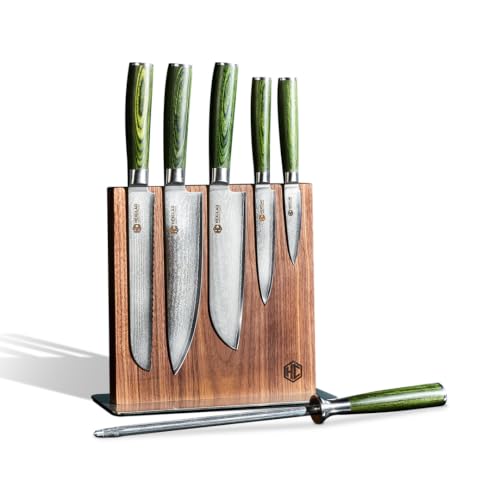


As an Amazon Associate we earn from qualifying purchases at no extra cost to you. Ratings are shown as listed on Amazon.
What “Damascus” Means in a Kitchen Knife
Modern Damascus kitchen knives are usually made by forge-welding multiple layers of steel around a harder central core. The core provides most of the cutting performance, while the outer layers protect and decorate the blade. In a common VG-10 construction, a hard VG-10 core may be surrounded by softer stainless layers. In higher-end SG2 construction, a powdered stainless-steel core can deliver greater hardness and edge stability.
The visible waves do not automatically prove superior steel. Some inexpensive knives use a competent core with an etched pattern; others use a thin decorative cladding around a less impressive core. Pattern welding can be useful for construction, but the number of layers—67, 73, or 101, for example—is not a direct measurement of sharpness or durability.
Look for the core steel, stated hardness, blade thickness, grind, and manufacturer’s sharpening guidance. If a listing talks only about “67 layers” and “beautiful Damascus” without identifying the cutting-core steel, treat that as a warning sign.
Blade Construction and Edge Retention
VG-10 and similar stainless cores
VG-10 is a practical choice for home cooks because it offers good corrosion resistance, respectable edge retention, and easier sharpening than very hard powder steels. At roughly 60–61 HRC, it is hard enough to stay sharp through regular vegetable, meat, and herb preparation while remaining less fragile than many ultra-hard blades.
SG2 and other powder steels
SG2, also called R2 in some knife ranges, is commonly hardened to approximately 62–64 HRC. It can hold a fine edge longer than VG-10 when used on a suitable cutting board. The trade-off is greater sensitivity to twisting, hard bones, frozen food, and accidental contact with plates or sinks. It also takes more time to sharpen once the edge has finally degraded.
Hardness is not the whole story
A knife with a thin, even edge can outperform a harder knife with a poorly finished grind. Edge angle matters too. Many Japanese-style Damascus knives use an included edge angle around 30–36 degrees, while sturdier Western-style knives may use approximately 36–45 degrees. A narrower edge feels keener but has less tolerance for abuse.
Handle Comfort and Balance
Handle comfort is a deciding factor because a knife can be technically excellent and still unpleasant to use. Traditional Japanese wa handles are lightweight and often wood or composite, shifting the balance toward the blade. Western-style handles are commonly heavier, riveted, and shaped to place the balance closer to the bolster or grip.
When comparing sets, check four details:
- Grip clearance: The handle should leave enough room for your knuckles when the blade rests on the board.
- Seam quality: Handle scales should meet cleanly without gaps that trap food or moisture.
- Bolster shape: A bulky bolster can restrict a pinch grip, while a partial bolster usually makes sharpening easier.
- Weight: An 8-inch chef’s knife commonly falls around 150–230 grams, but balance matters more than the exact number.
People who prefer rocking cuts may like a slightly heavier Western-style handle. Cooks who use push cuts and precise slicing often prefer a thinner, lighter Japanese-style knife.
Which Knife Sizes Actually Matter?
| Knife | Useful blade length | Best jobs | Priority in a set |
|---|---|---|---|
| Chef’s knife | 8 inches | Vegetables, herbs, boneless meat, general prep | Essential |
| Santoku | 6.5–7 inches | Compact chopping and slicing | Useful alternative to a chef’s knife |
| Utility knife | 5–6 inches | Small produce, sandwiches, trimming | Useful |
| Paring knife | 3.5–4 inches | Peeling, coring, detail work | Essential companion |
| Petty or prep knife | 5–5.5 inches | Precise trimming and small-board work | Useful in compact kitchens |
| Steak knives | 4.5–5 inches | Table use | Only if you need matching place settings |
A block containing a bread knife, shears, honing steel, and four steak knives may be good value if those items replace tools you would otherwise buy. It is poor value if it adds knives you will store permanently. Most cooks can cover nearly all daily tasks with a chef’s knife, paring knife, and bread knife.
Sharpening and Ownership Requirements
Damascus knives are not maintenance-free. A honing rod can realign a slightly displaced edge, but it does not remove enough steel to repair a genuinely dull knife. For harder Japanese blades, use a fine ceramic rod sparingly or, preferably, water stones or a reputable professional sharpening service.
A practical maintenance schedule
- Wash and dry the knife immediately after use, particularly after acidic foods or salty ingredients.
- Use a wood, quality composite, or soft plastic board; avoid glass, stone, ceramic, and hard bamboo surfaces.
- Touch up a frequently used chef’s knife every few weeks if needed, using the manufacturer’s recommended angle.
- Sharpen when the knife begins crushing tomato skin or slipping from an onion rather than waiting until it is completely blunt.
- Store blades in a sheath, magnetic rack, or knife block so edges do not strike other cutlery.
- Do not put Damascus knives in the dishwasher; heat, detergent, and movement can damage both the edge and handle.
A sharpening stone is a consumable ownership cost. A basic two-sided water stone commonly costs about $30–$80 and may last for years in a home kitchen. Professional sharpening may cost roughly $10–$25 per knife, depending on location and service level.
How to Choose Without Overpaying
| Your situation | Best choice | Why |
|---|---|---|
| Cooking several times a week and new to sharpening | VG-10 or VG-MAX, 60–61 HRC | Good edge life with relatively manageable sharpening |
| Experienced cook who values long edge retention | SG2, approximately 62–64 HRC | Fine edge and strong retention, provided technique is controlled |
| Small kitchen or limited storage | Three-piece set | Less duplication and easier safe storage |
| Frequent family meal preparation | Chef’s, paring, bread, and utility knives | Covers volume prep without relying on one knife for everything |
| Rough use, bones, frozen food, or shared kitchen | Thicker, moderately hard Western-style set | More forgiving than a thin, hard Japanese edge |
As a simple value check, suppose a $450 set contains three knives you use regularly. Over five years, using the set 250 days per year, the cost is about $0.12 per knife-use day if all three receive regular use: $450 divided by 3,750 knife-use days. A $700 block with several unused pieces can have a higher practical cost even if its price per item looks attractive.
Bottom Line
Choose a Shun Classic or Shun Premier set for a balanced VG-MAX option with broad home-kitchen appeal. Choose a Miyabi Birchwood 5000MCD set if you want a lighter, harder SG2 blade and are prepared to use better technique and more careful sharpening. For a tighter budget, seek an explicitly identified VG-10 or AUS-10 core, a stated hardness near 58–61 HRC, and a small set with useful sizes.
The Damascus pattern should be the final consideration, not the first. A well-made plain blade with a reliable core, comfortable handle, thin consistent grind, and clear care instructions will usually serve you better than a heavily patterned knife whose steel and construction are left vague.





Write Your Review
No reviews yet. Be the first to share your experience!