

Key takeaways
- Healthy & Natural Cooking
- Authentic Japanese Donabe Design
- Versatile Stovetop & Oven Use
The best donabe Japanese clay pot for most homes is a 1.5–2.0 litre, gas-compatible pot with a thick unglazed clay body: it is large enough for two to four portions, retains moisture well, and remains manageable to season, lift, and store.
Our top picks
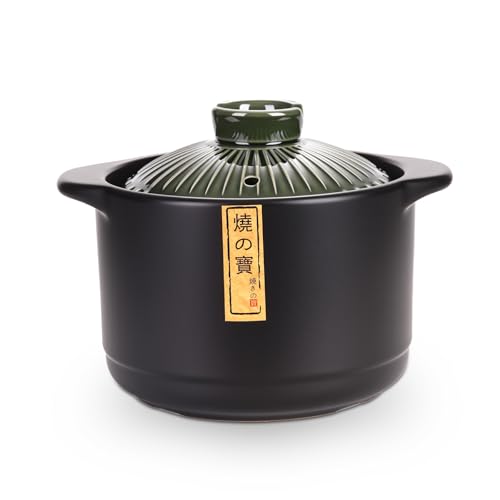 Ceramic Cooking Pot 2.1QT
- Healthy & Natural Cooking
- Authentic Japanese Donabe Design
- Versatile Stovetop & Oven Use
 TIKUSAN Donabe Japanese Hot Pot Banko Ware
- Craft hearty, authentic Japanese cuisine with this high-quality…
- Our Japanese hot pot ensures heat retention, making…
- Create homemade soups and hot pot recipes with…
 JapanBargain
- Authentic Japanese Cooking: Donabe, also known as earthen…
- Handmade and Durable: The Earthen Donabe Cooking Clay…
- Multi-Functional: The donabe pot can be used for…
| Product | Key specs | |
|---|---|---|
| Ceramic Cooking Pot 2.1QT | Healthy & Natural Cooking Authentic Japanese Donabe Design Versatile Stovetop & Oven Use | Check price |
| TIKUSAN Donabe Japanese Hot Pot Banko Ware | Craft hearty, authentic Japanese cuisine with this high-quality… Our Japanese hot pot ensures heat retention, making… Create homemade soups and hot pot recipes with… | Check price |
| JapanBargain | Authentic Japanese Cooking: Donabe, also known as earthen… Handmade and Durable: The Earthen Donabe Cooking Clay… Multi-Functional: The donabe pot can be used for… | Check price |
 Okllen Large Korean Ceramic Bowl with Lid Okllen Large Korean Ceramic Bowl with Lid | Okllen Korean ceramic bowl overall size, 9.8"Dx5.1"H, holding… Premium Material: This Korean ceramic bowl is crafted… Easy to Grip: Designed with double handles and… | Check price |
As an Amazon Associate we earn from qualifying purchases at no extra cost to you.
Best donabe Japanese clay pot choices by cooking situation
| Cooking situation | Best size or style | Why it fits | Main limitation |
|---|---|---|---|
| One or two people, small kitchen | 0.7–1.2 L single-serving or small nabe | Quick to heat, easier to store, ideal for rice, soup, or one-pot meals | Limited headroom for bubbling stews and leftovers |
| Two to four people | 1.5–2.0 L medium pot | The most versatile compromise for rice, hot pot, braises, and steaming | Usually too small for a large dinner party |
| Four to six people | 2.5–3.5 L large nabe | Enough surface area and volume for shared hot pot and substantial stews | Heavy, slower to heat, and harder to fit in a cabinet |
| Exceptional rice and grain cooking | Thick-walled rice donabe, such as a kamado-style pot | Dense clay moderates heat and holds steam for fluffy rice | Less convenient for quick sautéing or frequent stirring |
| Steamed vegetables, fish, and poultry | Donabe steamer with an internal rack or basket | Moist heat cooks gently without immersing food in water | Taller storage footprint and more parts to clean |
What makes a donabe different from a standard ceramic casserole?
A donabe is a Japanese earthenware cooking pot, traditionally associated with Iga-yaki pottery. Its porous clay and relatively thick walls absorb and distribute heat gradually. Once hot, the body continues radiating heat after the burner is lowered or switched off. This makes a donabe particularly effective for rice, soups, hot pot, braised vegetables, and other foods that benefit from steady heat and a humid cooking environment.
The same properties create trade-offs. A donabe is not a metal saucepan: it dislikes sudden temperature changes, needs careful drying, and may not work on induction. Some models are glazed inside, while others deliberately retain a more porous interior. Construction therefore matters more than decorative shape.
Head-to-head: size, clay thickness, and everyday practicality
| Typical capacity | Approximate empty weight | Typical body thickness | Best uses | Storage and handling reality |
|---|---|---|---|---|
| 0.7–1.0 L | 1.5–2.5 kg | 8–12 mm | Rice for one or two, miso soup, oatmeal, small gratins | Compact, but easy to overfill because usable capacity is below the rim |
| 1.2–2.0 L | 2.5–4.5 kg | 10–15 mm | Two- to four-person meals, rice, curry, braises, hot pot | Best general-purpose range; allow a stable shelf rather than a high cupboard |
| 2.5–3.5 L | 4.5–7.5 kg | 12–18 mm | Family hot pot, large soups, whole small chicken, batch cooking | Needs two-handed lifting and generous drying space |
| 4.0–6.0 L | 7–12 kg | 15–20 mm | Entertaining, large stews, communal nabe | Specialist choice; weight and burner size become significant |
These are practical ranges, not universal specifications. Diameter, lid design, handles, and the clay source can change the weight considerably. A thick wall generally improves heat buffering and moisture retention, but it also increases warm-up time and makes the pot less forgiving to lift while full.
Choose the pot by dish, not just by capacity
Rice and grains
Choose a rice-focused donabe with a snug, heavy lid and a broad, thick base. Some rice pots use a double-lid design to regulate pressure and reduce boil-over. A 1.5–2.0 L pot is usually practical for roughly two to four servings of cooked rice, depending on the manufacturer’s maximum uncooked-rice rating. Do not use capacity alone: the maker’s rice measure and fill line are more useful than litres.
Hot pot, soup, and shabu-style meals
Select a wider, shallower nabe with comfortable side handles. The broader opening lets diners reach food and gives ingredients room to cook evenly. A 2.5–3.5 L pot is more useful than a narrow deep pot for four or more people. Leave generous space above the liquid because a crowded pot boils unevenly and spills more readily.
Braises and slow-cooked vegetables
A medium or large thick-walled donabe is excellent when the food should stay moist and the cooking temperature should change gradually. Look for a well-fitting lid and an interior suited to wet cooking. Donabe heat is gentle only after the pot has warmed; an empty clay pot over high heat can still crack.
Steaming
A steamer insert or dedicated donabe steamer is the better choice for fish, dumplings, leafy vegetables, and chicken. The closed vessel traps steam, so food can remain tender without being submerged. Check the insert height before buying: tall models may not fit below standard kitchen cabinets or under a low exhaust hood.
Heat-source limitations that can rule out a donabe
- Gas: Usually the most compatible heat source. Use a burner that supports the base without flames climbing up the sides.
- Induction: Traditional clay is not magnetic and normally will not activate an induction hob. An adapter plate is not a universal solution and can create uneven heating; buy only a model explicitly rated for that setup.
- Electric ceramic and glass-top hobs: Compatibility varies. The concentrated heating pattern and dragging a rough clay base across glass can be problematic. Follow the manufacturer’s instructions.
- Oven: Some donabe models are oven-safe, while others are intended only for stovetop use. Confirm both the maximum temperature and whether the lid is included in that rating.
- Microwave: Do not assume compatibility. Decorative finishes, metal accents, or trapped moisture can make microwave use unsuitable.
If your kitchen has induction only, a heavy enameled cast-iron pot may provide a similar moisture-retaining cooking experience with fewer restrictions. A donabe is worth choosing when its clay construction and cooking style suit your available burner.
Seasoning: the setup step that protects the pot
Most unglazed or porous donabe interiors require 目止め, commonly called seasoning or sealing. The purpose is to fill some pores with starch and reduce the chance of liquid penetrating the clay. Use the instructions supplied with the pot because formulas differ, but the usual process is:
- Rinse the new pot and lid gently, then dry every surface completely. Clay can crack if moisture remains trapped.
- Fill the pot about one-third to one-half full with water and add a starch source, such as cooked rice or rice flour, according to the maker’s directions.
- Bring it slowly to a gentle simmer over low to medium-low heat. Simmer for about 30–60 minutes rather than boiling aggressively.
- Switch off the heat and let the pot cool naturally. Never put a hot donabe in cold water.
- Discard the mixture, rinse without abrasive detergent, and air-dry completely, often overnight.
Do not season a pot that the manufacturer identifies as already treated unless the instructions request it. Repeat seasoning if the interior develops a persistent odor or shows unusually absorbent, unsealed areas.
Ownership costs and durability
General market pricing is often about $60–$150 for a small or basic donabe, $100–$250 for a well-made medium pot, and $200–$500 or more for large, multi-part, or specialty rice and steamer models. The cost per use can be reasonable: a $160 pot used twice weekly for four years costs about $0.38 per cooking session before fuel, assuming 416 uses. That calculation only works if the pot is used regularly and stored correctly.
The lid, rim, handles, and outer base usually show wear before the clay body. Chips can develop from knocks, abrasive scrubbing, or stacking. Hairline cracks caused by thermal shock may spread even when the pot initially appears usable. Never heat an empty donabe for prolonged periods, never add cold liquid to a hot pot, and never place a hot pot directly on a wet or cold stone surface.
For cleaning, let the pot cool, soak stuck food in warm water, and use a soft brush or sponge. Avoid dishwasher cycles unless the maker explicitly permits them. Dry the body and lid separately with the lid ajar; storing a damp lid on the pot encourages stale odors and mold.
Final buying decision
For a first purchase, choose a 1.5–2.0 L medium donabe with a thick base, a well-fitting lid, clear gas-stove instructions, and a documented seasoning method. Choose a smaller pot only when portions and storage space are genuinely limited. Choose a 2.5–3.5 L model for shared hot pot or family batch cooking, and choose a dedicated rice or steamer design when that dish is your main reason for buying. The best donabe Japanese clay pot is not the largest or thickest one; it is the pot whose capacity, clay construction, and approved heat source match how you will cook every week.








Write Your Review
No reviews yet. Be the first to share your experience!