

Best Japanese Donabe Pots for Rice, Stews & Hot Pot
The best Japanese donabe pot depends on what you cook most: choose a rice-focused two-lid donabe for fluffy rice, a wide single-lid model for hot pot, or a deep, generously sized model for stews and batch cooking.
Japanese donabe means an earthenware cooking pot, traditionally made from porous clay. That porosity helps moderate heat and can contribute to gentle, even cooking, while the thick ceramic body stores heat long after the burner is turned off. The trade-off is that donabe pots are heavier and more vulnerable to thermal shock than metal cookware. Most are designed for gas stovetops, not induction.
Our top picks
 TIKUSAN Donabe Japanese Hot Pot Banko Ware
- Craft hearty, authentic Japanese cuisine with this high-quality…
- Our Japanese hot pot ensures heat retention, making…
- Create homemade soups and hot pot recipes with…
 Kotobuki Donabe Japanese Hot Pot
- 11-inch diameter
- Large enough for a meal for 4 to…
- Traditional gray mishima design
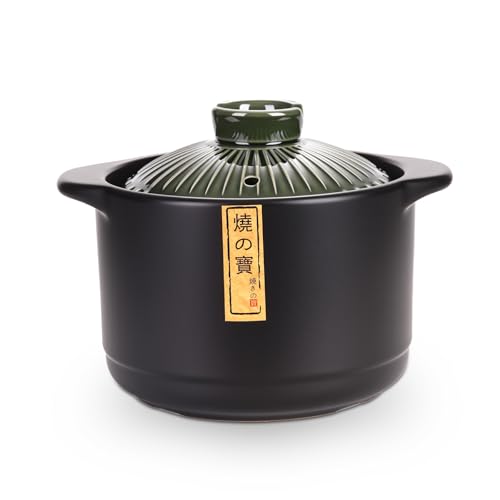 Ceramic Cooking Pot 2.1QT
- Healthy & Natural Cooking
- Authentic Japanese Donabe Design
- Versatile Stovetop & Oven Use
| Product | Key specs | |
|---|---|---|
| TIKUSAN Donabe Japanese Hot Pot Banko Ware | Craft hearty, authentic Japanese cuisine with this high-quality… Our Japanese hot pot ensures heat retention, making… Create homemade soups and hot pot recipes with… | Check price |
| Kotobuki Donabe Japanese Hot Pot | 11-inch diameter Large enough for a meal for 4 to… Traditional gray mishima design | Check price |
| Ceramic Cooking Pot 2.1QT | Healthy & Natural Cooking Authentic Japanese Donabe Design Versatile Stovetop & Oven Use | Check price |
 JapanBargain JapanBargain | Authentic Japanese Cooking: Donabe, also known as earthen… Handmade and Durable: The Earthen Donabe Cooking Clay… Multi-Functional: The donabe pot can be used for… | Check price |
As an Amazon Associate we earn from qualifying purchases at no extra cost to you.
Quick picks by cooking situation
- Best for reliable rice: Nagatani-en Kamado-san, a double-lid rice donabe designed specifically to regulate steam and heat.
- Best all-rounder: A medium Iga-yaki or Shigaraki-yaki donabe with a single lid, roughly 2.5–3.5 liters, for rice, soup, curry and hot pot.
- Best for hot pot: A wide, shallow 2–3 liter donabe with a broad opening for arranging ingredients and serving at the table.
- Best for families or batch stews: A 4–5 liter deep donabe, provided your stovetop and storage space can accommodate its diameter and weight.
- Best for beginners on a budget: A standard gas-compatible clay donabe with a replaceable or inexpensive lid, rather than a highly specialized rice cooker.
What separates a good donabe from a decorative clay pot?
Clay porosity
Unglazed or partly unglazed earthenware contains microscopic pores. These pores do not make the pot waterproof in the same way as glazed stoneware; they are part of the material’s thermal behavior. A porous base heats more gradually than thin metal, which can make simmering and rice cooking forgiving. It also absorbs moisture during initial seasoning, so a new donabe should usually be “seasoned” by cooking a starch-rich porridge in it before regular use.
Porosity is not a sign that a pot should leak during normal cooking. Small damp patches during the first few uses can occur, but persistent seepage, a widening crack or a pot that smells musty when dry indicates a problem. Follow the manufacturer’s seasoning instructions, since clay bodies and glazes differ.
Heat retention
Thick clay takes longer to heat than aluminum or stainless steel, but it holds heat well. This makes a donabe useful for serving hot pot at the table and for letting rice, beans or stew finish gently after the burner is switched off. It also means you should not use high heat as a shortcut: the exterior may become stressed before the food needs more heat.
Lid design and steam control
Rice donabe pots often use two lids. The inner lid helps distribute steam and can create pressure, while the outer lid adds insulation and controls escaping moisture. A single-lid pot is simpler and usually more versatile for soups and hot pot. Look for a lid that sits securely but is not so tight that steam cannot escape; a blocked vent can cause bubbling over and uneven cooking.
Size guide: buy by go, not just by liters
In Japanese rice cookware, one go is approximately 180 ml of uncooked rice. After cooking, one go usually yields about 330–360 ml of rice, depending on the rice variety and water ratio. Capacity claims vary, so treat the guide below as a practical starting point rather than a fill-to-the-rim target.
| Rice capacity | Uncooked rice | Cooked rice yield | Practical use | Typical pot capacity |
|---|---|---|---|---|
| 1 go | 180 ml | 330–360 ml | One large serving or two small servings | 1.0–1.5 L |
| 2 go | 360 ml | 660–720 ml | Two to three people | 1.5–2.0 L |
| 3 go | 540 ml | 1.0–1.1 L | Three to four people | 2.0–3.0 L |
| 4–5 go | 720–900 ml | 1.3–1.8 L | Family meals or leftovers | 3.0–4.5 L |
Do not fill a donabe to the rim. Rice foams, and hot-pot broth needs room for vegetables and bubbling. For example, a household that regularly cooks 2 go of rice but also wants hot pot should usually favor a 2.5–3.5 liter general-purpose pot rather than a compact 2-go rice specialist. A wider pot may also fit your burner better than a tall one even when the stated capacity is similar.
Head-to-head: specialized rice donabe or versatile donabe?
| Feature | Rice-focused two-lid donabe | General-purpose single-lid donabe |
|---|---|---|
| Best use | White rice, mixed rice and grains | Hot pot, soup, stew, braises and rice |
| Steam control | More controlled; layered lid system | Simple; depends mainly on lid fit and heat |
| Typical size | 1–3 go | 2–5 L |
| Learning curve | Low once timing is established | More flexible but recipes need adjustment |
| Cleanup | Extra lid and occasional starch residue | Usually simpler |
| Best buyer | Someone who cooks rice several times weekly | Someone who wants one pot for many dishes |
Nagatani-en’s Kamado-san is a well-known example of the specialized approach. Its two-lid construction is intended to make rice cooking repeatable without constant stirring or manual steam adjustment. By contrast, a classic Iga-yaki or Shigaraki-yaki nabe is the better choice when rice is only one of several uses. The exact clay, glazing and dimensions differ by maker, so check the individual manual rather than assuming all Japanese donabe behave identically.
Stovetop compatibility: the decision that prevents disappointment
- Gas: Usually the intended cooking method. Use a burner that supports the base and keeps flames from climbing far up the sides.
- Induction: Standard clay donabe is not induction-compatible because clay is not magnetic. Do not place it directly on an induction zone unless the manufacturer explicitly approves a particular converter, and recognize that converter plates can heat unevenly.
- Electric coil and glass-top electric: Compatibility is model-specific. Sudden concentrated heating and sliding can damage earthenware or the cooking surface.
- Oven: Some donabe models are oven-safe, while others are not. Never assume that a gas-stovetop model can go under a grill or broiler.
- Microwave and dishwasher: Avoid unless the maker specifically states otherwise. Porous clay and rapid heating or drying can lead to damage.
Measure the burner grate and the available storage shelf before ordering. A 30 cm-wide pot can overwhelm a small hob, and a filled 4-liter donabe may weigh more than 7 kg once food and broth are included. Handles, lid knobs and the lid’s overhang also require clearance.
How to prevent cracking and extend ownership
- Dry the pot completely. After washing, leave it upside down or uncovered until no moisture remains. Trapped water can expand when heated.
- Season a new pot if instructed. Cook a thin rice porridge or another recommended starch mixture, allow it to cool, then wash gently. This helps condition the interior.
- Start with low to medium heat. Increase gradually only when the recipe requires it. Thick clay does not respond instantly to burner changes.
- Never pour cold liquid into a hot pot. Add room-temperature or warm stock instead. Do not set a hot pot on a wet, cold countertop.
- Use dry trivets and lift rather than slide. Sliding can stress the base and scratch a cooktop.
- Do not heat it empty for long. An empty earthenware pot can develop severe thermal stress, especially on a strong burner.
- Clean without soaking for hours. Use warm water and a soft sponge. Avoid abrasive powders, metal scrubbers and sudden cold rinses.
The lid is often the first part to chip because it is lifted frequently and set down on hard surfaces. Lid knobs can loosen, and unglazed surfaces may discolor from repeated use. These cosmetic changes do not automatically mean the pot is unsafe, but stop using cookware with a structural crack, active leakage or a visibly unstable lid.
Decision matrix for choosing your first donabe
| Your situation | Recommended choice | Why |
|---|---|---|
| Small kitchen, cooks for one or two | 1–2 go rice donabe or 1.5–2 L general-purpose model | Lower storage demand and quicker to clean |
| Rice several times per week | Two-lid 2–3 go rice donabe | Steam control rewards repeated use |
| Weekly hot pot for three or four | 2.5–3.5 L wide donabe | More useful opening and serving area |
| Occasional use and limited budget | Basic single-lid gas-compatible donabe | Avoids paying for specialized rice hardware |
| Frequent batch cooking | 4–5 L deep donabe with sturdy handles | Better volume, but confirm burner and cabinet clearance |
| Induction-only kitchen | Do not buy a conventional donabe without explicit compatibility | Most traditional clay pots are not designed for direct induction heating |
Bottom line
For the best Japanese donabe pots, match the shape to the job before comparing decoration or glaze. Choose a two-lid 2–3 go model such as Kamado-san if rice is the priority; choose a 2.5–3.5 liter wide nabe if you want hot pot and everyday versatility; and move to 4–5 liters only when your household, burner and storage space justify it. The pot will reward gradual heating, careful drying and sensible capacity, but it is not a carefree replacement for metal cookware—especially on an induction-only stove.








Write Your Review
No reviews yet. Be the first to share your experience!