

Key takeaways
- Authentic Japanese Sukiyaki Pan
- Versatile Cooking Pan
- Includes Glass Lid for Enhanced Cooking & Heat…
Best Shabu Shabu Pot for Japanese Hot Pot
The best shabu shabu pot for Japanese hot pot is usually a 5- to 6-quart electric divided pot for four to six diners, while a 3- to 4-quart single-basin pot is the better choice for two people and a large 8- to 10-quart divided pot suits frequent family meals.
The right choice depends less on appearance than on four practical questions: how many people will eat at once, whether you need two broths, what type of stovetop you have, and how precisely you need to control simmering. Shabu shabu requires a pot that can maintain a steady, gentle boil without scorching the broth or overcrowding the ingredients.
Our top picks
 JapanBargain 3868
- Authentic Japanese Sukiyaki Pan
- Versatile Cooking Pan
- Includes Glass Lid for Enhanced Cooking & Heat…
 TRUMDAKE 7" Cast Iron Japanese Sukiyaki Hot
- Versatile and Compact: The TRUMDAKE 7" Cast Iron…
- Excellent Heat Retention: This versatile cast iron pot,…
- Easy to Clean and Maintain: Cleaning is a…
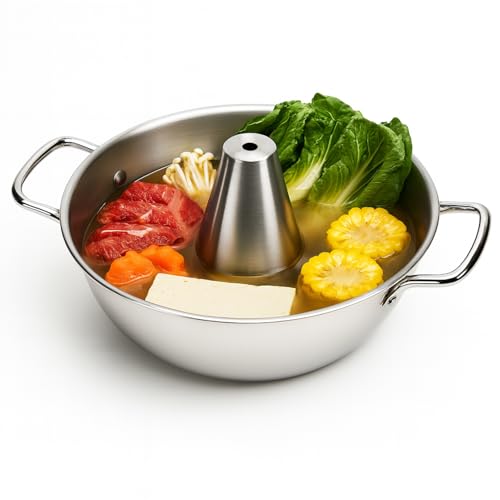 JapanBargain
- Authentic Japanese Shabu Shabu Hot Pot
- Premium Food-Grade Stainless Steel
- Perfect Size for Sharing
| Product | Key specs | |
|---|---|---|
| JapanBargain 3868 | Authentic Japanese Sukiyaki Pan Versatile Cooking Pan Includes Glass Lid for Enhanced Cooking & Heat… | Check price |
| TRUMDAKE 7" Cast Iron Japanese Sukiyaki Hot | Versatile and Compact: The TRUMDAKE 7" Cast Iron… Excellent Heat Retention: This versatile cast iron pot,… Easy to Clean and Maintain: Cleaning is a… | Check price |
| JapanBargain | Authentic Japanese Shabu Shabu Hot Pot Premium Food-Grade Stainless Steel Perfect Size for Sharing | Check price |
 JapanBargain 4590 JapanBargain 4590 | High-Quality Food Grade Stainless Steel: Constructed from food-grade… Efficient Heat Distribution: Designed for optimal cooking efficiency,… Perfect Size for Small Gatherings: Measuring 26cm (10-1/4… | Check price |
As an Amazon Associate we earn from qualifying purchases at no extra cost to you.
Quick comparison: which pot fits your table?
| Pot type | Typical capacity | Best serving size | Divider layout | Typical power or heat source | Approximate price range |
|---|---|---|---|---|---|
| Small electric single pot | 3–4 quarts | 1–2 people | None | 1,000–1,300 watts | $35–$70 |
| Medium electric divided pot | 5–6 quarts | 3–5 people | Half-and-half or curved S-shaped divider | 1,300–1,500 watts | $50–$110 |
| Large electric divided pot | 8–10 quarts | 5–8 people | Usually half-and-half | 1,500 watts or more | $80–$160 |
| Stainless steel stovetop shabu pot | 4–8 quarts | 2–6 people | None, half-and-half, or yin-yang divider | Gas, electric, or induction depending on base | $30–$100 |
| Premium induction-compatible pot | 5–8 quarts | 3–6 people | Single or divided | Induction cooktop; wattage varies | $70–$180 |
These are useful buying ranges rather than universal specifications. Actual usable capacity is lower than the filled-to-the-rim capacity: leave roughly 1 to 1½ inches of space to prevent broth from splashing when diners add vegetables, noodles, and meat.
Best choices by situation
Best for two people: a 3- to 4-quart single-basin pot
A small single-basin pot is the simplest option for a couple or solo diner. It heats quickly, takes up less counter space, and is easier to wash than a divided model. It also gives you a wider uninterrupted cooking area, which is helpful for dipping thinly sliced beef or pork.
Choose a pot with at least 1,000 watts of power if it is electric. A lower-powered unit may maintain heat once the broth is hot but can recover slowly after several chilled ingredients are added. For occasional meals, a stovetop stainless steel pot can be more economical and may store inside another pan.
Best all-rounder for four people: a 5- to 6-quart divided electric pot
This is the most versatile format for a household that wants shabu shabu regularly. A half-and-half divider lets diners choose a mild kombu broth on one side and a spicy, mushroom, or miso broth on the other. Independent heat controls are useful, but not essential; a single thermostat can work if both broths have similar simmering requirements.
Look for removable cooking pans, cool-touch handles, and a lid with a steam vent. A removable pan is particularly valuable because it allows you to soak and wash the cooking surface without carrying the electrical base to the sink.
Best for mixed preferences: a yin-yang or curved-divider pot
A curved divider provides two broths while leaving more room in each compartment than some narrow half-and-half designs. This layout can be comfortable for four diners, but it may be less convenient for a large group because each section has a smaller opening for retrieving food.
Check the divider weld or seam carefully. A thin divider that flexes under pressure can be difficult to clean and may allow the two broths to mix. A permanently attached divider is usually more durable than a loose insert, but it can create corners where starch and aromatics collect.
Best for six or more people: an 8- to 10-quart pot
A large pot prevents the common problem of overcrowding. When eight diners add vegetables, tofu, noodles, and meat at the same time, a small pot can stop simmering and become difficult to manage. A 1,500-watt electric unit or a strong induction burner generally recovers heat more effectively than a compact tabletop appliance.
Large pots need a wide, stable base. Measure the table or portable burner before buying: an 8-quart pot can exceed 12 inches in diameter, and the handles may add another 2 to 4 inches. On a crowded dining table, a slightly narrower pot may be safer than the largest available model.
Divider layouts compared
| Layout | Advantages | Limitations | Best use |
|---|---|---|---|
| Single basin | Maximum cooking area; easiest to clean; usually lowest cost | Only one broth | Small groups and traditional single-broth meals |
| Half-and-half | Simple separation; easy to understand and serve | Each side can feel narrow in smaller pots | Two broths for three to six people |
| Yin-yang or curved divider | More flexible shape; often gives each broth a broad cooking zone | More seams and corners to clean | Different broth preferences at one table |
| Removable divider | Can convert the pot into a single basin | May shift or leak; requires careful fitting | People who want both formats |
Induction compatibility and heat control
For a stovetop pot, look for a magnetic stainless steel base or explicit induction compatibility. A stainless steel exterior alone does not guarantee that the pot will work on induction. Test an existing pan with a magnet before assuming a similar-looking shabu pot will work.
Electric pots are convenient because the heating element and thermostat are integrated. Useful controls include a low setting for maintaining broth, a medium setting for cooking vegetables, and a high setting for bringing the liquid to a boil. A dial with several heat positions is usually more practical than a single on/off switch.
Temperature numbers can be misleading. Many countertop pots cycle their heating element rather than holding an exact liquid temperature. For shabu shabu, stable simmering matters more than laboratory precision. The pot should produce small, steady bubbles without violently boiling the broth.
A simple sizing calculation
Plan on approximately 1 to 1¼ quarts of starting broth for each pair of diners, plus room for ingredients. For four people:
- Starting broth: about 2½ to 3 quarts
- Headroom and ingredient displacement: about 1½ to 2 quarts
- Practical pot size: at least 5 quarts
For six people, that calculation gives approximately 3¾ quarts of broth and 2 to 2½ quarts of working space, making a 7- to 8-quart pot more comfortable than a tightly filled 5-quart model. If your group eats a large amount of noodles or vegetables, choose the next size up rather than relying on a pot filled nearly to its rim.
What wears out first
On electric models, the thermostat, power connector, and nonstick cooking surface are usually more vulnerable than the metal body. Do not drag metal ladles across a coated interior, and avoid stacking other cookware inside it. If the coating blisters, flakes, or exposes the metal beneath, replace the cooking pan or the appliance rather than continuing to use it.
On stovetop models, the base can warp if a hot pot is placed directly into cold water. Let it cool before washing. Divider seams and rivets also deserve attention: food trapped around them can cause odors and discoloration if the pot is stored while damp.
Broth residue is easier to remove when the pan is soaked promptly in warm water. Avoid abrasive scouring pads on coated surfaces. For stainless steel, a nonabrasive cleanser can remove mineral film, while a soft brush is useful around divider corners.
Common buying mistakes
- Choosing capacity by the advertised maximum: A 6-quart pot should not be filled to 6 quarts during active cooking.
- Ignoring table clearance: Measure the burner, handles, lid, and the space needed for serving bowls.
- Assuming every divided pot has separate heat controls: Many models heat both sections together.
- Buying a non-induction pot for an induction cooktop: Confirm compatibility from the manufacturer’s specifications.
- Prioritizing a divider over usable space: For two diners, a single basin may be more functional than two cramped compartments.
- Forgetting cleanup: Fixed electrical bases and narrow divider seams can make routine washing frustrating.
Final recommendation
For most households, choose a 5- to 6-quart electric divided pot with at least 1,300 watts, a removable cooking pan, a sturdy lid, and a clearly adjustable thermostat. Choose a 3- to 4-quart single-basin pot for one or two people, an 8- to 10-quart model for larger gatherings, and a stainless steel induction-compatible pot if you already own a suitable portable induction burner or want maximum stovetop flexibility. The best shabu shabu pot for Japanese hot pot is the one that leaves enough room for ingredients, maintains a gentle simmer, and can be cleaned without turning every meal into a maintenance project.








Write Your Review
No reviews yet. Be the first to share your experience!