

The best cheese knife set for entertaining is a three- or four-piece stainless-steel set with a soft-cheese spreader, a semi-soft cheese knife, a hard-cheese chisel or cleaver, and a fork-tipped serving knife—ideally with comfortable handles and a compact storage case.
A large 6- or 7-piece set can look impressive, but most hosts repeatedly use only three essential shapes. The right choice depends on the cheeses you serve, how often you entertain, how much drawer space you have, and whether the set must travel to picnics or dinner parties.
Our top picks
 Dolly Parton 3-Piece Assorted Cheese Knife Set
- Each handle features a unique pattern—rose, blue butterfly,…
- A CHEESE LOVER’S DREAM: Includes a cheese knife…
- Stainless steel blades handle slicing and serving with…
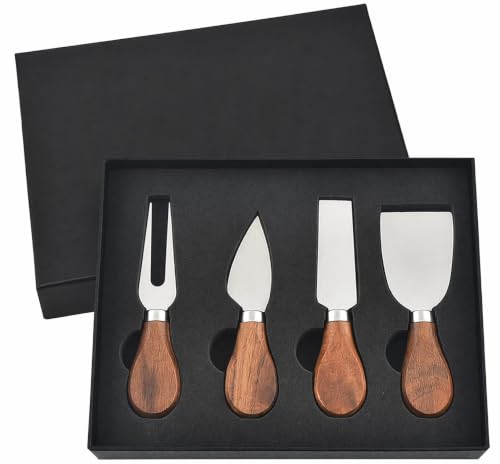 D-ChuangX 4Pcs Cheese Knife Set
- Superior Stainless Steel Blades Ensure Effortless Slicing: Crafted…
- Acacia Wood Handles for Comfort and Style: The…
- 4-Piece Set Covers All Cheese Varieties: This comprehensive…
As an Amazon Associate we earn from qualifying purchases at no extra cost to you.
Best cheese knife set choices by entertaining style
- Best all-round choice: a 4-piece stainless-steel set containing a cheese fork, spreader, hard-cheese knife, and semi-soft cheese knife.
- Best for occasional hosts: a 3-piece set with a spreader, pointed cheese knife, and hard-cheese chisel.
- Best for a cheese-board enthusiast: a 6- or 7-piece set adding a wire cutter, cheese plane, and serving tongs.
- Best for small kitchens: a nesting set or slim case no wider than about 10 inches.
- Best for gifts and travel: a handled case with rust-resistant stainless steel and tools that can be secured separately.
Which cheese knives do you actually need?
Cheese tools are designed around texture rather than cheese name. A soft Brie and a soft goat cheese may need similar treatment, while a crumbly aged cheddar and a dense Parmesan need different blades even though both are relatively firm.
| Tool | Typical size | Best for | Important design detail |
|---|---|---|---|
| Cheese spreader | 5–7 inches | Brie, chèvre, cream cheese, pimento cheese | Broad, blunt blade that scoops and spreads |
| Soft or semi-soft cheese knife | 6–8 inches | Camembert, Havarti, Gouda, mozzarella | Perforated or narrow blade to reduce sticking |
| Hard-cheese knife or chisel | 5–7 inches | Parmesan, aged cheddar, Gruyère, Manchego | Thick, rigid blade for splitting or levering |
| Cheese fork | 5–7 inches | Holding cheese while cutting and serving cubes | Two sharp tines with a stable handle |
| Cheese plane | 7–9 inches | Thin slices of firm Gouda, Swiss, or cheddar | Sharp slot and rigid frame; less versatile than a knife |
| Wire cutter | 6–8 inches | Clean cuts through soft and semi-soft blocks | Replaceable or tensioned wire is preferable |
If a set contains only a generic pointed knife and a spreader, it may handle a small snack board but will be less capable with hard cheeses. Conversely, a set filled with specialty tools can create clutter without improving the experience for casual entertaining.
Head-to-head: three-piece versus four-piece sets
Three-piece sets
A three-piece set usually combines a spreader, a pointed or slotted cheese knife, and a hard-cheese tool. It is the better value when you serve cheese a few times a year. Typical market prices range from about $15 to $35, depending on handle materials, finish, and packaging.
The limitation is that one knife often has to perform two jobs. A pointed knife can break off hard cheese, but it is not as controlled as a dedicated chisel. A spreader is excellent for soft cheese but does not make tidy portions from a firm wedge.
Four-piece sets
A four-piece set adds a cheese fork or separates the soft-cheese and hard-cheese functions more effectively. This is usually the best balance for entertaining because guests can serve themselves without passing one tool back and forth. Expect a general market range of approximately $25 to $60.
For most households, the ideal four-piece combination is a spreader, a perforated soft-cheese knife, a rigid hard-cheese knife, and a fork-tipped serving knife. It covers the broadest range of textures without requiring a dedicated cheese drawer.
Six- and seven-piece sets
Larger sets become worthwhile when you regularly serve several cheese styles at once or want matching tools for a formal table. They may include a cheese plane, wire cutter, tongs, and extra serving forks. Prices commonly range from $40 to $100 or more.
Check whether every tool has a practical role. A second pointed knife is less useful than a sturdy cheese fork or a properly tensioned wire cutter. More pieces also mean more washing, more storage space, and more opportunities for small parts to disappear.
Handle comfort matters more than decorative styling
Cheese can be surprisingly difficult to cut when it is cold, dense, or crumbly. A narrow handle can make a hard-cheese knife feel unstable, while a glossy handle may become slippery if it picks up oil from the board.
Look for handles approximately 3/4 to 1 inch thick, with smoothly rounded edges and enough length for a full grip. Stainless steel handles are durable and easy to clean, but hollow designs can feel less balanced than a solid or weighted handle. Wood and composite handles may feel warmer and more secure, though they require more careful drying.
Balance the tool near the point where the blade meets the handle. If the blade immediately drops toward the board, cutting can require more wrist effort. Avoid decorative ridges, deep seams, or exposed rivet gaps that can trap cheese residue.
Storage cases: useful feature or unnecessary packaging?
A case is valuable when the set travels, lives in a crowded kitchen, or is given as a gift. The most useful cases have individual elastic loops, molded slots, or a removable tray so blades do not strike one another. A case measuring roughly 10 by 8 inches is usually compact enough for a kitchen drawer while accommodating four to six tools.
Inspect the interior material. A fabric-lined case protects finishes but should not be used to store damp tools. A hard shell offers better protection for travel but takes more space. Magnetic storage can be convenient, although strong magnets may make removing pointed tools awkward and do not replace safe blade coverage.
If the set will stay in a drawer, a case is optional. A simple blade guard or a compact tray may provide the same protection with less bulk.
Decision matrix: match the set to your situation
| Your situation | Recommended configuration | Why |
|---|---|---|
| Budget under $30; entertaining 1–4 times yearly | 3-piece stainless-steel set | Covers soft, semi-soft, and hard cheese without paying for rarely used tools |
| Entertaining monthly; mixed cheese boards | 4-piece set with fork and dedicated hard-cheese tool | Better serving flow and less cross-use between textures |
| Frequent host; six or more cheeses | 6- or 7-piece set with plane, wire cutter, and tongs | Specialty tools improve portion control and presentation |
| Small kitchen or shared drawers | 3- or 4-piece nesting set under 10 inches wide | Reduces storage clutter while retaining the essential tools |
| Picnics, potlucks, or holiday travel | Set with a fitted case and secured tools | Prevents blades from contacting food containers or other utensils |
| Limited hand strength or frequent hard cheeses | Wide-handled set with rigid chisel-style knife | Provides more grip and leverage than thin decorative tools |
Materials, cleaning, and durability
Rust-resistant stainless steel is the safest default for blades and forks. It resists staining from moist cheeses and requires less maintenance than carbon steel. “Stainless” does not mean stain-proof: salt, acidic accompaniments, and prolonged moisture can still cause discoloration or pitting.
Dishwasher-safe construction is convenient, but hand-washing is kinder to polished finishes, wooden handles, and sharp edges. Rinse tools soon after use, wash them with mild detergent, and dry them completely before placing them in a case. Do not leave them soaking in a sink; water can work into handle seams and dull the finish.
The parts most likely to wear first are the cutting edge, the wire on a wire cutter, and wooden or bonded handle surfaces. A wire tool is only a good long-term purchase if replacement wires are available or inexpensive to obtain. Cheese planes can also bend if used as levers, and thin pointed knives may twist when forced through aged Parmesan.
How to use and maintain the set during a party
- Bring cheese toward serving temperature. Remove most cheeses from refrigeration about 30–60 minutes before serving, following the food-safety guidance appropriate to the cheese. Slightly tempered cheese is easier to cut and less likely to fracture.
- Assign tools by texture. Keep the spreader with soft cheese, the perforated blade with semi-soft cheese, and the chisel or rigid knife with hard cheese.
- Cut a few starter portions. Pre-cutting a wedge or two shows guests how the cheese should be served and reduces aggressive sawing.
- Wipe blades between strongly flavored cheeses. A clean damp cloth removes oily residue and prevents blue, washed-rind, or smoked flavors from transferring.
- Wash and dry promptly. Pay attention to the blade-handle junction, fork tines, and any perforations before storage.
For a simple ownership calculation, suppose a $40 four-piece set is used for one gathering each month over four years. That is 48 uses, or about $0.83 per use before considering replacement or gift value. A cheaper set is not better value if its handles loosen, its blades bend, or its case cannot keep the tools organized.
What to look for before buying
- At least one tool designed specifically for soft cheese and one rigid tool for hard cheese.
- Handles that are comfortable at the blade junction, not merely attractive in photographs.
- Stainless steel suited to hand-washing, with no rough seams or loose rivets.
- A fork or serving tool if guests will be helping themselves.
- A case with individual slots if the set will travel or be stored in a drawer.
- Replacement wire availability when choosing a wire cutter.
- Clear care instructions, especially for wood, composite, or coated handles.
For most entertainers, a well-balanced four-piece stainless-steel set is the strongest choice: compact enough for everyday storage, capable of handling soft through hard cheese, and complete enough that guests can serve themselves without improvising with ordinary kitchen knives.








Write Your Review
No reviews yet. Be the first to share your experience!