

Key takeaways
- Full-tang construction: The blade steel extends through the handle, usually visible between two scales and secured with rivets. It generally provides a sturdy, substantial feel.
- Partial tang or hidden tang: The steel extends only partway into the handle. This can still be reliable, especially in lighter knives, but construction quality matters more than the label.
- Riveted polymer handles: Durable, hygienic, and usually dishwasher-tolerant when the manufacturer permits it. They are often the most practical option for everyday use.
- Wood handles: Attractive and comfortable, but repeated soaking and dishwasher heat can dry, swell, or crack the wood. Hand washing is the safer default.
- Composite or synthetic handles: These can offer the appearance of wood with better moisture resistance. Check whether the handle has seams that can trap food.
The best steak knife sets for most kitchens are four-piece sets with full-tang stainless-steel blades, comfortable riveted handles, and either fine straight edges for precise cuts or medium serrations for lower-maintenance everyday use.
The right choice depends less on the number of knives in the box than on how you cook, clean, and serve steak. Serrated blades stay serviceable for years with little sharpening, while straight edges offer a cleaner cut and can be resharpened properly. Below is a practical comparison of the features that matter at the table.
Our top picks

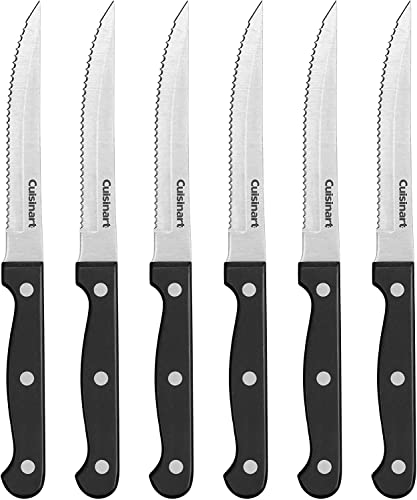
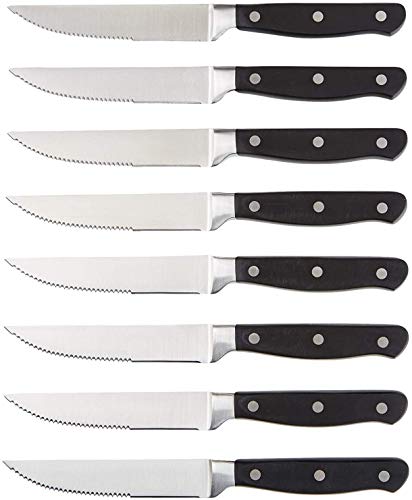

As an Amazon Associate we earn from qualifying purchases at no extra cost to you. Ratings are shown as listed on Amazon.
Best steak knife sets by situation
| Kitchen situation | Best choice | Useful specifications | Why it fits |
|---|---|---|---|
| Regular family dinners | Four-piece serrated set | 4–4.5-inch blade; 80–120 g per knife | Easy cutting, modest storage needs, and little maintenance |
| Frequent steak cooking | Four- or six-piece straight-edge set | 4.5–5-inch blade; X50CrMoV15 or comparable stainless steel | Sharper, cleaner cuts and better long-term resharpening |
| Limited drawer space | Two- or four-piece set with blade covers | Compact handles; individual sheaths included | Safer storage without needing a dedicated block |
| Large household or entertaining | Six- or eight-piece set | 4–5-inch blades; matching handles and storage block | Enough place settings without mixing knife styles |
| Lowest upfront cost | Stamped serrated set | 420 or 3Cr13 stainless steel; 60–90 g per knife | Lightweight and inexpensive, though replacement may come sooner |
Serrated versus straight-edge steak knives
Serrated edges: practical and forgiving
Serrated steak knives use pointed teeth to break through browned crusts and tougher connective tissue. They require less downward pressure than a dull straight blade, which makes them useful for casual dining and for households that do not want another sharpening task.
The trade-off is cutting quality. Coarse serrations can saw through tender meat, leaving a less even surface and creating more crumbs or shredded edges. Once the teeth become damaged, sharpening is difficult because each groove needs an appropriately sized sharpening rod. A serrated knife is often replaced rather than professionally restored.
Look for medium, closely spaced serrations rather than very aggressive saw teeth. A partially serrated blade can be a useful compromise, but many steak knife sets use a fully serrated edge for simpler manufacturing and consistent performance.
Straight edges: cleaner cuts and repairability
A fine straight edge glides through a well-rested steak and is the better option when presentation matters. It also works well for pork chops, roast poultry, vegetables, and other dining tasks. The blade will eventually dull, but it can be maintained with a honing rod between sharpenings and professionally or mechanically sharpened when necessary.
Straight-edge knives reward better technique. Pressing hard on a dull blade, cutting on ceramic plates, or twisting the knife in bone can roll or chip the edge. They are a strong choice for cooks who already maintain kitchen knives, but less convenient for a household seeking a nearly maintenance-free set.
Blade steel: what the label means in daily use
Most useful steak knife sets use stainless steel, but “stainless” does not mean stain-proof or equally durable. Common budget blades may use 420 or 3Cr13 stainless steel. These are generally easy to manufacture and resist corrosion reasonably well, but they tend to lose a fine edge sooner than better cutlery steels.
Mid-range and premium European-style sets frequently use X50CrMoV15 or a similar chromium-molybdenum-vanadium stainless steel. It offers a practical balance of corrosion resistance, toughness, and ease of sharpening. Japanese-style sets may use harder stainless steels, but hardness alone is not a guarantee of a better steak knife: an overly hard, thin edge can be less forgiving if it contacts a plate.
For most homes, prioritize edge geometry, comfortable construction, and sensible care over an impressive steel name. A well-made 3.5-inch blade with a properly finished edge can outperform a harder steel with poor balance or rough serrations.
Handle construction and balance
A steak knife should feel controlled rather than top-heavy. Hold the knife at the bolster or front of the handle and look for a balance point near the transition between blade and handle. A handle that is much heavier than the blade can feel slow; a blade-heavy knife may require unnecessary grip pressure.
- Full-tang construction: The blade steel extends through the handle, usually visible between two scales and secured with rivets. It generally provides a sturdy, substantial feel.
- Partial tang or hidden tang: The steel extends only partway into the handle. This can still be reliable, especially in lighter knives, but construction quality matters more than the label.
- Riveted polymer handles: Durable, hygienic, and usually dishwasher-tolerant when the manufacturer permits it. They are often the most practical option for everyday use.
- Wood handles: Attractive and comfortable, but repeated soaking and dishwasher heat can dry, swell, or crack the wood. Hand washing is the safer default.
- Composite or synthetic handles: These can offer the appearance of wood with better moisture resistance. Check whether the handle has seams that can trap food.
Bolsters and finger guards can make a knife feel secure, but a large bolster also adds weight and can limit how closely you can sharpen a straight edge. For a table knife, comfort over a full meal matters more than maximum mass.
How many steak knives should a set include?
A four-piece set suits a household of two to four people and is usually the best value if steak is an occasional dinner. A six-piece set makes sense for a family of four that regularly hosts one or two guests. Eight-piece sets are useful for entertaining, but they occupy more drawer or block space and may duplicate knives that are rarely used.
One practical calculation helps: if a four-knife set costs $40–$80 and is used twice a month for five years, it provides approximately 120 uses per knife. That is about $0.07–$0.13 per knife-use before considering replacement. A cheaper set is not automatically better value if its handles loosen or its edges become unpleasant to use after a year.
Recognizable sets and the type of buyer they suit
Victorinox
Victorinox is a sensible choice for buyers who value functional design and easy maintenance. Its steak knife offerings commonly emphasize lightweight stainless construction and practical handles rather than decorative presentation. Check the exact set because edge style and dishwasher guidance vary by model.
Wüsthof
Wüsthof is suited to buyers who want a more substantial, traditional European cutlery feel. Its steak knives are available in both serrated and straight-edge styles across different lines. Expect a higher general market price, especially for forged construction and premium handles.
Henckels and Zwilling
Henckels and Zwilling cover a broad range, from affordable stamped stainless sets to more substantial forged designs. Compare the specific product line rather than relying on the brand name alone: handle material, tang design, edge type, and dishwasher instructions can differ considerably.
Mercer Culinary
Mercer Culinary is worth considering for a budget-conscious kitchen that wants a straightforward workhorse. Many of its cutlery products use practical synthetic handles and stainless blades. The finish may be less decorative than premium tableware, but the value can be strong when durability and replacement cost matter most.
Dishwasher care and the parts that wear first
Even when a set is labeled dishwasher-safe, hand washing is usually better for the edge and finish. Dishwasher detergent is abrasive, high heat stresses some handle materials, and contact with other utensils can nick the cutting edge. If you use a dishwasher, place knives separately with the blade protected, avoid heated drying when the manufacturer advises against it, and remove them promptly.
Wash with warm water and mild dish soap, then dry immediately. Do not leave steak knives soaking in a sink, especially knives with wooden handles or exposed seams. Store them in a drawer organizer, knife block, or individual blade covers rather than loose among forks and spoons.
The edge usually wears before the handle fails. On a straight edge, light honing may realign a rolled edge, but it cannot restore metal that has been removed. Sharpen when the knife slips rather than cuts cleanly. Serrated knives should be serviced with a tapered serrated sharpener or by a professional; dragging them through a standard flat sharpener can flatten the teeth.
What to check before buying
- Choose four 4–5-inch blades for ordinary place settings; longer blades can feel awkward at the table.
- Confirm whether “dishwasher-safe” applies to the complete knife, including the handle.
- Look for smooth handle seams and no gaps around rivets or bolsters.
- Prefer a set with consistent balance and weight rather than one unusually heavy display piece.
- For straight edges, confirm that replacement sharpening is practical in your area.
- For serrated edges, choose moderate teeth if you want less tearing and easier everyday use.
For most households, a four-piece medium-serrated stainless set is the easiest recommendation when convenience comes first. Choose a four- or six-piece straight-edge set when clean presentation, versatility, and long-term sharpening matter more than low maintenance. Either way, the best steak knife set is the one whose size matches your table, whose handle suits your grip, and whose care requirements you will actually follow.







Write Your Review
No reviews yet. Be the first to share your experience!