

Best Steamer Insert for Pots
The best steamer insert for pots is a collapsible stainless-steel basket with an adjustable diameter, a 2.5- to 3-inch cooking depth, a heat-resistant lifting handle, and enough capacity for the vegetables or dumplings you usually prepare.
That recommendation suits most kitchens because one insert can fit several saucepans and stockpots while folding nearly flat for storage. However, a fixed-diameter basket can be the better choice if you steam frequently, own one main pot, or want maximum stability. The right decision depends less on the brand name than on fit, usable depth, handling, and how much space you have for storage.
Our top picks
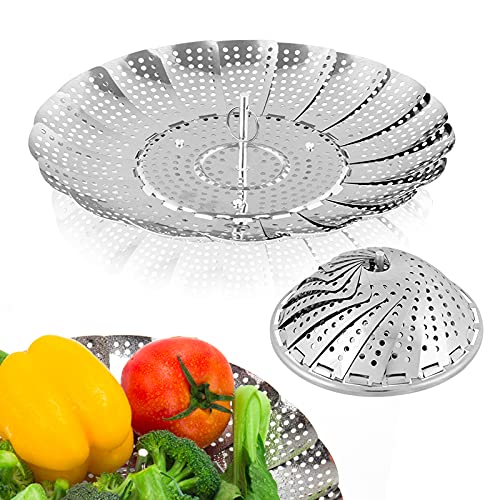 Vegetable Steamer Basket
- 【UPGRADE DESIGN & QUALITY 】- The steamer basket…
- 【SIZE FIT ANY POT】 - This Steamer basket…
- 【REMOVABLE CENTER POST 】- 2.4" Central post helps…
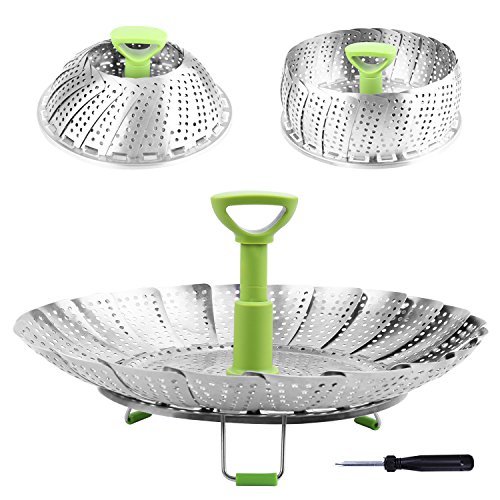 Consevisen Vegetable Steamer Basket for Cooking Food
- Healthier cooking choices: The steamer basket with high…
- Expandable and collapsible: Vegetable steamer basket collapsed diameter…
- Foldable, heat-resistant: 3 foldable legs with silicone will…
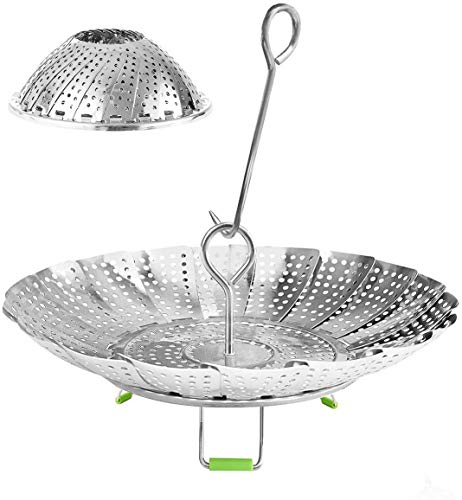 Stainless Steel Steamer Basket
- FOOD GRADE 100% STAINLESS STEEL: Our vegetable steamer…
- This steamer could collapses for compact storage and…
- The steaming rack can used to steaming Veggie,…
| Product | Key specs | |
|---|---|---|
| Vegetable Steamer Basket | 【UPGRADE DESIGN & QUALITY 】- The steamer basket… 【SIZE FIT ANY POT】 - This Steamer basket… 【REMOVABLE CENTER POST 】- 2.4" Central post helps… | Check price |
| Consevisen Vegetable Steamer Basket for Cooking Food | Healthier cooking choices: The steamer basket with high… Expandable and collapsible: Vegetable steamer basket collapsed diameter… Foldable, heat-resistant: 3 foldable legs with silicone will… | Check price |
| Stainless Steel Steamer Basket | FOOD GRADE 100% STAINLESS STEEL: Our vegetable steamer… This steamer could collapses for compact storage and… The steaming rack can used to steaming Veggie,… | Check price |
 ZOCY Steamer Basket ZOCY Steamer Basket | [PREMIUM QUALITY MATERIAL] - The foldable steamer basket… [ADJUSTABLE SIZE] - Opens like a water lily… 【REMOVABLE CENTER POST 】- 2.4" Central post helps… | Check price |
As an Amazon Associate we earn from qualifying purchases at no extra cost to you.
Adjustable Versus Fixed Steamer Inserts
Adjustable inserts use hinged petals, expanding perforated panels, or a flexible ring to fit multiple pot widths. A typical model fits pots from about 7 to 11 inches in internal diameter. This makes it useful in kitchens with mixed cookware, but the moving joints create more places for food residue and can make the basket less rigid when heavily loaded.
Fixed inserts have a set diameter, commonly 8, 9, or 10 inches. They usually sit more securely in a matching pot and offer a simpler, stronger structure. The trade-off is that the insert may be useless if your pot is too narrow, while a wide pot can leave an inefficient gap around the food.
| Feature | Adjustable insert | Fixed insert | Best for |
|---|---|---|---|
| Typical diameter range | 7–11 inches | One size, usually 8–10 inches | Adjustable: mixed cookware; fixed: one frequently used pot |
| Usable food capacity | Approximately 1.5–3 quarts | Approximately 1.5–3.5 quarts | Fixed models often use a broad pot more efficiently |
| Typical basket depth | 2–3 inches | 2.5–4 inches | Deeper fixed baskets suit larger portions |
| Folded or stored height | 2–4 inches, depending on design | 2.5–5 inches | Adjustable models usually suit shallow drawers |
| Common materials | Stainless steel, silicone feet, or silicone-coated handles | Stainless steel, aluminum, or silicone | Stainless steel is the most versatile for regular use |
| Typical market price | About $12–$35 | About $10–$30 | Price depends mainly on material and mechanism |
What to Check Before Buying
1. Measure the pot’s inside diameter
Measure across the inside rim, not the outside handles or lip. An insert should rest on the pot’s sides or on a stable support ring without its perforated base touching the water. For an adjustable model, measure the smallest and largest pots you expect to use.
Allow roughly 1/2 inch of support on each side. For example, a pot with an 8-inch internal diameter should work well with an insert that can sit securely at 7.5 to 8 inches. A 10-inch basket placed in that pot may buckle, catch on the rim, or leave the handles awkwardly positioned.
2. Look at basket depth, not just diameter
A shallow 2-inch basket is convenient for broccoli florets, green beans, and fish fillets. It is less useful for tall vegetables, corn sections, stuffed dumplings, or a large batch of potatoes. A 3- to 4-inch depth gives more capacity, but it also needs a taller lid and more boiling water clearance.
Do not fill the basket to the rim. Steam needs room to circulate, and crowded food cooks unevenly. A practical rule is to keep food below the lid by at least 1 inch and leave small gaps between pieces.
3. Confirm the minimum water level
The basket should sit above the water, with its lowest point at least about 1 inch clear of the water surface. If the insert is too shallow for your pot, the food may boil rather than steam. If the pot is too deep and the basket has a short handle, retrieving it can be uncomfortable and risky.
4. Treat handles as a safety feature
A central lifting handle is useful for removing a hot, full basket, but it must either fold down, detach, or remain low enough for the lid to close. Side handles can make lifting easier, yet they may prevent the insert from fitting inside smaller pots.
Prefer handles made from stainless steel with a heat-resistant grip, silicone, or another clearly heat-rated material. Plastic handles that sit close to the pot rim can soften or discolor over time, especially when exposed to a gas flame.
Best Choice by Kitchen Situation
| Your situation | Recommended insert | Why | What to avoid |
|---|---|---|---|
| Small kitchen or limited drawer space | Collapsible stainless-steel basket, 7–11 inches | Fits several pots and stores at roughly 2–3 inches high | Bulky tiered steamer sets |
| Frequent family cooking | Fixed 9–10-inch basket, at least 3 inches deep | More stable and usually holds larger portions | Small 7-inch baskets that require multiple batches |
| Occasional use and a tight budget | Basic fixed stainless-steel insert matched to your main pot | Fewer moving parts and lower cost | Complex mechanisms that add cost without adding capacity |
| Mixed cookware sizes | Adjustable petal-style insert with stable feet | One tool can cover several saucepans | Models that depend only on loose side handles for support |
| Large dumplings or tall vegetables | Deep fixed basket, 3–4 inches, with a domed or tall lid | Provides usable vertical space | Shallow baskets with flat lids |
| Induction or electric cooktop | Any insert, provided the pot itself is compatible | The insert does not need to be magnetic; the pot does | Assuming a stainless insert makes a nonmagnetic pot induction-ready |
Capacity: A Simple Way to Choose the Size
Capacity claims can be difficult to compare because manufacturers may measure the entire bowl rather than the usable space below the lid. Estimate by cooking portion instead. A 1.5-quart insert generally suits one or two portions of vegetables. A 2.5-quart insert is more practical for two to four portions. A 3- to 3.5-quart basket is better for family sides, although it requires a pot at least 10 inches wide and often 5 to 6 inches tall.
Consider batch cost as well as purchase price. Suppose a $18 small basket holds two portions and you cook four portions twice per week. You would need two batches each time, or roughly 104 extra steaming cycles per year. A $30 basket that holds four portions could recover its $12 price difference quickly through saved time and less repeated heating. This calculation only applies if your pot, lid, and storage space can accommodate the larger basket.
Setup and Cleaning That Extend Its Life
- Check the fit while cold. Place the empty insert in the pot and close the lid before adding water. This reveals handle interference and confirms that the basket remains above the base.
- Add measured water. Start with about 1 to 2 inches, adjusting for cooking time and pot depth. The water must not touch the food, but the pot should not boil dry.
- Load loosely. Arrange larger pieces around the outside and keep the center from becoming a dense pile. Cut food into similarly sized pieces for more even cooking.
- Use a lid that seals reasonably well. A loose lid lets steam escape and extends cooking time. Do not force a lid against a tall central handle.
- Cool before washing. Remove the insert with tongs or its lifting handle, then rinse food residue before it dries inside hinges and perforations.
- Dry every joint. Water trapped in folding mechanisms can leave mineral deposits and, on lower-quality metal, encourage corrosion.
Most stainless-steel inserts are dishwasher-safe when the manufacturer permits it, but repeated high-heat cycles can dull the surface and age silicone parts faster. Hand-washing is worthwhile for folding models with narrow hinges. Avoid abrasive steel wool, which can scratch the surface and create places for residue to collect.
Durability Problems to Watch For
The first parts to wear are usually silicone feet, central handles, and folding hinges rather than the perforated metal itself. Feet can loosen if the basket is dragged across a pot, while silicone grips may split after repeated contact with a hot rim. Check that replacement parts are available before paying extra for a complicated design.
Rust-colored spots on stainless steel are often surface contamination from harsh cleaners or contact with ordinary steel wool, but deep pitting, sharp edges, or a loose weld are reasons to replace the insert. Do not use a basket if its feet have fallen off and it can rest directly on a nonstick pot, since exposed metal may scratch the coating.
Final Recommendation
Choose an adjustable stainless-steel insert if flexibility and folding storage matter most. Choose a fixed 9- or 10-inch basket if you steam several times a week and already have a compatible pot. Whichever style you select, prioritize a secure fit, at least 2.5 inches of usable depth, a handle that works with the lid, and feet that keep food safely above the water. Those details matter more in daily use than decorative finishes or an extra set of perforations.








Write Your Review
No reviews yet. Be the first to share your experience!