

Best Pasta Pot With Strainer Insert: Which Design Is Right for Your Kitchen?
The best pasta pot with strainer insert for most home cooks is a 6- to 8-quart stainless-steel pot with a removable perforated insert, a secure lid, and a thick, induction-compatible base. That size handles a standard 1-pound box of pasta without crowding, while the insert lets you lift noodles out without pouring several quarts of boiling water into a sink.
However, the ideal pot changes with your cooking habits. A compact 4-quart model is easier to store and suits one or two portions; an 8- to 12-quart pot is more useful for frequent batch cooking, long pasta, corn, blanching, and entertaining. The most important differences are not marketing features but how the insert drains, whether the lid stays attached during lifting, and how much room the pot occupies between uses.
Our top picks
 Tramontina Signature Stainless Steel Pasta Strainer Insert
- Custom-Fit for 8-Quart Stock Pots: Specifically engineered to…
- Premium 18/10 Stainless Steel: Crafted from high-quality, food-grade…
- Efficient Drainage & Even Cooking: The precision-perforated basket…
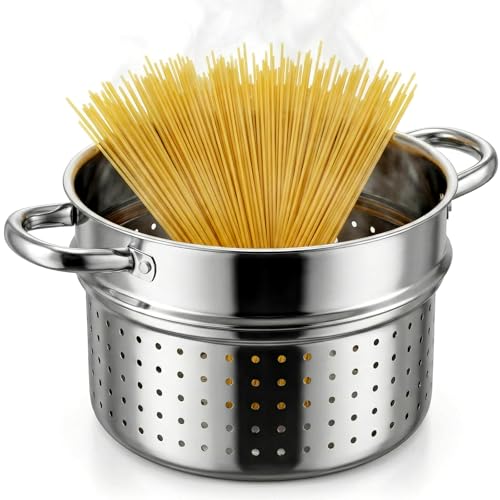 Mifoci 6 Qt Stainless Steel Pasta Strainer
- Sized for Your Cooking Needs: about 10 inches…
- Durability Meets Versatility: crafted from 304 stainless steel,…
- Versatile Use: this stainless steel pasta strainer insert…
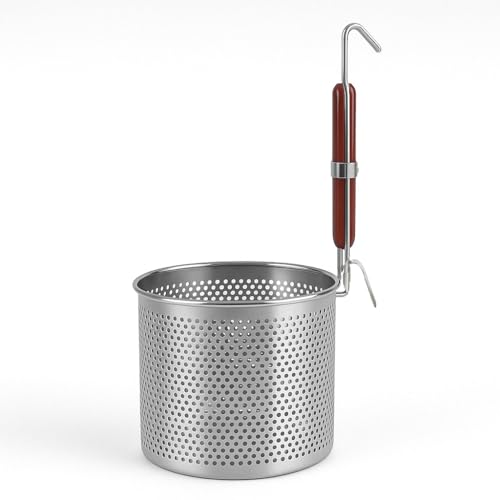 Mesh Pasta Basket Food Strainer Insert For
- Made from stainless steel mesh with sturdy plate…
- Included 1 pack stainless steel mesh pasta basket
- Tiny, closely spaced holes mean your food drains…
| Product | Key specs | |
|---|---|---|
| Tramontina Signature Stainless Steel Pasta Strainer Insert | Custom-Fit for 8-Quart Stock Pots: Specifically engineered to… Premium 18/10 Stainless Steel: Crafted from high-quality, food-grade… Efficient Drainage & Even Cooking: The precision-perforated basket… | Check price |
| Mifoci 6 Qt Stainless Steel Pasta Strainer | Sized for Your Cooking Needs: about 10 inches… Durability Meets Versatility: crafted from 304 stainless steel,… Versatile Use: this stainless steel pasta strainer insert… | Check price |
| Mesh Pasta Basket Food Strainer Insert For | Made from stainless steel mesh with sturdy plate… Included 1 pack stainless steel mesh pasta basket Tiny, closely spaced holes mean your food drains… | Check price |
 Made In Cookware Made In Cookware | Total Diameter: 10.75” | Cooking Surface Diameter: 7.75”… Versatile Cooking Convenience - The Made In Stainless… Mess-Free Draining - Enjoy easy and clean draining,… | Check price |
As an Amazon Associate we earn from qualifying purchases at no extra cost to you.
Quick comparison of the main pasta-pot designs
| Pot configuration | Typical capacity | Insert design | Best for | Main compromise |
|---|---|---|---|---|
| Compact saucepan with basket | 3.5–5 quarts | Deep perforated basket with side handles | One or two people, small kitchens | Limited room for long pasta and large batches |
| Standard stockpot with pasta insert | 6–8 quarts | Full-height removable insert, often with two lift handles | Most families and regular pasta dinners | Requires tall cabinet or shelf storage |
| Large stockpot with strainer | 10–12 quarts | Deep basket or perforated colander insert | Batch cooking, entertaining, blanching | Heavy when filled and slower to heat |
| Two-piece pot and colander system | 6–8 quarts | Separate colander that may sit inside or over the pot | People who want flexible draining and serving | More pieces to wash and store |
| Nonstick pasta pot | 4–8 quarts | Coated perforated insert or basket | Gentle cooking and easy release | Coating requires careful utensils and cleaning |
Best choices by cooking situation
Best all-around choice: 6- to 8-quart stainless steel
Choose a standard stainless-steel stockpot with a removable insert if you cook pasta weekly and want one dependable tool. A 6-quart pot is easier to handle, while an 8-quart version gives spaghetti, linguine, and lasagna sheets more room to move. Look for a three-layer or impact-bonded base rather than an extremely thin single layer, which can create hot spots and scorch sauce if you reuse the pot for simmering.
Brands such as Cuisinart, All-Clad, and Tramontina sell stainless-steel cookware lines that include stockpots or pasta-pot configurations. Exact capacities, insert arrangements, and lid designs vary by model, so check the manufacturer’s dimensions rather than assuming every pot in a range has the same construction.
Best for a small kitchen: 4- to 5-quart compact pot
A compact pot is the practical choice when cabinet space matters more than maximum capacity. It can cook roughly 8 to 12 ounces of dry pasta comfortably, depending on the shape and water level. The insert may also work as a steaming basket or blanching basket, making the pot more useful than a dedicated large pasta cooker.
Check the insert’s folded or nesting dimensions. Some baskets have long fixed handles that prevent the pot from fitting neatly inside a cabinet. A model with two short side handles is often easier to store, although it may be less comfortable to lift when hot.
Best for frequent batch cooking: 8- to 12-quart pot
Choose a large pot if you regularly cook a pound or more of pasta, prepare meals for a crowd, or use the insert for vegetables and seafood. Extra water helps maintain a boil after pasta is added, but the filled pot can become very heavy. Eight quarts of water weighs about 16.7 pounds before adding the pot, insert, and food.
For that reason, a large model should have wide, firmly attached side handles rather than one narrow helper handle. It should also have an insert with a positive grip: broad handles that stay cool enough to grasp with dry, heat-resistant mitts and do not wobble when lifted.
Features that separate a useful insert from an awkward one
Drainage control
Perforations should be numerous enough to drain quickly but not so large that small pasta shapes fall through. A useful general range is approximately 2–4 millimeters for most all-purpose baskets. Holes concentrated only at the bottom can leave water trapped around the pasta; perforations extending up the sides drain more effectively as the insert rises.
A basket that lifts completely out of the pot gives the greatest control. A built-in side-drain spout is convenient for pouring, but it does not provide the same separation between pasta and water and may still require handling a heavy, steaming vessel. If you save pasta water for sauces, a removable insert is especially convenient: scoop out a measured amount before lifting the basket.
Lid fit and lifting safety
The lid should sit on the outer pot rim, not on a loose inner basket. A lid that fits only when the insert is in a particular position can be frustrating, especially when the basket handles project above the rim. Tempered glass makes it easy to monitor boiling, while stainless steel is more resistant to breakage and often stores more easily.
Do not assume a lid is designed to lock onto the insert. Unless the manufacturer specifically describes a locking or drain-through lid, hold the insert with both hands and use oven mitts. Steam escaping around the lid can burn hands and forearms even when the pot itself feels manageable.
Materials and stovetop compatibility
- Stainless steel: Durable, nonreactive, and usually dishwasher-friendly. It is the safest default for frequent use.
- Aluminum: Lightweight and quick to heat, but uncoated aluminum can discolor or react with acidic ingredients.
- Hard-anodized aluminum: More resistant to scratching than ordinary aluminum, though compatibility with induction depends on the base.
- Nonstick coating: Convenient for cleaning, but avoid metal utensils, abrasive pads, and overheating an empty pot.
- Enamel-coated steel: Attractive and corrosion-resistant, but chipped enamel can expose the underlying metal and requires careful handling.
For induction cooking, the pot needs a magnetic base across the cooking area. A stainless-steel appearance alone does not prove induction compatibility. Gas and electric coil users have more flexibility, but a flat, stable base still matters. On a smooth glass cooktop, avoid dragging a heavy pot or a rough-bottomed insert across the surface.
A practical decision matrix
| Your situation | Recommended specification | Why it fits |
|---|---|---|
| Budget-conscious occasional cook | 4–6 quarts, stainless steel or aluminum, two side handles | Lower cost and easier storage; no need to pay for oversized capacity |
| Beginner cooking pasta weekly | 6–8 quarts, full-height basket, fitted lid | Simple lifting and fewer pouring accidents |
| Small kitchen or limited cabinet space | 4–5 quarts, nesting insert, removable lid knob if applicable | Reduces the pot’s stored height and footprint |
| Large household or meal prep | 8–12 quarts, heavy base, wide handles, sturdy insert | Better batch capacity and more stable lifting |
| Induction cooktop owner | Magnetic stainless-steel base, flat bottom, compatible lid | Ensures the pot heats rather than merely sitting on the burner |
| Frequent dishwasher user | Uncoated stainless steel, simple basket, dishwasher-safe parts | Fewer delicate components and less coating maintenance |
Storage, cleaning, and durability realities
The part most likely to become inconvenient is usually the insert handle, not the pot body. Handles can loosen, plastic grips can discolor, and thin wire baskets can bend if they are forced into the pot. Before buying, measure the insert and pot together, then measure your cabinet opening. A nominal 8-quart capacity does not reveal whether the assembled cookware is 10 inches or 14 inches tall.
After cooking, lift the insert and let it drain over the pot for several seconds. Rinse starch from the perforations before it dries. If the basket is dishwasher-safe, place it where spray reaches both sides; otherwise, use a narrow nylon brush around the holes. Do not use steel wool on stainless steel with a polished finish, and do not use abrasive cleaners on nonstick surfaces.
For a 1-pound package of pasta, an 8-quart pot gives room for approximately 6–8 quarts of water, but never fill to the rim. Leave headspace for bubbling and displacement when the insert is lowered. As a rough handling calculation, 6 quarts of water weighs about 12.5 pounds; adding a 2-pound pot and 1 pound of pasta produces nearly 16 pounds before accounting for the insert. If that load feels excessive, choose a smaller pot and cook in batches rather than buying the largest available model.
Final buying recommendation
For most kitchens, choose a 6- or 8-quart stainless-steel pasta pot with a removable, full-height perforated insert, wide side handles, a lid that fits the outer rim, and a flat base rated for your stovetop. Move down to 4–5 quarts when storage and lighter handling are priorities. Move up to 10–12 quarts only when batch cooking justifies the extra weight and cabinet space. The best design is the one whose filled insert you can lift securely and whose parts you will still be willing to clean and store after every pasta dinner.








Write Your Review
No reviews yet. Be the first to share your experience!