

Best Tempura Pot for Deep Frying
The best tempura pot for deep frying is a 2.5- to 3-quart enameled or stainless-steel pot with a wide opening, a stable base, a removable thermometer, and a lid or splatter guard that protects your hands without trapping steam.
Tempura needs more than a pot that can hold hot oil. The vessel should recover heat quickly when cold batter enters, reduce splashing, leave enough headroom for bubbling, and pour or drain cleanly after cooking. The right choice depends on whether you make tempura weekly, fry only occasionally, or need a compact pot for a small kitchen.
Our top picks
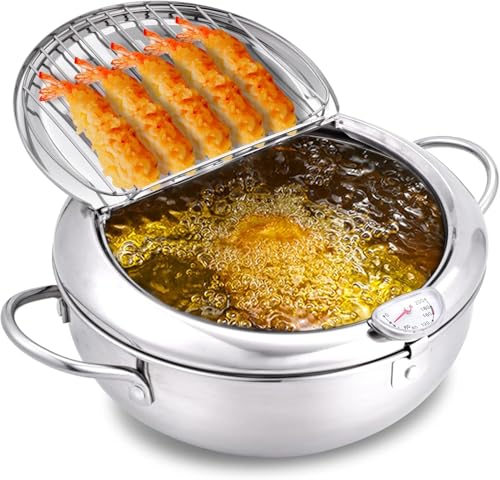 cuomaop Deep Fryer Pot
- Small deep fryer pot is crafted from durable…
- Japanese deep fryer pot compatible with gas, electric,…
- cuomaop Japanese deep fryer with temperature gauge can…
 KOMONG Tempura Deep Frying Pot 3.4L
- PREMIUM QUALITY
- SIZE
- OIL TEMPERATURE CONTROL
 Saltlas Deep Fryer Pot
- PREMIUM QUALITY
- SPACIOUS SIZE for LARGE FAMILIES
- OIL TEMPERATURE CONTROL
| Product | Key specs | |
|---|---|---|
| cuomaop Deep Fryer Pot | Small deep fryer pot is crafted from durable… Japanese deep fryer pot compatible with gas, electric,… cuomaop Japanese deep fryer with temperature gauge can… | Check price |
| KOMONG Tempura Deep Frying Pot 3.4L | PREMIUM QUALITY SIZE OIL TEMPERATURE CONTROL | Check price |
| Saltlas Deep Fryer Pot | PREMIUM QUALITY SPACIOUS SIZE for LARGE FAMILIES OIL TEMPERATURE CONTROL | Check price |
 Deep Fryer Pot Deep Fryer Pot | 【304 STAINLESS STEEL CONSTRUCTION】Made from durable 304 stainless… 【BUILT-IN THERMOMETER FOR OIL TEMPERATURE】The integrated thermometer lets… 【REMOVABLE OIL DRAIN RACK】After frying, place cooked food… | Check price |
As an Amazon Associate we earn from qualifying purchases at no extra cost to you.
Quick comparison: which tempura pot suits you?
| Pot type | Typical oil capacity | Temperature stability | Splash protection | Thermometer compatibility | Cleanup and best use |
|---|---|---|---|---|---|
| Compact Japanese-style tempura pot | 1.5–2.5 qt | Good for small batches; moderate recovery | Usually high, with a fitted lid or guard | Often includes a clip-on thermometer; check rim clearance | Easy to store and clean; best for 1–2 people |
| Medium enameled steel pot | 2.5–4 qt | Very good when the base is at least 2 mm thick | Good with a separate mesh screen | Excellent; works with probe or clip-on models | Nonporous and easy to wipe; best all-round option |
| Stainless-steel saucepan or fry pot | 3–5 qt | Good to excellent, especially with an aluminum core | Depends on the lid or screen | Excellent, but avoid sealing the lid during frying | Durable and dishwasher-friendly in some cases; versatile |
| Cast-iron Dutch oven | 3–6 qt | Excellent heat retention, slower adjustment | Requires a separate splatter screen | Good, although thick walls can obstruct some clips | Heavy and slower to wash; best for frequent frying |
What to look for in the best tempura pot for deep frying
1. Choose useful oil capacity, not the largest pot
A larger oil volume is usually more stable, but overfilling creates a serious safety problem. A practical target is a pot that holds two to three times the oil you expect to use, leaving at least 5 cm of empty space above the oil. This headroom allows the oil to foam when batter and wet ingredients enter.
For two people, 1.5 to 2 quarts of oil in a 2.5- to 3-quart pot is usually enough for a controlled batch. For four people, a 3- to 4-quart pot with approximately 2 to 3 quarts of oil provides better recovery without requiring a commercial fryer. Avoid a very shallow pan unless it has exceptionally high sides; hot oil can splash over the rim when you lower food.
2. Prioritize temperature stability
Tempura is generally fried around 170–180°C (340–355°F), depending on the ingredient and batter. When several cold pieces go into the pot, the oil temperature falls. A thin, lightweight vessel may heat quickly but lose heat just as quickly, producing pale, greasy batter while the burner catches up.
For home use, look for a thick base or a multi-layer stainless-steel construction. Enameled steel is a good compromise: it heats more responsively than heavy cast iron but is less vulnerable to uneven temperature swings than very thin metal. Cast iron provides excellent stability for repeated batches, though it takes longer to preheat and can continue heating the oil after you lower the burner.
Do not judge performance by maximum heat alone. A pot that allows precise low and medium heat control is more useful than one that simply becomes extremely hot.
3. Treat splash protection as a design feature
The safest setup combines high sides with a removable mesh splatter screen. A screen blocks droplets while allowing steam to escape. A solid lid is useful after the burner is off, but it should not be placed tightly over actively frying food because trapped steam can condense and drip back into the oil.
Some purpose-built tempura pots have a perforated lid or a built-in draining rack. These features are convenient, but check that the rack sits above the oil rather than directly in it. A draining rack should allow excess oil to run back into the pot without forcing you to hold food over the burner.
Long, heat-resistant handles are preferable to short loop handles. They keep your hand farther from the oil, but the handle should remain over the counter rather than projecting into a walkway where it can be knocked.
4. Check thermometer compatibility before buying
Temperature control is one of the biggest differences between good and frustrating tempura. A clip-on thermometer should reach the oil without touching the base or side of the pot. If the probe touches metal, it may read the vessel’s temperature rather than the oil accurately.
Measure the pot’s depth and compare it with the thermometer’s minimum immersion line. A narrow pot may not accommodate a large digital probe alongside a draining basket. A wide rim is helpful because it gives a clip-on thermometer and a pair of tongs more working room.
A thermometer rated for at least 200°C (392°F) is sufficient for normal deep frying. Digital models are fast to read, while analog clip-on thermometers are simple and do not need batteries. Whichever type you choose, calibrate or check it periodically in boiling water; the boiling point varies with altitude, but a substantial reading error is still easy to spot.
Best choices by cooking situation
| Your situation | Best pot style | Recommended specification | Why it fits |
|---|---|---|---|
| Budget-conscious occasional cook | Small enameled steel pot | 2.5–3 qt capacity; 16–20 cm diameter; removable screen | Low cost, compact storage, and simple cleanup |
| Beginner learning temperature control | Medium pot with thermometer clip | 3–4 qt capacity; tall sides; 170–180°C range clearly marked | More headroom and easier monitoring |
| Small kitchen or induction cooktop | Flat-bottom stainless or enameled pot | 18–22 cm base; induction-compatible; under 2.5 kg empty | Stable on the hob and manageable to store |
| Frequent frying for a family | Heavy stainless or cast-iron pot | 4–6 qt capacity; thick base; sturdy side handles | Better heat recovery across several batches |
Worked sizing example: how much oil do you really need?
Suppose you are frying 500 g of vegetables for three people. A practical batch may contain 6 to 8 pieces, with each batch taking roughly 3 to 5 minutes. If you use 2.5 qt, or about 2.4 litres, of oil in a 3-quart pot, adding approximately 150 g of chilled food may cause a noticeable temperature drop but still leave enough thermal mass for recovery.
By contrast, putting the same amount of food into only 1 litre of oil creates a larger temperature shock. The oil may fall well below the target range, encouraging the batter to absorb oil before it sets. The larger amount is not automatically better: use the smallest volume that reaches the thermometer’s safe immersion depth while maintaining generous headroom.
For a 3-quart pot, a useful starting point is 2 quarts of oil, then adjusting downward only if the thermometer still sits correctly and the food remains well covered. Never fill based solely on the pot’s stated capacity.
Cleanup, oil reuse, and durability
Enameled interiors are convenient because they are nonporous and do not require seasoning. Let the oil cool completely, strain it through a fine filter, and store it in a sealed, light-resistant container if it remains clean and has not overheated. Discard oil that smells burnt, smokes at normal frying temperatures, or becomes unusually thick and dark.
Stainless steel tolerates scrubbing better than enamel, but burnt batter may still require soaking. Avoid abrasive tools on enamel because chips can expose the underlying metal. Cast iron needs more care: remove the oil, wipe the interior, wash it promptly, dry it thoroughly, and apply a very thin layer of cooking oil to help prevent rust.
The parts most likely to wear are thermometer clips, silicone grips, removable racks, and enamel around the rim. A loose thermometer clip is not merely inconvenient; it can allow the probe to fall into hot oil. Choose a model with replaceable or standard-size accessories where possible, and inspect the handle fasteners before every use.
Safe setup for frying tempura
- Place the pot on a level burner with the handle turned away from the edge.
- Keep the cooking area dry. Water on wet food or utensils can cause oil to spit.
- Attach the thermometer before heating and keep the probe away from the metal base.
- Heat gradually to about 170–180°C (340–355°F), then adjust the burner as food is added.
- Lower food gently with long chopsticks or tongs, moving it away from your body.
- Fry in small batches so pieces do not touch and the oil temperature can recover.
- Never leave hot oil unattended, and never move the pot while the oil is hot.
- If oil catches fire, turn off the heat if safe and cover the pot with a metal lid; never use water.
Final verdict
For most home cooks, the best tempura pot for deep frying is a 3-quart enameled steel or multi-layer stainless-steel pot with tall sides, a thick flat base, a removable mesh screen, and enough rim space for a clip-on thermometer. Choose a compact 2.5-quart model for occasional cooking and limited storage, or move to a 4- to 6-quart heavy pot if you regularly fry several batches. Capacity, headroom, temperature measurement, and safe handling matter more than decorative accessories or the highest advertised heat setting.








Write Your Review
No reviews yet. Be the first to share your experience!