

The best wall mount pot racks for small kitchens are compact, load-rated racks with adjustable hooks and enough wall clearance to keep cookware accessible without blocking cabinets, worktops, or walkways.
Our top picks
 KES 30-Inch Kitchen Pot Rack
- Sturdy Grid Shelf with 12 Movable Hooks: Our…
- 16" Stud Mounting - Easy to Install: We've…
- Creates & Organizes Kitchen Space: KES pan organizer…
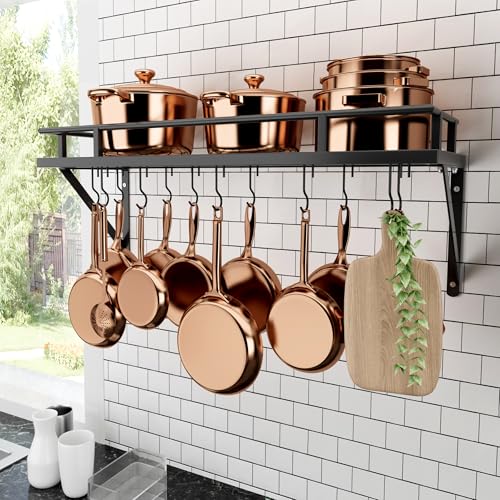 KES 30-Inch Kitchen Pan Pot Rack Wall
- All the kitchen cookwares such as pans, pots…
- 16-INCH WALL STUD for A MORE STURDY CONSTRUCTION:…
- Large grid shelf measuring 29.5" by 9.8" can…
 YATINEY Wall Mounted Pot Rack
- Heavy-Duty Iron Construction: Built with robust iron, this…
- Ample Storage with 12 Hooks: With 2 bars…
- Space-Saving Wall Design: This hanging pot rack is…
| Product | Key specs | |
|---|---|---|
| KES 30-Inch Kitchen Pot Rack | Sturdy Grid Shelf with 12 Movable Hooks: Our… 16" Stud Mounting - Easy to Install: We've… Creates & Organizes Kitchen Space: KES pan organizer… | Check price |
| KES 30-Inch Kitchen Pan Pot Rack Wall | All the kitchen cookwares such as pans, pots… 16-INCH WALL STUD for A MORE STURDY CONSTRUCTION:… Large grid shelf measuring 29.5" by 9.8" can… | Check price |
| YATINEY Wall Mounted Pot Rack | Heavy-Duty Iron Construction: Built with robust iron, this… Ample Storage with 12 Hooks: With 2 bars… Space-Saving Wall Design: This hanging pot rack is… | Check price |
 VyGrow 28 Inch Pot Rack Wall Mounted | 【Strong and Sturdy】Made of high quality steel, the… 【2 Tier Large Capacity】Different from traditional design, we… 【20 Hooks & 6 Lid Holders】Thanks to 20… | Check price |
As an Amazon Associate we earn from qualifying purchases at no extra cost to you.
Quick picks by kitchen situation
| Kitchen situation | Best rack format | Recommended length | Minimum useful capacity | Why it works |
|---|---|---|---|---|
| Narrow wall between cabinets | Single rail with sliding hooks | 16–24 inches | 15–25 lb | Uses vertical space without competing with cabinet doors |
| Short wall above a counter | Low-profile rail or shallow shelf rack | 24–30 inches | 25–35 lb | Provides storage while keeping the backsplash usable |
| High ceiling and several heavy pans | Steel rack with a top shelf | 30–36 inches | 40–60 lb | Stores pans below and lids, spices, or utensils above |
| Rented home or uncertain wall construction | Light rail with appropriate anchors | 16–24 inches | 10–20 lb | Limits wall stress and is easier to remove cleanly |
What to look for in the best wall mount pot racks
1. Rack length and usable wall width
Measure the clear wall area, not the entire wall. Leave at least 2 inches on each side of a rack, and check that cabinet doors can open fully beneath or beside it. A 24-inch rack typically needs about 28 inches of unobstructed width once side clearance is included.
For most small kitchens, a 16- to 24-inch rail is easier to live with than a long decorative rack. It can hold three or four frequently used pans without creating a crowded row. A 30- to 36-inch rack makes sense only when the wall is wide enough and you regularly use at least five pieces of cookware.
Do not count the rack’s end brackets as storage space. On many rails, the first hook must sit 2 to 3 inches inward, so a nominal 24-inch rack may offer only about 18 to 20 inches of practical hanging space.
2. Weight capacity and the wall behind it
A rack’s advertised capacity is useful only when it is mounted into suitable material with the correct hardware. Cast-iron skillets can weigh 5 to 12 pounds each, while stainless-steel saucepans commonly weigh 2 to 5 pounds before adding food.
For everyday use, choose a rack rated for at least twice your expected load. If four pans total 20 pounds, a rack rated for 40 pounds gives a sensible margin for pulling cookware off at an angle and for uneven weight distribution.
Brick, concrete, and wooden studs provide the most dependable fixing points. Drywall alone usually requires substantial toggle anchors and still may not support the same load as a stud-mounted screw. If a rack has two brackets, distribute the fixings across both rather than relying on one central anchor.
3. Mounting hardware
Mounting hardware is often the deciding difference between a secure rack and one that gradually pulls away from the wall. Look for brackets with multiple screw holes, screws suitable for the wall type, and a clear indication of the maximum load when fixed into a stud or masonry.
- Wood stud: use screws long enough to penetrate the stud by roughly 1½ inches after passing through the bracket and any plaster or drywall.
- Masonry: use the manufacturer-matched wall plugs and masonry screws; drill diameter and depth matter.
- Drywall: use heavy-duty toggle-style anchors where a stud is unavailable, and reduce the working load.
- Tile backsplash: avoid drilling through grout when possible. Use a suitable tile bit, switch to masonry drilling after passing through the tile, and do not use hammer action on the tile surface.
Racks from established cookware-storage brands such as Enclume, Old Dutch International, and Spectrum Diversified are available in multiple wall-mounted formats, but hardware and load ratings vary by model. Check the individual installation sheet rather than assuming every rack from a brand has the same capacity.
4. Hook flexibility
Fixed hooks look tidy but can make a small rack frustrating when pan handles collide. Sliding or removable S-hooks are more useful because you can group cookware by size and move the heaviest items closer to the brackets.
For a narrow rack, six hooks may be more useful than ten. Allow approximately 4 to 6 inches per hanging item, depending on handle width. A 24-inch rail with six tightly spaced hooks can hold small saucepans, but four larger pans will be easier to remove without disturbing their neighbors.
Look for hooks with a closed or deep-curved profile. Shallow hooks can jump off the rail when a pan is lifted. Rubber or silicone sleeves reduce metal-on-metal noise, although they may wear first and can trap grease if they are not removable for cleaning.
5. Clearance from the wall
Measure from the wall to the furthest point of the hanging cookware, not merely to the front of the rail. A rail that projects 3 inches may hold a pan whose handle extends 7 inches into the room.
Above a counter, aim for at least 18 inches between the worktop and the lowest pan. Above a cooking surface, follow the clearance guidance for the cooktop, hood, and local building requirements; grease, steam, and heat make that location harder to clean and can affect handles. Beside a walkway, keep cookware from protruding into shoulder or head height.
| Rack style | Typical projection | Typical load range | Best for | Main drawback |
|---|---|---|---|---|
| Single metal rail | 2–4 inches | 15–40 lb | Small walls and everyday pans | Little or no room for lids |
| Rail with shallow shelf | 5–8 inches | 25–50 lb | Pans plus lids or small cookware | Needs more vertical and forward clearance |
| Decorative grid rack | 4–8 inches | 30–60 lb | Several pans and utensils | Can look crowded in a very small kitchen |
| Wood-backed rail | 3–5 inches | 15–35 lb | Warm, furniture-like kitchens | Wood needs protection from steam and grease |
Best wall mount pot rack formats compared
Best overall: a 24-inch sliding-hook rail
This is the most adaptable choice for a small kitchen. A 24-inch steel rail with four to six movable hooks can hold a skillet, saucepan, sauté pan, and a small pot while leaving enough space to handle each item. Choose a matte or satin finish if fingerprints and water spots bother you.
It is also the easiest format to mount between cabinets. The limitation is capacity: bulky Dutch ovens and wide lids quickly consume the available space.
Best for maximum storage: a 30- to 36-inch shelf rack
A shelf rack adds a second storage level for lids, colanders, or small containers. It is a better choice than a longer single rail when wall height is available but floor and cabinet space are limited.
Use the shelf for lightweight items rather than stacking heavy cast iron above head height. A shelf also needs more frequent dust and grease cleaning, especially if installed near the range.
Best for a tight budget: a basic fixed rail
Simple rails often cost about $20–$50, while heavier shelf racks and premium forged or hammered-steel designs commonly range from about $60–$180 or more. A budget rail can be excellent when its brackets are rigid and its stated capacity matches your cookware.
Spend less on decoration, not on anchors. Replacing inadequate wall plugs is usually more important than upgrading from a painted finish to a premium metal finish.
How to size and install the rack
- Inventory the cookware. Weigh or estimate the pans you intend to hang, then add at least 100% capacity margin.
- Mark the usable wall zone. Account for cabinet doors, switches, trim, the backsplash, and the furthest projection of each pan handle.
- Find studs or identify masonry. Use a stud finder, pilot hole, or the building plans. Do not guess when hanging cast iron.
- Position the brackets. Keep the rack level and place the strongest fixing points over studs where possible.
- Install the specified anchors. Do not substitute lightweight picture hooks or generic plastic plugs for a loaded cookware rack.
- Load gradually. Start with one pan, check for movement, then add the remaining cookware while keeping heavy pieces near the brackets.
Ownership, cleaning, and common mistakes
The parts that wear first are usually rubber hook sleeves, plastic end caps, soft mounting washers, and the wall surface around an over-tightened bracket. Wipe painted or stainless steel racks with warm water and mild dish soap, then dry them fully. Avoid abrasive pads on coated finishes.
Do not hang wet cast iron or place greasy lids on an open shelf. Moisture and cooking residue can stain walls and accelerate rust on uncoated steel. Inspect the screws every few months, especially if the rack is mounted to drywall. A slight gap between the bracket and wall, creaking, or a rail that tilts under load indicates that the rack should be unloaded and remounted.
For most compact kitchens, the safest recommendation is a 20- to 24-inch rail with four or five deep, movable hooks, a 30- to 40-pound rating when correctly mounted, and at least 18 inches of counter clearance. Choose a shelf rack only when you need the extra storage and can accommodate its greater projection.





Write Your Review
No reviews yet. Be the first to share your experience!