

The best wok ring for round bottom woks is a heavy-gauge steel ring about 8 to 10 inches in outside diameter, 1.5 to 2.5 inches high, with a textured or raised base that grips your stovetop without blocking the flame.
For most home cooks, the best all-round choice is a 9-inch carbon-steel or stainless-steel ring with a broad, stable base and several ventilation gaps. Choose a smaller 7- to 8-inch ring for a compact burner or a 10- to 12-inch ring only when your wok and cooktop can support its width safely.
Our top picks
 JOYCE CHEN Wok Ring for Pairing with
- Cradles classic round bottom works over traditional gas…
- Focuses flame’s heat to increase temperature for a…
- Dimensions: 14 inches round
 Cast Iron Wok Ring Support for Samsung
- Durable Cast Iron Construction: Made from high-grade cast…
- Universal Wok Compatibility: Designed to cradle round-bottom woks,…
- Samsung Gas Range Compatibility: Fits samsung gas range…
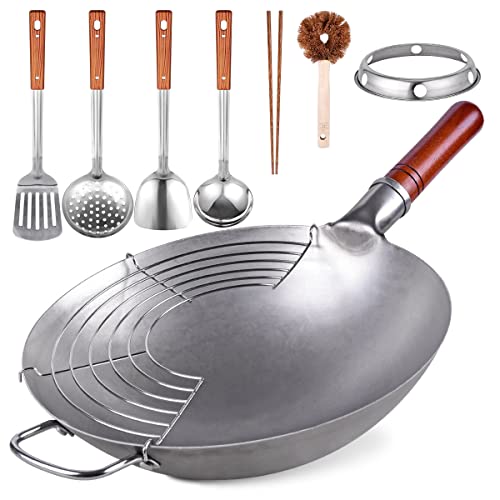 Teewe 13.4" Carbon Steel Wok Traditional Hand
- 15 gauge Carbon steel wok made of premium…
- You can get round bottom wok pan, wooden…
- PERFECT SIZE & MULTIFUNCTIONAL (COMMERCIAL GRADE): Our 13.4"…
| Product | Key specs | |
|---|---|---|
| JOYCE CHEN Wok Ring for Pairing with | Cradles classic round bottom works over traditional gas… Focuses flame’s heat to increase temperature for a… Dimensions: 14 inches round | Check price |
| Cast Iron Wok Ring Support for Samsung | Durable Cast Iron Construction: Made from high-grade cast… Universal Wok Compatibility: Designed to cradle round-bottom woks,… Samsung Gas Range Compatibility: Fits samsung gas range… | Check price |
| Teewe 13.4" Carbon Steel Wok Traditional Hand | 15 gauge Carbon steel wok made of premium… You can get round bottom wok pan, wooden… PERFECT SIZE & MULTIFUNCTIONAL (COMMERCIAL GRADE): Our 13.4"… | Check price |
 Pizarra Universal Wok Support Rack Stand Pizarra Universal Wok Support Rack Stand | Wok ring has a construction with an top… [USED FOR]: Wok Rack can be use to… [INNOVATIVE DESIGN]:This wok ring with is design and… | Check price |
As an Amazon Associate we earn from qualifying purchases at no extra cost to you.
Top picks by cooking situation
| Best for | Recommended ring specification | Why it works | Typical market range |
|---|---|---|---|
| Most kitchens | 9-inch outside diameter, 2-inch height, 1.2- to 1.8-mm steel | Balances stability, burner access, and compatibility with 12- to 14-inch woks | $15-$30 |
| Small gas burner | 7- to 8-inch diameter, 1.5- to 2-inch height, open-wire construction | Keeps the wok centered while allowing heat to reach the base | $10-$22 |
| Frequent high-heat cooking | 9- to 10-inch diameter, 1.5- to 2.5-mm carbon steel or stainless steel | Resists distortion and remains steady during tossing | $25-$50 |
| Smooth glass or ceramic cooktop | Wide flat base with silicone or heat-resistant non-slip feet | Reduces sliding and distributes pressure more gently than thin wire legs | $20-$45 |
| Occasional or budget use | 8- to 9-inch single-piece steel ring, approximately 1 mm thick | Affordable and easy to store, provided it fits tightly | $8-$18 |
What separates the best wok ring for round bottom woks
Ring diameter
Diameter is the first measurement to check, but it is not the diameter of the wok. Measure the ring’s outside diameter and the opening diameter separately. The wok should sit in the opening with roughly one-quarter to one-third of its lower curve supported by the ring. If the opening is too wide, the wok can drop through or rock. If it is too narrow, the ring contacts the wok too high on the sides and becomes easier to tip.
For a typical 12- to 14-inch round-bottom wok, an opening around 6.5 to 8 inches is often suitable. A 14-inch wok does not automatically require a 10-inch ring; the shape of the wok’s lower curve matters more than its rim diameter. A flat-bottom wok should not be used with a round-bottom ring unless the ring is explicitly designed for both shapes.
Height and center of gravity
A taller ring holds more of the wok above the burner, but it also raises the center of gravity. That can make a full wok less stable, especially on a narrow burner grate. Rings around 1.5 to 2 inches high are a practical range for indoor stoves. Heights above 2.5 inches are mainly useful when a burner needs extra clearance or when the ring is designed to sit inside a large commercial-style grate.
For stir-frying, a lower ring usually gives better control. For simmering, steaming, or holding a large wok steadily over a broad flame, a slightly taller ring may be acceptable.
Steel construction
Carbon steel is inexpensive, rigid, and well suited to high heat, but uncoated carbon steel can develop surface rust if it is stored damp. Wipe it dry after washing and apply a very thin film of cooking oil if the manufacturer recommends it.
Stainless steel costs more but resists rust and is easier to maintain in humid kitchens. It can still discolor from heat, which is cosmetic rather than a sign of failure. Thin stainless wire rings are convenient but may flex under a heavy wok. For frequent cooking, look for material roughly 1.2 mm thick or more, or a rigid ring with reinforced crossbars.
Painted or powder-coated steel can work, but inspect the coating around the burner opening. Peeling, blistering, or flaking near direct flame is a reason to replace the ring rather than scrape it and continue using it.
Base grip
On a gas range, three or four broad feet usually grip better than a perfectly smooth circular base. On glass or ceramic cooktops, bare metal can slide and may scratch if grit becomes trapped underneath. A ring with heat-resistant silicone feet is preferable, but check the stated temperature rating and keep the feet away from direct flame.
Do not confuse rubbery pads intended for countertop appliances with high-temperature feet. Ordinary rubber can soften, smoke, or leave residue. A ring that moves when you press the wok handle is not stable enough, regardless of its material.
Head-to-head: common wok ring designs
| Design | Stability | Heat and airflow | Best use | Main drawback |
|---|---|---|---|---|
| Open wire ring | Good when correctly sized | Excellent airflow and direct flame access | Gas stoves and high-heat stir-frying | Can flex or slide if the feet are narrow |
| Solid steel collar | Very good with a broad base | Less airflow; may reduce flame contact | Simmering and heavier woks | Can trap heat and soot underneath |
| Collapsible ring | Variable | Usually adequate | Small kitchens and occasional use | Hinges or joints can loosen over time |
| Ring with non-slip feet | Best on smooth surfaces | Depends on the amount of open space | Glass cooktops and controlled indoor cooking | Feet may wear, loosen, or become heat damaged |
Stovetop compatibility: the decision that matters most
- Gas: An open-wire ring is usually the strongest choice. Center it over the burner so the flame does not lick excessively around the outside of the wok or heat one side of the ring.
- Electric coil: Compatibility varies. A ring can lift the wok too far from the coil, reducing heat transfer. Use one only if it sits securely and leaves adequate clearance from the coil.
- Glass or ceramic: Prioritize a wide, stable base and non-slip, cooktop-safe feet. Avoid dragging the ring across the surface, and check the cooktop manual before using a concentrated heavy load.
- Induction: A steel ring does not make a round-bottom wok induction-compatible. Induction needs a flat magnetic contact area. Use a flat-bottom induction wok or an induction interface specifically approved for your cooktop, recognizing that heating may be slower and less responsive.
- Outdoor burner: A low, heavy ring or the burner’s built-in wok support is generally safer than a lightweight household ring. Keep the assembly on a level, nonflammable surface.
A quick fit calculation before buying
Use the following simple check: measure the wok’s outside diameter at the point where you want the ring to touch it, then compare that measurement with the ring’s inner opening. The ring should support the wok below its widest point, not at the rim.
For example, if the wok measures 8 inches across at its lower support point, choose an opening of about 6.5 to 7.5 inches. This leaves the curved sides resting on the ring rather than allowing the wok to sit entirely inside it. If the ring opening is 8 inches or wider, the same wok may wobble or sit too low.
Also check the total footprint. A 10-inch ring on a burner grate only 8 inches wide may overhang and rock. The ring’s base should sit fully on the grate or on a stable cooktop area, with no foot suspended in space.
Setup steps for safer, steadier cooking
- Place the ring on a cold, level surface. Confirm that every foot contacts the grate or cooktop.
- Center the ring over the burner. The opening should align with the flame or heating zone rather than sit forward or to one side.
- Set the empty wok in place and press lightly on the handles. If it rocks, slides, or tilts, stop and change the ring size or position.
- Add food in moderate batches. A ring stabilizes the wok; it does not eliminate the leverage created by a heavy load or vigorous tossing.
- Turn off the heat before moving the wok. Lift rather than drag the ring on a smooth cooktop.
- Allow everything to cool before cleaning. Sudden cooling can warp thin steel and creates a burn hazard.
Durability and maintenance realities
The first parts to fail are usually thin feet, welded joints, hinges on collapsible models, and non-slip pads—not the main steel body. Inspect the ring periodically for cracks, bent supports, loose feet, and openings that have become noticeably oval. A small distortion can cause a round-bottom wok to rock.
Wash removable grime with warm water and mild detergent, then dry the ring completely. Avoid leaving it submerged, particularly when it is made from carbon steel. Do not use a ring with peeling coating, exposed sharp welds, or softened feet. Store it where other cookware cannot bend its supports.
Final recommendation
For most people, choose a 9-inch steel wok ring approximately 2 inches high, with an inner opening matched to the wok’s lower curve, reinforced supports, and a broad base. Select an open-wire carbon-steel design for a gas burner and high-heat cooking; choose stainless steel with heat-resistant non-slip feet for a smoother cooktop or a humid storage area. The best wok ring for round bottom woks is ultimately the one that fits both the wok and the burner tightly enough that the setup stays still before food ever goes in.








Write Your Review
No reviews yet. Be the first to share your experience!