

The best survival knives for backcountry emergencies are fixed-blade knives with secure grips, corrosion-resistant steel, dependable sheaths, and enough edge length for wood processing without becoming awkward to carry.
For most people, the Mora Garberg is the best balance of price, weight, steel, and carry options. Choose the ESEE-6 when repairability and a large cutting surface matter most, the Fallkniven A1x for a compact premium knife with strong weather resistance, or the KA-BAR Becker BK2 when chopping and heavy batoning take priority over low weight.
Our top picks
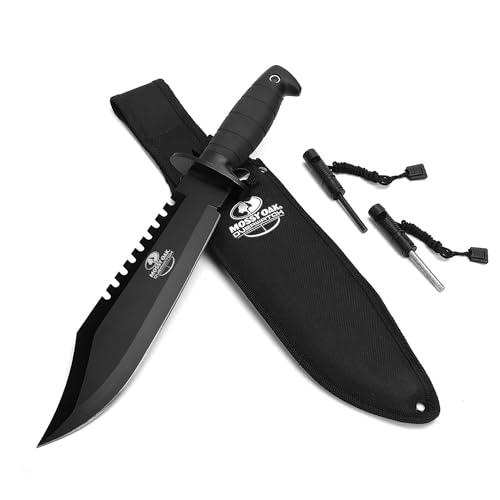 Mossy Oak 15-inch Survival Knife with Sharpener
- 15" Fixed Blade Knife: Ultra-sharp combat knife, stronger…
- Razor Sharp Clip Point Blade: The survival Knife…
- Rubber Handle & Nylon Sheath: Classic rubber handle…
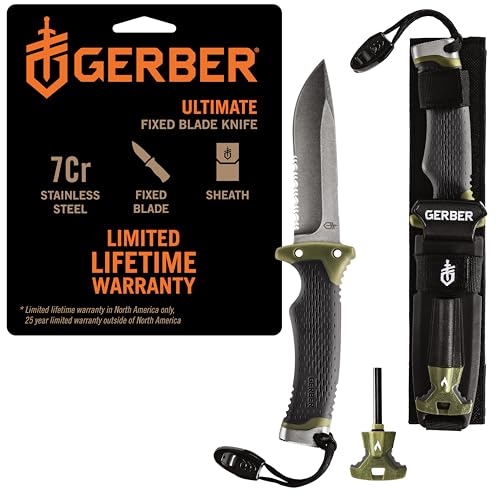 Gerber Ultimate Fixed Blade Knife w/Sheath
- The Gerber Ultimate survival knife features a half-serrated,…
- Multifunctional rugged sheath houses a sharpening stone and…
- Survival knife perfect for hunting, fishing, bushcraft, and…
 Naifu Bushcraft 6-in-1 Survival Knife
- Built for the unexpected with a full tang…
- A precision-ground stainless steel drop point blade with…
- Heavy-duty sheath with a built-in sharpening stone keeps…
| Product | Key specs | |
|---|---|---|
| Mossy Oak 15-inch Survival Knife with Sharpener | 15" Fixed Blade Knife: Ultra-sharp combat knife, stronger… Razor Sharp Clip Point Blade: The survival Knife… Rubber Handle & Nylon Sheath: Classic rubber handle… | Check price |
| Gerber Ultimate Fixed Blade Knife w/Sheath | The Gerber Ultimate survival knife features a half-serrated,… Multifunctional rugged sheath houses a sharpening stone and… Survival knife perfect for hunting, fishing, bushcraft, and… | Check price |
| Naifu Bushcraft 6-in-1 Survival Knife | Built for the unexpected with a full tang… A precision-ground stainless steel drop point blade with… Heavy-duty sheath with a built-in sharpening stone keeps… | Check price |
 Freelander Outdoor Fixed Blade Knife Freelander Outdoor Fixed Blade Knife | Built for Extreme Durability: Crafted from high-performance D2… Full Tang Construction: Engineered with a 5mm thick… Ergonomic Handle: Designed for long-term comfort and control,… | Check price |
As an Amazon Associate we earn from qualifying purchases at no extra cost to you.
What matters most in a survival knife
A survival knife is emergency equipment, not simply a large knife. It may need to prepare food, shave tinder, cut cord, make feather sticks, clear light vegetation, and assist with shelter construction. No blade safely replaces an axe or saw for major wood processing, so the best choice is the knife that handles common tasks reliably without encouraging misuse.
- Blade steel: Determines edge retention, toughness, sharpening difficulty, and resistance to rust.
- Grip security: A textured handle, useful finger indexing, and a shape that remains controllable when wet matter more than decorative features.
- Sheath quality: Retention, drainage, belt attachment, and one-handed access affect whether the knife is useful under stress.
- Blade length: Approximately 4 to 5 inches is the most versatile range. Longer blades gain leverage but add weight and reduce precision.
- Construction: A full-tang fixed blade is generally more suitable for demanding outdoor work than a folding knife or narrow hidden tang.
Best survival knives compared
| Knife | Blade steel | Blade length | Approx. weight | Best suited to | Typical market range |
|---|---|---|---|---|---|
| Mora Garberg | 14C28N stainless or carbon steel, depending on version | 4.3 in | 9.6 oz, knife only | General backcountry use and value | $65–$110 |
| ESEE-6 | 1095 carbon steel | 6.0 in | 12 oz, knife only | Heavy cutting and field repairability | $120–$170 |
| Fallkniven A1x | Laminated CoS stainless steel | 6.3 in | 13.8 oz, knife only | Wet climates and premium outdoor use | $250–$350 |
| KA-BAR Becker BK2 | 1095 Cro-Van carbon steel | 5.25 in | 16 oz, knife only | Chopping, batoning, and thick-stock work | $110–$160 |
Weights and prices vary by handle, sheath, finish, and retailer. The table compares the knives themselves rather than adding sheath weight, which can noticeably change the carry burden.
Best overall: Mora Garberg
The Mora Garberg is the easiest recommendation for most backcountry emergency kits. Its 4.3-inch blade is long enough for carving and modest wood processing while remaining nimble for food preparation, cord cutting, and fine tinder work. The full-tang design offers more confidence than Mora’s lighter utility models when the work becomes demanding.
The stainless version uses 14C28N, a practical steel with good corrosion resistance, useful toughness, and relatively easy sharpening. That combination is valuable for people who carry a knife in damp conditions but do not want to maintain carbon steel after every outing. The carbon-steel version can take a keen working edge and is simple to sharpen, but it needs prompt drying and a thin protective coating to prevent rust.
Its textured polymer handle is secure without being excessively aggressive against bare hands. The supplied polymer sheath generally provides dependable retention, and some configurations include a multi-mount system. The Garberg is not the strongest chopper in this group, but its moderate weight makes it the knife most likely to be carried rather than left at home.
Best for repairability: ESEE-6
The ESEE-6 is a robust choice for users who expect hard use and want a manufacturer-backed lifetime warranty. Its six-inch blade provides more reach and leverage than the Garberg, and the broad 1095 carbon-steel profile is well suited to batoning, carving, and rough shelter work.
1095 is tough and easy to sharpen in the field, but it is not stainless. Scratches, edge wear, and surface patina are normal. The important maintenance routine is simple: dry the blade, remove sap and food residue, touch up the edge before it becomes completely dull, and apply a light food-safe or knife-appropriate protective coating when storing it.
The ESEE-6’s removable handle scales are an ownership advantage. If scales become damaged, they can be replaced instead of forcing the owner to discard the entire knife. Its main disadvantages are weight, corrosion susceptibility, and a sheath that is functional but less refined than premium molded systems unless upgraded. Choose it when durability and field serviceability matter more than compact carry.
Best premium choice for wet conditions: Fallkniven A1x
The Fallkniven A1x combines a 6.3-inch blade with laminated CoS stainless steel. The laminated construction places a harder cutting steel between tougher outer layers, aiming to balance edge retention with resistance to breakage. It holds an edge longer than simpler, softer utility steels, although sharpening takes more patience and a quality abrasive.
This knife suits repeated use in rainy forests, coastal areas, and winter trips where corrosion control is inconvenient. Its convex edge geometry cuts efficiently, but owners should avoid treating it like a flat-ground blade during sharpening. A guided system or careful abrasive work helps preserve the convex profile.
The textured thermorun handle remains comfortable during extended carving, while the molded sheath offers secure retention and drainage. The trade-off is cost: this is a premium tool whose advantages are most noticeable for frequent users who will maintain it properly. Occasional campers may get better value from the Garberg or a simpler stainless fixed blade.
Best for heavy wood processing: KA-BAR Becker BK2
The Becker BK2 is built around a thick, heavy 5.25-inch 1095 Cro-Van blade. Its substantial stock and weight give it authority for batoning and rough chopping, and the full-tang construction is reassuring when processing small to medium pieces of wood.
That strength comes with compromises. At approximately one pound before the sheath, it is significantly heavier than the Garberg. The thick blade is also less graceful for delicate food preparation, shaving fine tinder, or precision carving. Like other 1095 knives, it requires rust prevention, particularly around the edge and any coating wear.
Choose the BK2 if your emergency kit is designed around a stout knife and you are willing to carry the extra weight. If your primary need is cutting cord, preparing food, and making small shavings, it is more knife than necessary.
Decision guide by situation
| Your situation | Best direction | Why |
|---|---|---|
| First fixed-blade survival knife | Mora Garberg stainless | Balanced size, manageable sharpening, reasonable cost |
| Frequent wet-weather trips | Fallkniven A1x or another quality stainless fixed blade | Less corrosion anxiety and strong edge retention |
| Dry climate and easy field sharpening | ESEE-6 or Becker BK2 | Tough carbon steel is simple to touch up and field-service |
| Minimal pack weight | 4–4.5-inch stainless fixed blade | Enough length for general tasks without excess steel |
| Heavy batoning is expected | Becker BK2 or ESEE-6 | Thicker, longer blades provide more leverage |
| Occasional emergency carry | Mora Garberg | Lower purchase cost reduces the penalty of infrequent use |
Blade length: why bigger is not automatically better
For general emergency use, a 4- to 5-inch blade usually provides the best control-to-capability ratio. A 4.3-inch blade can prepare food, cut webbing, carve notches, and process small branches. Moving to 6 inches adds leverage and reach, but it increases sheath size, weight, and the chance that fine work feels clumsy.
As a practical example, replacing a roughly 10-ounce knife with a 16-ounce model adds about 6 ounces before accounting for different sheaths. On a day hike that may be trivial; in a lightweight overnight pack, it is the equivalent of carrying an additional small accessory. Select the longer knife because you need its leverage, not because length looks more capable.
Maintenance that prevents most failures
- Clean after each trip. Remove sap, food acids, mud, and grit with mild soap and water.
- Dry the pivot-free fixed blade completely. Pay attention to the handle junction, tang, sheath mouth, and belt hardware.
- Inspect the sheath. Clear grit from molded channels and confirm that the knife clicks or locks securely into place.
- Touch up early. A few light passes on the correct abrasive are easier and safer than rebuilding a badly damaged edge.
- Protect carbon steel. Apply a thin suitable coating before storage, and check it periodically for orange spotting.
- Do not pry or twist. Batoning should use appropriate, straight-grained wood and controlled strikes, not sideways force through the blade.
Final recommendation
Buy the Mora Garberg stainless if you want one dependable, reasonably priced knife for most backcountry emergencies. Pick the ESEE-6 for a tougher, easily serviced carbon-steel tool, the Fallkniven A1x for premium wet-weather performance, and the Becker BK2 when heavy wood processing justifies its extra weight. Whichever model you choose, a secure sheath, a small sharpening tool, and regular rust inspection are as important to emergency readiness as the blade itself.








Write Your Review
No reviews yet. Be the first to share your experience!