

The best nakiri knives for most vegetable-heavy kitchens are the 165 mm Tojiro DP for value, the MAC Superior 6.5-inch Nakiri for a light, precise upgrade, and the Mercer Culinary Genesis 7-inch Nakiri for an affordable Western-style handle and forgiving feel.
A nakiri is a Japanese vegetable knife with a straight or nearly straight edge, a tall rectangular blade, and a blunt tip. Its profile excels at push-cutting, slicing, julienning, and making clean vertical cuts through onions, cabbage, carrots, herbs, and other produce. It is less suitable than a chef’s knife for rocking cuts, splitting bones, or general-purpose chopping.
Our top picks
 Shun Premier 5.5" Nakiri Knife
- The Shun Premier 5.5-inch Nakiri Knife is expertly…
- Part of the Premier Series, this knife features…
- Crafted with VG-MAX steel and 68 layers of…
 Cuisinart 7" Nakiri Knife with Blade Guard
- High-quality stainless steel blade
- Ideal for chopping, slicing, and dicing a vaiety…
- Includes matching blade guard for safe and easy…
 7'' Japanese Nakiri Knife
- 【Professional Nakiri Knife for Vegetable Prep】Designed specifically for…
- 【67-Layer Damascus with Japanese VG10 Core】Our vegetable knife…
- 【Razor-Sharp Edge for Effortless Cutting】Our damascus knife is…
| Product | Key specs | |
|---|---|---|
| Shun Premier 5.5" Nakiri Knife | The Shun Premier 5.5-inch Nakiri Knife is expertly… Part of the Premier Series, this knife features… Crafted with VG-MAX steel and 68 layers of… | Check price |
| Cuisinart 7" Nakiri Knife with Blade Guard | High-quality stainless steel blade Ideal for chopping, slicing, and dicing a vaiety… Includes matching blade guard for safe and easy… | Check price |
| 7'' Japanese Nakiri Knife | 【Professional Nakiri Knife for Vegetable Prep】Designed specifically for… 【67-Layer Damascus with Japanese VG10 Core】Our vegetable knife… 【Razor-Sharp Edge for Effortless Cutting】Our damascus knife is… | Check price |
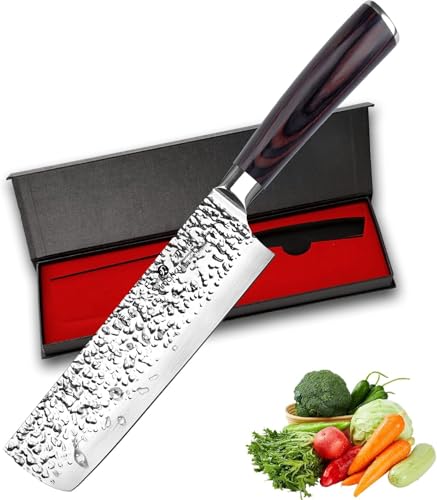 imarku Nakiri Knife 7 Inch imarku Nakiri Knife 7 Inch | 【ULTRA SHARP BLADE】Experience smooth slicing, dicing, chopping and… 【ANTI-STICK DESIGN】With its elegant hammered finish, hollow-edge design,… 【ERGONOMIC HANDLE】Experience a secure, non-slip grip with FSC-Certified… | Check price |
As an Amazon Associate we earn from qualifying purchases at no extra cost to you.
Best nakiri knives at a glance
| Knife | Blade length | Steel and hardness | Approx. weight | Best for | Typical market range |
|---|---|---|---|---|---|
| Tojiro DP Nakiri | 165 mm | VG-10 stainless, about 60–61 HRC | About 150–170 g | Best value and first Japanese-style nakiri | $55–$90 |
| MAC Superior Nakiri | 6.5 in / 165 mm | High-carbon stainless, about 58–60 HRC | About 135–150 g | Fast, light prep and fine slicing | $100–$150 |
| Mercer Culinary Genesis Nakiri | 7 in / 178 mm | High-carbon German stainless, about 56–58 HRC | About 200–230 g | Budget buyers wanting a Western handle | $35–$60 |
| Victorinox Fibrox Nakiri | 6.5 in / 165 mm | Stainless steel, about 56–58 HRC | About 150–180 g | Low-maintenance everyday prep | $45–$75 |
| Shun Classic Nakiri | 6.5 in / 165 mm | VG-MAX stainless, about 60–61 HRC | About 175–190 g | Premium fit, finish, and edge retention | $150–$220 |
Weights and hardness figures can vary slightly by production run, handle configuration, and measurement method. They are useful for comparing the knives, not substitutes for the manufacturer’s current specification.
Our picks by cooking situation
Best overall for most home cooks: MAC Superior 6.5-inch Nakiri
The MAC Superior combines a thin blade, moderate hardness, comfortable Western-style handle, and a useful 165 mm length. It feels quick rather than hefty, which is valuable when a meal involves several pounds of vegetables. Its edge geometry is generally more refined than that of inexpensive stamped knives, so it enters onions and dense root vegetables with less wedging.
The blade is not excessively delicate. That makes it a better daily choice than an ultra-thin, very hard Japanese knife for cooks who want performance without treating the knife like a display object. The main compromise is price: it costs more than a basic stainless nakiri while offering fewer visual flourishes than some premium alternatives.
Best value: Tojiro DP Nakiri
The Tojiro DP is a strong choice when cutting performance matters more than handle luxury. Its VG-10 core offers good stain resistance and holds a keen edge longer than many softer budget blades. At 165 mm, it is long enough for cabbage and large onions but compact enough for a small cutting board.
VG-10 can feel crisp and responsive, but it is also less forgiving of twisting cuts, hard contact with the board, and careless sharpening than softer German stainless steel. The handle is functional rather than especially plush. For a cook who uses a nakiri several times each week and is willing to learn basic whetstone maintenance, it offers an unusually capable entry point.
Best budget Western-style option: Mercer Culinary Genesis Nakiri
The Mercer Genesis is a sensible fit for cooks who prefer a fuller handle, a little more blade weight, and a less demanding edge. Its 7-inch blade gives extra coverage for large vegetables, while the German-style stainless steel is comparatively tolerant of ordinary home-kitchen mistakes.
Its edge will usually need refreshing sooner than the harder VG-10 and VG-MAX options, but sharpening is also less stressful because the steel is not as prone to chipping. Choose it for shared kitchens, frequent family cooking, or anyone transitioning from a conventional chef’s knife.
Best for low-maintenance prep: Victorinox Fibrox Nakiri
Victorinox’s Fibrox handle is grippy and practical, and the stainless blade is easy to live with. This is the choice for someone who values reliable sanitation, an inexpensive replacement, and a knife that does not demand ceremonial care.
The edge geometry is typically less thin and refined than on the MAC or Tojiro. As a result, it may feel less effortless through dense produce, but it tolerates routine use well. It is particularly appropriate for cooks who sometimes leave a knife in the dish rack briefly or share tools with people who are still learning knife technique—although hand-washing remains the safer approach.
Best premium option: Shun Classic Nakiri
The Shun Classic Nakiri offers a refined finish, a hard VG-MAX stainless blade, and a thin cutting profile designed for clean vegetable work. Its balance and handle contours appeal to cooks who spend a great deal of time on precise slicing and value a polished fit and finish.
The harder steel can retain a sharp edge impressively, but it is less tolerant of lateral force. Do not use it to pry apart stuck food, cut through bones, or chop directly into hard pits. The premium cost makes the most sense for a careful cook who will use a proper cutting board and maintain the edge before it becomes completely dull.
How the important specifications affect vegetable prep
Blade length
A 165 mm blade is the most versatile nakiri size. It gives adequate room for onions, peppers, leafy greens, and medium squash without feeling cumbersome. A 178 mm blade can reduce the number of strokes when processing cabbage or large vegetables, but it needs more board space and may feel awkward on a narrow counter.
For a cutting board under about 16 inches wide, or for cooks with smaller hands, 165 mm is usually the safer starting point. The tall blade matters as much as length: it gives your knuckles clearance and provides a broad surface for transferring chopped food.
Steel type and sharpening
Harder steels such as VG-10 and VG-MAX generally retain a fine edge longer, but they reward controlled technique. They should be sharpened with a whetstone or a carefully adjusted professional service rather than a forceful pull-through sharpener. Softer German-style stainless steel loses its initial bite sooner but is often easier to deburr and less likely to chip when the knife meets an imperfect board.
For most home cooks, edge retention should not be the only priority. A slightly softer blade that is sharpened correctly is more useful than a hard blade that is allowed to become blunt and then forced through food.
Edge geometry and food release
A thin, low-wedge blade separates food with less resistance, especially in potatoes, carrots, and dense onions. However, very thin geometry can stick to wet potato slices or cucumber rounds because a flat blade creates suction. Some nakiri knives use a subtle convex face, textured finish, or small surface dimples to improve food release.
No release feature eliminates sticking. Cutting with a smooth push motion, wiping the blade when buildup becomes noticeable, and avoiding oversized produce that twists the blade are more important than texture alone.
Weight and handle comfort
Light knives around 140–170 g feel fast during repetitive herb and vegetable work. Heavier knives around 190–230 g can feel steadier and may help a cook who prefers gravity-assisted cuts. Neither is universally better. A light blade reduces fatigue for some users; a heavier one can reduce the need to press.
Handle comfort is highly personal. Western handles such as those on MAC, Mercer, and Victorinox knives tend to suit cooks moving from a chef’s knife. Traditional Japanese handles can feel nimble but may require a short adjustment period. Hold the knife in a pinch grip behind the blade, and choose the handle that lets your thumb and forefinger remain relaxed.
A practical decision matrix
| Your situation | Best direction | Why |
|---|---|---|
| Budget under $75 | Mercer Genesis or Victorinox Fibrox | Durable stainless steel, familiar handles, inexpensive sharpening |
| First Japanese-style knife | Tojiro DP | Thin, capable edge at a moderate price |
| Vegetables prepared daily | MAC Superior | Light weight, comfortable handle, balanced edge retention |
| Small kitchen or small cutting board | Any 165 mm model | More maneuverable and easier to store |
| Careful enthusiast who wants premium finish | Shun Classic | Hard premium steel and refined construction |
| Shared kitchen or rougher handling | Mercer Genesis or Victorinox Fibrox | More forgiving steel and lower replacement cost |
Ownership: what wears first and how to maintain it
The edge wears first, usually becoming less crisp before the knife looks damaged. A honing rod may realign a slightly rolled edge on a softer knife, but it will not replace sharpening and can be inappropriate for a very hard, thin Japanese edge. A fine whetstone around 1,000–2,000 grit is suitable for establishing an edge, followed by a finer stone if you want more polish. Beginners should prioritize a consistent angle—roughly 12–15 degrees per side for many Japanese nakiri knives, and closer to 15–20 degrees for many softer Western-style models—over chasing an exact number.
Wash the knife by hand with warm water and mild detergent, dry it immediately, and store it in a block, sheath, or magnetic strip that protects the edge. Avoid dishwashers, glass cutting boards, ceramic plates, frozen food, bones, and twisting through stuck cuts. Use end-grain or quality plastic as the cutting surface.
A simple ownership calculation illustrates why sharpening matters: a $120 knife used four times weekly for five years sees about 1,040 uses, or roughly 12 cents per use before maintenance. Replacing a good knife because of preventable chips is far more expensive than occasional professional sharpening or a modest whetstone.
Final recommendation
Choose the MAC Superior if you want the best balance of light handling, thin geometry, comfort, and everyday durability. Choose the Tojiro DP if value and edge performance come first. Choose Mercer or Victorinox for a forgiving, low-cost kitchen tool, and the Shun Classic when premium materials and finish justify the added care. Whichever model you choose, a 165 mm blade, a stable cutting board, and disciplined hand-washing will matter more to long-term vegetable-prep performance than a decorative handle or the highest hardness number.








Write Your Review
No reviews yet. Be the first to share your experience!