

Best Tablet Stand for Kitchen Recipes
The best tablet stand for kitchen recipes is a weighted, adjustable stand with a washable surface, a viewing range of roughly 20 to 70 degrees, and a cradle that supports tablets from about 7 to 13 inches without covering the charging port.
For most home cooks, a freestanding metal-and-silicone stand is the strongest choice. It stays steadier than a lightweight folding stand when you tap the screen, takes less counter space than an articulated arm, and can be moved away from splashes between tasks. A clamp-mounted arm is better when counter space is scarce, while a simple folding stand is sufficient for occasional recipe reading.
Our top picks
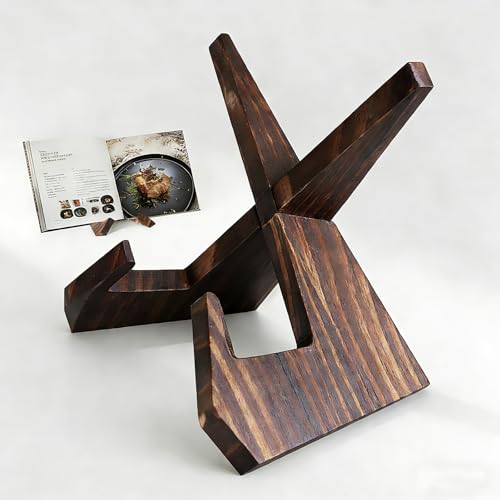 Aloimiki Wooden Cookbook Stand
- Hands-Free Cooking:Keeps recipe books and tablets upright at…
- Fold Flat for Easy Storage: The lightweight folding…
- Natural Carbonized Pine Wood: Crafted from solid pine…
 PUERSI Cookbook Stand for Kitchen
- Reasonable size to easily hold hardcover cookbook from…
- Rustic brown, distressed finishes and clear wood texture…
- The cookbook holder is made of natural and…
 EFFORTICH Cookbook Stand
- Our cookbook stand, meticulously crafted from smooth pine…
- 8.5“ x 4.9” x 6.5“ dimensional design to…
- This well made handmade rack can not only…
| Product | Key specs | |
|---|---|---|
| Aloimiki Wooden Cookbook Stand | Hands-Free Cooking:Keeps recipe books and tablets upright at… Fold Flat for Easy Storage: The lightweight folding… Natural Carbonized Pine Wood: Crafted from solid pine… | Check price |
| PUERSI Cookbook Stand for Kitchen | Reasonable size to easily hold hardcover cookbook from… Rustic brown, distressed finishes and clear wood texture… The cookbook holder is made of natural and… | Check price |
| EFFORTICH Cookbook Stand | Our cookbook stand, meticulously crafted from smooth pine… 8.5“ x 4.9” x 6.5“ dimensional design to… This well made handmade rack can not only… | Check price |
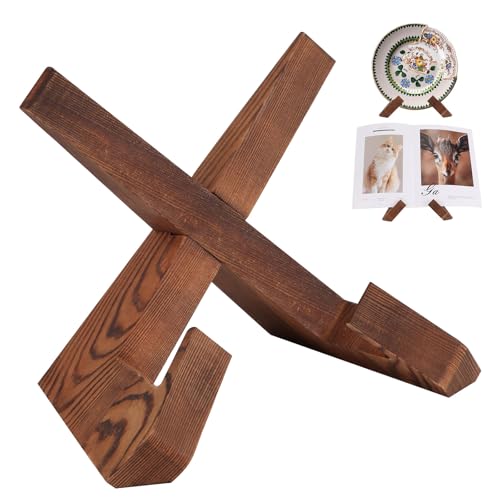 Justore Wooden Cookbook Stand for Kitchen Justore Wooden Cookbook Stand for Kitchen | Perfect Size & Adjustable Design: Holds hardcover cookbooks… Premium Solid Wood Construction: Crafted from smooth, carbonized… Rustic Farmhouse Aesthetic: Distressed finishes and warm brown… | Check price |
As an Amazon Associate we earn from qualifying purchases at no extra cost to you.
What matters most in a busy kitchen
Stability when you tap, swipe, and adjust
Recipe reading involves more movement than watching a video. You may tap to wake the display, scroll with a damp finger, or press a large on-screen button while holding a utensil. Look for a broad base, a low center of gravity, and rubber or silicone feet. A stand weighing approximately 1 to 2 pounds is usually much more planted than a thin plastic model weighing under half a pound.
The support ledge matters as much as the base. It should be deep enough to hold a tablet in a case, but not so deep that it blocks the lower edge of the screen or the charging connector. A ledge around 0.4 to 0.6 inches deep suits many tablets and slim cases. Very thick rugged cases may require a wider channel.
Viewing angles and glare
An adjustable back support is more useful than a stand that offers only one fixed angle. A near-upright position works when the tablet is behind a chopping board; a lower angle can reduce glare under overhead lighting. Aim for at least three usable positions or a hinge that holds any angle between approximately 20 and 70 degrees.
Do not confuse screen rotation with viewing adjustment. A rotating cradle lets you switch between portrait and landscape, but it does not necessarily solve glare or prevent the tablet from tipping. For recipes, landscape is convenient for large ingredient lists, while portrait often shows more of a vertically formatted recipe page.
Footprint and placement
Measure the free area beside your work zone rather than the entire countertop. A compact stand with a base around 5 by 4 inches can fit beside a kettle or mixing bowl. Larger weighted models may occupy 7 by 5 inches or more, but they are typically more stable. Keep the tablet outside the splash zone and away from the edge where a sleeve, towel, or elbow can catch it.
An arm that clamps to a counter or shelf can preserve valuable workspace. However, it needs a solid clamping surface, and its joints can gradually sag under a heavy tablet. It is less suitable for frequent repositioning or for counters with rounded edges.
Cleanability and materials
Kitchen stands collect flour, oil, and sticky fingerprints in the same places: the support ledge, hinge gaps, and rubber pads. Smooth anodized aluminum, stainless steel, and sealed hard plastic are easier to maintain than fabric-covered bases or open foam padding.
Choose a stand with removable silicone pads or sealed pads that can be wiped without trapping crumbs. Never rinse a stand with exposed springs, charging components, or unsealed hinges. Disconnect the tablet, wipe the stand with a slightly damp cloth and mild dish-soap solution, then dry it before use. Avoid abrasive powders and excessive liquid around moving joints.
Tablet stand comparison
| Stand type | Typical tablet range | Typical weight | Typical footprint or mounting space | Best viewing range | Best for |
|---|---|---|---|---|---|
| Weighted desktop stand | 7–13 inches | 1.0–2.2 lb | 5 × 4 to 7 × 5 inches | 20–70 degrees | Frequent cooking and larger tablets |
| Folding travel stand | 7–11 inches | 0.2–0.7 lb | 4 × 3 to 6 × 4 inches | 35–65 degrees | Small kitchens and occasional use |
| Clamp-mounted arm | 7–13 inches | 1.5–3.5 lb | Clamp opening commonly 0.8–2.5 inches | 15–85 degrees | Minimal counter space |
| Heavy-duty kitchen holder | 8–13 inches, often with case | 2.0–4.0 lb | 7 × 5 to 9 × 6 inches | 25–75 degrees | Large tablets and vigorous tapping |
These are useful market ranges rather than universal specifications. Check the manufacturer’s stated dimensions, especially if the tablet remains inside a case.
Best choice by kitchen situation
| Your situation | Recommended choice | Why | What to avoid |
|---|---|---|---|
| Budget-conscious, occasional use | Folding stand with rubber feet | Low cost, easy storage, adequate for light tapping | Very light stands with smooth plastic feet |
| Several cooking sessions each week | Weighted adjustable desktop stand | Better stability, faster angle changes, easier cleaning | Fabric-covered or permanently fixed-angle models |
| Small counter or crowded galley kitchen | Clamp-mounted arm | Moves the tablet above unused vertical space | Arms that require constant tightening |
| Large tablet or thick protective case | Heavy-duty holder with a wide ledge | More support and lower tipping risk | Narrow channels designed for phone-sized devices |
| Multiple cooks using the same stand | Freely adjustable stand with portrait and landscape support | Adapts to different heights and recipes | Single-angle stands with a small viewing window |
Compatibility: measure the case, not just the tablet
Tablet stands are commonly described by screen size, but screen size alone does not determine fit. A 10.9-inch tablet in a slim folio case may be easier to mount than a smaller tablet in a thick rugged case.
Measure three things:
- Overall width: the tablet’s widest dimension with its case attached.
- Overall thickness: include raised corners, a folio cover, or a detachable keyboard.
- Port location: confirm that the ledge does not cover the charging port in portrait or landscape orientation.
As a practical fit calculation, suppose a tablet and case are 7.2 inches wide and the stand’s inner support width is listed as 8 inches. That leaves 0.8 inches of total clearance, or approximately 0.4 inches per side if centered. This is comfortable enough for placement, but a case with a protruding corner may still interfere. A stand with only 0.2 inches of total clearance is likely to feel awkward and may not hold the device securely.
For common tablet categories, choose a holder that explicitly supports 7–9-inch compact tablets, 10–11-inch mainstream tablets, or 12–13-inch large tablets. If you switch devices often, select an open cradle with at least 0.5 inches of extra width and enough ledge depth for your thickest case.
Ownership realities: what wears first
The first parts to deteriorate are usually rubber feet, silicone contact pads, and hinge tension rather than the metal frame. Feet can collect grease and lose grip; pads may peel if cleaned with harsh solvents; hinges can loosen after repeated angle changes.
Inspect the stand every few months. Replace or reattach loose pads before the tablet begins sliding. If a hinge uses a tightening screw, adjust it in small increments rather than forcing it tight. Over-tightening can damage plastic housings or make one-handed angle changes impractical.
For frequent use, a more expensive weighted stand can have a lower cost per use. For example, a $40 stand used four times a week for three years provides about 624 uses. Its approximate cost is 6 cents per use before replacement or repair. A $12 folding stand used once a week for the same period costs about 8 cents per use. The cheaper option still makes sense if portability is the priority, but daily cooks benefit more from stability and cleanability than from the lowest purchase price.
Setup and cleaning routine
- Place the stand on a dry, level surface outside the main splash and steam path.
- Set the viewing angle before adding wet or greasy ingredients to your hands.
- Position the charging cable so it runs behind the stand rather than across the work area.
- Test one tap and one swipe. If the stand moves, shift it farther back or use a heavier model.
- After cooking, remove the tablet first, then wipe flour and moisture from the ledge and feet.
- Dry the stand fully before folding it or storing it in a cupboard.
Final verdict
For the widest range of kitchen recipes, choose a weighted adjustable desktop stand with a 7–13-inch compatibility range, a rubberized base, a support ledge that accommodates your case, and a viewing range of roughly 20–70 degrees. Choose a folding stand if you cook occasionally or store everything in a drawer. Choose a clamp-mounted arm only when preserving counter space outweighs its greater setup complexity. Whichever style you buy, prioritize stable contact, accessible charging, smooth wipe-clean surfaces, and a measured fit over the tablet’s advertised screen size alone.








Write Your Review
No reviews yet. Be the first to share your experience!