

Best Splatter Screen for Frying Pans
The best splatter screen for frying pans is a fine stainless-steel mesh guard that is 2–3 inches wider than your pan, has a heat-resistant handle, and leaves enough open area for steam to escape without allowing oil droplets through.
For most home cooks, a 13-inch universal screen is the most useful size. It usually covers 8-, 10-, and 12-inch skillets, while a 15-inch screen is better for large sauté pans or Dutch ovens. The right choice depends less on brand than on four practical details: diameter, mesh fineness, how the rim contacts the pan, and whether the handle folds or detaches for storage.
Our top picks
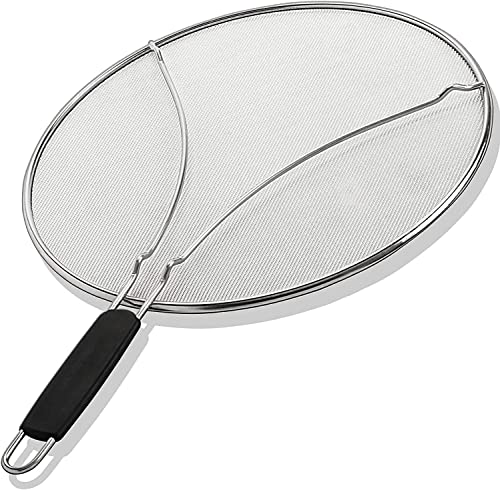 BergKoch Splatter Screen for Frying Pan
- Our oil splatter guard shield securely joins to…
- KEEPS THE STOVE, CABINETS, AND COUNTER CLEAN -…
- Our heavy-duty, grease splatter screen for frying pan…
 PLACHIDAY Splatter Screen for Frying Pan
- 【Safety and Health 】The grease splatter guards are…
- 【Ergonomic Design】our splatter guards for frying boasts a…
- 【Clean and Tidy】Our silicone splatter screens for frying…
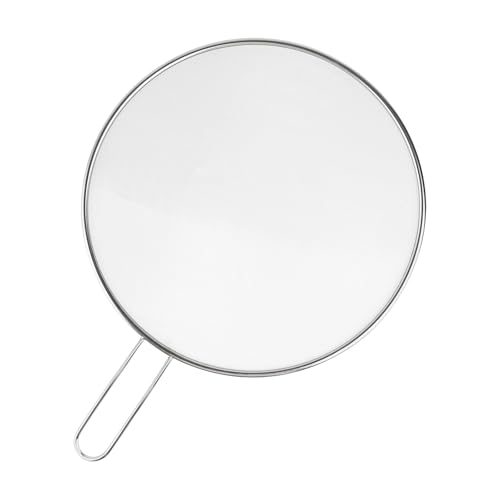 Stainless Steel Splatter Guard
- Premium Splatter Guard: Includes 1 silver grease splatter…
- Effective Protection: Stainless-steel splatter screen with fine mesh…
- Practical Features: This 13-inch stainless mesh fits skillets,…
| Product | Key specs | |
|---|---|---|
| BergKoch Splatter Screen for Frying Pan | Our oil splatter guard shield securely joins to… KEEPS THE STOVE, CABINETS, AND COUNTER CLEAN -… Our heavy-duty, grease splatter screen for frying pan… | Check price |
| PLACHIDAY Splatter Screen for Frying Pan | 【Safety and Health 】The grease splatter guards are… 【Ergonomic Design】our splatter guards for frying boasts a… 【Clean and Tidy】Our silicone splatter screens for frying… | Check price |
| Stainless Steel Splatter Guard | Premium Splatter Guard: Includes 1 silver grease splatter… Effective Protection: Stainless-steel splatter screen with fine mesh… Practical Features: This 13-inch stainless mesh fits skillets,… | Check price |
 BergKoch Splatter Screen for Frying Pan BergKoch Splatter Screen for Frying Pan | Our oil splatter guard shield securely joins to… KEEPS THE STOVE, CABINETS, AND COUNTER CLEAN -… Our heavy-duty, grease splatter screen for frying pan… | Check price |
As an Amazon Associate we earn from qualifying purchases at no extra cost to you.
Quick comparison of splatter-screen types
| Screen type | Typical diameter | Mesh or surface | Best for | Main limitation |
|---|---|---|---|---|
| Universal fine-mesh screen | 11–13 inches | 304 stainless steel, approximately 0.6–1.0 mm openings | Everyday frying, bacon, burgers, chicken, and shallow-frying | Can clog with sticky residue if not rinsed promptly |
| Large fine-mesh screen | 14–15 inches | Stainless steel mesh, approximately 0.8–1.2 mm openings | 12–14-inch pans, griddles, and large batches | Needs more cabinet or drawer space |
| Silicone-edged screen | 11–13 inches | Fine metal mesh with a silicone perimeter | Reducing gaps on pans with curved or irregular rims | Silicone can discolor and may retain oily smells |
| Perforated solid lid | 10–12 inches | Stamped or perforated stainless steel | Maximum oil containment and occasional cooking | Releases steam less freely and can trap condensation |
| Collapsible screen | 11–13 inches | Mesh with folding or sliding handle | Small kitchens, drawers, and infrequent use | More hinges and joints can loosen over time |
How to choose the right diameter
A splatter screen should cover the cooking surface without sitting so far outside the pan that oil lands on the counter. Measure the pan across its outside rim, not across the flat interior. Then choose a screen with a diameter about 2 inches larger.
- 8-inch pan: an 10- or 11-inch screen is usually suitable.
- 10-inch pan: choose an 11- or 12-inch screen.
- 12-inch pan: a 13- or 14-inch screen offers better coverage.
- 14-inch sauté pan or wok-style skillet: look for a 15- or 16-inch model, if the rim is compatible.
This sizing rule allows the screen to rest on the rim while reducing the chance that the mesh dips into food. A screen that is exactly the same diameter as the pan can leave gaps when the pan has sloped sides or a pouring lip. One that is much larger may be awkward to lift and can direct condensation onto the countertop.
Worked fit example
Suppose your frying pan measures 10.25 inches across its outside rim. Adding roughly 2 inches gives a target screen diameter of 12.25 inches. A 12-inch screen may work if its rim is broad and the pan is flat, but a 13-inch screen is the safer universal choice. If you also own a 12-inch skillet, that 13-inch screen can cover both pans, making it more space-efficient than buying two exact-size guards.
Mesh fineness: oil control versus steam release
Fine mesh is the most important feature if you fry bacon, sausage, cutlets, or foods with high water content. Smaller openings interrupt more droplets, but they also slow steam release and collect residue faster.
For general frying, a mesh opening around 0.6–1.0 mm is a useful balance. It blocks ordinary oil spray while allowing steam to escape through thousands of small openings. Very fine mesh can reduce visible splatter further, but it may become greasy or partially blocked during long cooking. Coarser mesh is easier to rinse, yet larger droplets may pass through.
A perforated solid lid is not equivalent to a mesh screen. Its holes are fewer and larger, so steam may condense on the underside and drip back into hot oil. That can cause additional sizzling and splashing when you lift the lid. Choose a perforated lid only when containing oil is more important than rapid steam release.
Rim design and pan fit matter more than they look
Flat stainless-steel rim
A flat rim is durable, easy to clean, and works well with traditional skillets. It is usually the best choice for frequent use. Look for a rim that is smoothly rolled rather than sharply folded; sharp edges can catch cloths and may become uncomfortable when the screen is lifted with greasy hands.
Silicone or rubberized edge
A heat-resistant silicone edge can close small gaps on pans with rounded sides and reduce metal-on-metal noise. It is useful when you own several pans with different rim shapes. Check the stated temperature rating, especially if you place the screen in an oven or near a gas flame. Many screens are intended for stovetop use only, and the silicone may discolor even when the mesh remains intact.
Raised or stepped rim
A raised rim helps keep the mesh above food and provides clearance for turning pieces with tongs. This is particularly helpful for chicken thighs or breaded cutlets. The trade-off is extra height in a drawer and a greater chance of steam condensing on the underside.
Avoid screens that rock noticeably on a flat pan. Movement creates gaps and makes the handle more difficult to control. A small pouring notch can be convenient, but it should not extend so far that it leaves an exposed opening beside the pan handle.
Handle designs: fixed, folding, and detachable
- Fixed handle: the strongest and simplest option. Choose it if you have a utensil drawer or a hanging rail.
- Folding handle: the best compromise for a small kitchen. Confirm that the hinge feels firm and does not place fingers directly above the hot mesh.
- Sliding or telescoping handle: compact when stored, but the mechanism can collect grease and become stiff.
- Detachable handle: offers the smallest storage footprint and can make cleaning easier, but the connection must lock securely before use.
- Silicone-covered handle: more comfortable during extended frying, although it should not be treated as oven-safe unless the manufacturer states that it is.
For heavy food or a large screen, a helper loop opposite the handle is valuable. It allows you to lift the screen with two hands without touching the hot rim. A short handle may save drawer space but can bring your hand too close to rising steam, so compactness should not outweigh safe clearance.
Best choice by cooking situation
| Your situation | Recommended specification | Why it fits |
|---|---|---|
| One 10-inch skillet and a limited budget | 11–12-inch fixed-handle fine mesh | Simple construction, adequate coverage, and fewer parts to fail |
| Several pans from 8 to 12 inches | 13-inch universal screen with a flat or silicone-edged rim | Covers the widest range without buying multiple screens |
| Frequent bacon, shallow-frying, or high-splatter foods | Fine 0.6–0.8 mm mesh, reinforced rim, helper loop | Improves droplet control and makes repeated lifting safer |
| Small drawer or shared kitchen | 11–13-inch collapsible screen with a locking hinge | Uses less storage depth, provided the mechanism is sturdy |
| Large 12–14-inch sauté pan | 14–15-inch screen with a broad, stable rim | Reduces uncovered areas at the pan perimeter |
| Occasional use and easiest rinsing | Coarser stainless mesh or perforated lid | Less likely to clog, though steam control is less effective |
Cleaning, durability, and ownership costs
Stainless steel mesh generally outlasts coated mesh, particularly when exposed to high heat and repeated washing. The first parts to show wear are commonly the handle joint, silicone edge, and fine mesh around the rim. A bent rim can prevent a stable fit, while a loose hinge can make the screen twist when lifted.
Rinse the screen with hot water soon after cooking, then use dish soap and a soft brush from both sides. Brushing in one direction helps remove oil without forcing food deeper into the mesh. For baked-on grease, soak it in hot soapy water before brushing. Avoid scraping with a knife, which can deform the wires and create larger openings.
Dishwasher cleaning may be convenient, but check the handle and silicone instructions. High heat and repeated detergent exposure can dull metal, loosen adhesive, or shorten the life of a plastic grip. Dry the screen fully before storing it; trapped moisture around a folded hinge is a common source of odor and corrosion on lower-quality components.
A basic screen costing roughly $10–$20 can be economical if used weekly. At two uses per week for three years, even a $15 screen costs about 5 cents per use. A more expensive reinforced model may be worthwhile for daily frying, but not if its extra features add storage problems or parts that you will not use.
Common mistakes to avoid
- Buying by the advertised pan size instead of measuring the outside rim.
- Choosing an extra-fine screen that is difficult to clean after every use.
- Using the screen as a sealed lid while cooking foods that need steam to escape.
- Leaving the handle over a burner or allowing a silicone edge to touch an open flame.
- Storing a wet screen folded, especially when it has a sliding or hinged handle.
Final recommendation
For most kitchens, choose a 13-inch fine stainless-steel mesh screen with a stable rolled rim, a heat-resistant handle, and either a flat profile or a low silicone edge. It should cover common 10- and 12-inch frying pans, release steam more effectively than a solid lid, and remain easy to rinse. Choose a 15-inch version for oversized pans, or a folding model when drawer space is the deciding factor. The best splatter screen for frying pans is the one that fits your largest regularly used skillet without sacrificing a secure rim, manageable cleaning, or safe handle clearance.








Write Your Review
No reviews yet. Be the first to share your experience!