

The best baguette pans for most home bakers are perforated aluminized-steel pans with three narrow troughs, while a heavier carbon-steel pan is better for frequent baking and a ceramic baguette baker is the easiest choice when steam retention matters more than maximum airflow.
A baguette pan does not create a crust by itself. Its job is to support the dough’s shape, allow hot air to reach the underside, and help moisture escape. The right choice depends on whether you value crispness, easy release, durability, compact storage, or the ability to bake several loaves at once.
Our top picks
 Pavsrmy Baguette Bread Pan
- 【CRISPY GOLDEN-BROWN BAGUETTES EVERY TIME】Bake up to 4…
- 【FOOD-GRADE NON-STICK COATING】Pavsrmy 4-wave french bread baking pan…
- 【BAKE TO PERFECTION】Professional perforation holes on the bottom…
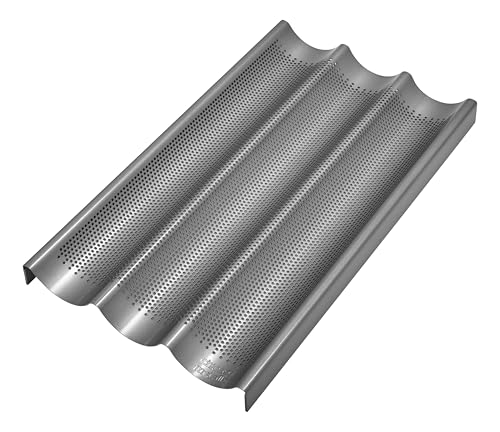 Chicago Metallic Commercial II Non-Stick Perforated Baguette
- CRISP, GOLDEN-BROWN CRUST EVERY TIME: Perforated pan design…
- Two-layer nonstick coating helps bread slide right off…
- Constructed from heavy-weight aluminum that distributes heat uniformly…
 Tiawudi 2 Pack Nonstick Perforated Baguette Pan
- Our baguette pan is made of food grade…
- Our baguette bread pan is with perforated surface…
- You only need to pay 1 but get…
| Product | Key specs | |
|---|---|---|
| Pavsrmy Baguette Bread Pan | 【CRISPY GOLDEN-BROWN BAGUETTES EVERY TIME】Bake up to 4… 【FOOD-GRADE NON-STICK COATING】Pavsrmy 4-wave french bread baking pan… 【BAKE TO PERFECTION】Professional perforation holes on the bottom… | Check price |
| Chicago Metallic Commercial II Non-Stick Perforated Baguette | CRISP, GOLDEN-BROWN CRUST EVERY TIME: Perforated pan design… Two-layer nonstick coating helps bread slide right off… Constructed from heavy-weight aluminum that distributes heat uniformly… | Check price |
| Tiawudi 2 Pack Nonstick Perforated Baguette Pan | Our baguette pan is made of food grade… Our baguette bread pan is with perforated surface… You only need to pay 1 but get… | Check price |
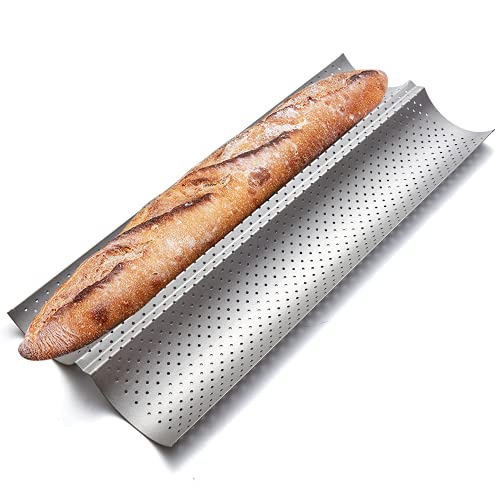 KITESSENSU Nonstick Baguette Pans for French Bread KITESSENSU Nonstick Baguette Pans for French Bread | Bread Pan for Homemade Bread: No matter if… Make Everything Simple: No longer need proofing baskets,… Clever Designed Helper: The curved grooves will shape… | Check price |
As an Amazon Associate we earn from qualifying purchases at no extra cost to you.
Best baguette pans by baking situation
| Best for | Recommended pan type | Useful specifications | Typical price range |
|---|---|---|---|
| First-time baguette bakers | Coated perforated steel | 2 or 3 troughs; about 15–17 inches long; under 2 lb | $15–$30 |
| Crispest underside | Open perforated aluminized steel | Perforations roughly 2–4 mm; three troughs; rigid rim | $20–$45 |
| Frequent baking | Heavy carbon steel or aluminized steel | Approximately 0.8–1.0 mm metal; reinforced edges | $30–$60 |
| Steam-retaining artisan loaves | Ceramic baguette baker with lid | Two or three channels; usually 12–16 inches long; 5–10 lb | $50–$150 |
| Small oven or limited storage | Two-trough perforated pan | About 12–14 inches long; two loaves; narrow footprint | $15–$35 |
What to look for in the best baguette pans
Material: airflow versus heat retention
Perforated metal is the most practical material for a conventional home oven. Aluminum or aluminized steel heats quickly and transfers heat efficiently to the dough. The holes let hot air circulate below the loaf, reducing the pale, soft strip that can occur when dough sits on solid metal or parchment.
Carbon steel and thicker aluminized steel heat more gradually but hold heat better. That extra mass can produce more consistent browning when you bake repeatedly, although it also makes preheating more important. A lightweight pan is easier to handle and usually costs less, but thin metal can flex, warp, or develop uneven contact with the oven rack.
Silicone-coated or other nonstick surfaces make releasing dough easier, particularly when a shaped loaf expands into the sides of the trough. They are convenient for beginners, but the coating is the part most likely to wear first. Avoid metal utensils, abrasive pads, broiler heat, and temperatures above the manufacturer’s limit. An uncoated pan may last longer, but it generally needs a light film of oil or a dusting of flour before use.
Ceramic bakers, such as the Emile Henry Baguette Baker, work differently. Their covered design traps moisture around the dough during the initial bake, helping the crust set more gradually. They are attractive and excellent for a traditional enclosed-baking approach, but they are heavy, more expensive, and do not offer the same under-loaf airflow as a perforated metal pan. Always follow the manufacturer’s instructions for preheating and temperature changes.
Perforation size and pattern
Look for holes distributed across the bottom and lower sides of every trough, not merely a few openings near the edges. Small perforations around 2–4 mm across provide useful airflow while still supporting dough that has been shaped correctly. Very large holes can leave marks on a soft loaf or allow sticky dough to press through; very small holes provide less ventilation and may clog with flour or dough.
Perforations do not eliminate the need for correct proofing. An over-proofed or very wet dough can spread through the holes, while an under-proofed loaf may press hard against the sides and stick. For high-hydration dough, use a pan with a smooth, well-finished surface and a removable liner only if the manufacturer supplies or recommends one.
Size and oven fit
A three-trough pan typically makes three narrow baguettes, but the total length is often 15–17 inches. Measure the oven rack between the side walls, not just the advertised interior width. Leave clearance around the pan so air can circulate and so the rim does not catch when you slide it in.
Check the trough diameter as well as the outside dimensions. A channel around 2¼–2¾ inches wide is suited to slim baguettes. Wider channels produce shorter, broader loaves that are easier to shape but less traditionally slender. A two-trough pan can be preferable in a compact oven because it leaves more space for steam and is easier to lift while filled.
For a simple fit calculation, measure your usable rack width and subtract at least 1 inch for handling clearance. If the result is 16 inches, choose a pan no longer than about 15 inches. Also measure the distance from the rack to the heating element if your oven has a narrow upper cavity; a tall rim or covered ceramic baker may not fit even when its length does.
Notable options and how they compare
USA Pan French Bread Pan
The USA Pan French Bread Pan is a practical coated-metal option for home bakers who want easy release and multiple loaves. Its corrugated, perforated design supports airflow, while the coating reduces the need for oil. It is a good fit for occasional baking, especially if you use silicone, wood, or nylon tools and wash it by hand.
Chicago Metallic Perforated Baguette Pan
Chicago Metallic’s perforated baguette pans are aimed at a more commercial-style approach. Their metal construction and open perforations favor browning and airflow rather than decorative presentation. Choose this style if crust texture is your priority and you are comfortable applying a small amount of release oil when necessary.
Emile Henry Baguette Baker
The Emile Henry Baguette Baker is a covered ceramic alternative rather than a direct substitute for a perforated metal pan. It is suited to bakers who want a controlled, humid baking environment and a substantial serving piece. Its weight and storage requirements make it less convenient for quick weekday use, and ceramic should not be treated like thin metal when changing temperatures.
Uncoated French-style carbon-steel pans
Uncoated carbon-steel baguette pans are attractive for frequent bakers who prefer a durable surface with no synthetic nonstick layer. They require more care: dry them immediately, avoid prolonged soaking, and apply a very thin protective coat of oil if the manufacturer recommends seasoning. A poorly maintained pan can rust, while excess oil can become sticky and transfer odor to the dough.
How to get better results from any baguette pan
- Measure the pan and oven first. Confirm length, width, height, and rack clearance before buying. A pan that barely fits is difficult to load safely.
- Preheat thoroughly. Heat the oven for at least 30 minutes after it reaches temperature if your recipe uses a baking stone, steel, or a heavy pan. This stabilizes the metal and improves initial oven spring.
- Use minimal release aid. For coated pans, start with no oil or a very light spray. For uncoated metal, brush a thin layer of neutral oil and dust lightly with flour or semolina if needed.
- Place the seam underneath. Shape the dough firmly and position the seam down the center of the trough. This reduces the chance of the loaf opening or sticking along the seam.
- Score immediately before baking. Use several overlapping angled cuts rather than pressing repeatedly with a blunt blade. Scoring directs expansion along the top of the loaf.
- Cool before cleaning. Remove baked crumbs with a soft brush, then hand-wash with mild detergent. Dry perforated pans completely, including around the rim and folded edges.
Durability and ownership details
The first failure point on a nonstick baguette pan is usually the coating, not the metal. Scratches, bubbling, discoloration, and loss of release are signs to replace it rather than scrape harder. On uncoated pans, rust usually begins where water remains trapped in perforations or seams. Warping is more likely when a hot pan is placed under cold water or when a lightweight pan is stored under heavy cookware.
Expect a two- or three-trough pan to occupy more cabinet space than its baking frequency suggests. If you bake one baguette at a time, a narrow two-trough model can be more useful than a large three-loaf pan. Conversely, if a batch of dough makes three loaves, the larger pan may reduce total oven time and lower energy use. For example, baking three loaves together instead of three separate 30-minute batches saves about 60 minutes of oven operation per baking day; over 20 baking days, that is approximately 20 hours.
Final buying recommendation
Choose a coated perforated steel pan with two or three troughs if you want the easiest path to crisp bottoms and simple cleanup. Pick a heavier uncoated carbon-steel or aluminized-steel model if you bake weekly and are willing to maintain it. Choose the Emile Henry Baguette Baker or another covered ceramic baker when moisture retention and presentation matter more than maximum underside airflow. Whatever the material, prioritize a rigid rim, evenly distributed perforations, a size that leaves oven clearance, and a surface you can maintain without damaging the pan.








Write Your Review
No reviews yet. Be the first to share your experience!