

The best baguette pan for French bread is a perforated, three-ridge pan with 1–1½-inch holes, a dark metal body, and enough room for three loaves without crowding; choose a nonstick version for easy release or an uncoated aluminized-steel pan for the driest, crispest crust.
Our top picks
 Pavsrmy Baguette Bread Pan
- 【CRISPY GOLDEN-BROWN BAGUETTES EVERY TIME】Bake up to 4…
- 【FOOD-GRADE NON-STICK COATING】Pavsrmy 4-wave french bread baking pan…
- 【BAKE TO PERFECTION】Professional perforation holes on the bottom…
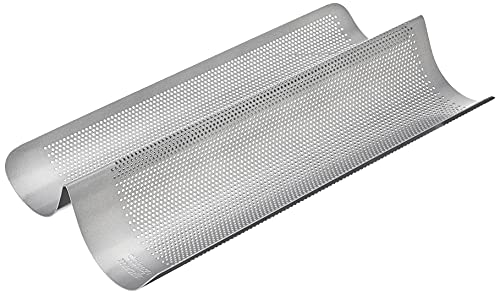 Chicago Metallic Commercial II Non-Stick Perforated French
- CRISP, GOLDEN-BROWN CRUST: Perforations allow air to circulate…
- Advanced dual-layer nonstick coating ensures bread releases cleanly…
- Constructed from heavy-weight aluminum that distributes heat evenly…
 Tiawudi 2 Pack Nonstick Perforated Baguette Pan
- Our baguette pan is made of food grade…
- Our baguette bread pan is with perforated surface…
- You only need to pay 1 but get…
| Product | Key specs | |
|---|---|---|
| Pavsrmy Baguette Bread Pan | 【CRISPY GOLDEN-BROWN BAGUETTES EVERY TIME】Bake up to 4… 【FOOD-GRADE NON-STICK COATING】Pavsrmy 4-wave french bread baking pan… 【BAKE TO PERFECTION】Professional perforation holes on the bottom… | Check price |
| Chicago Metallic Commercial II Non-Stick Perforated French | CRISP, GOLDEN-BROWN CRUST: Perforations allow air to circulate… Advanced dual-layer nonstick coating ensures bread releases cleanly… Constructed from heavy-weight aluminum that distributes heat evenly… | Check price |
| Tiawudi 2 Pack Nonstick Perforated Baguette Pan | Our baguette pan is made of food grade… Our baguette bread pan is with perforated surface… You only need to pay 1 but get… | Check price |
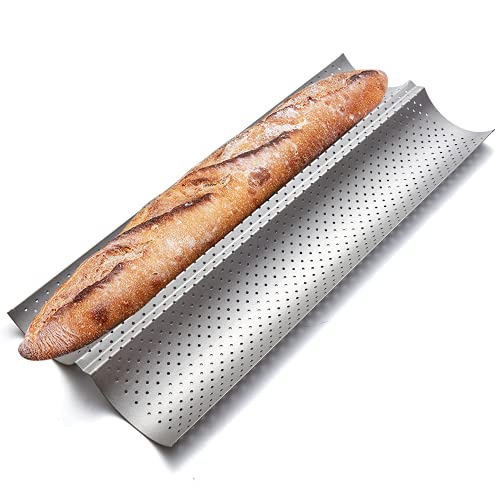 KITESSENSU Nonstick Baguette Pans for French Bread KITESSENSU Nonstick Baguette Pans for French Bread | Bread Pan for Homemade Bread: No matter if… Make Everything Simple: No longer need proofing baskets,… Clever Designed Helper: The curved grooves will shape… | Check price |
As an Amazon Associate we earn from qualifying purchases at no extra cost to you.
Quick picks by baking situation
| Best for | Pan type to choose | Useful specifications | Why it fits |
|---|---|---|---|
| First-time baguette bakers | Nonstick three-loaf pan | 14–16 inches long, 3 ridges, about 1.5–2.5 lb | Releases dough easily and keeps shaping consistent |
| Maximum crust development | Perforated aluminized steel | Approximately 0.8–1.2 mm steel, 3 channels, 1–2 mm perforations | Allows more direct heat and moisture escape |
| Occasional baking in a small kitchen | Two-loaf compact pan | 11–13 inches long, under 2 lb | Uses less storage space and suits smaller ovens |
| Soft sandwich-style French bread | Solid nonstick pan | 2–3 ridges, smooth interior, 12–16 inches long | Supports the dough and gives a more uniform, less aggressively crisp base |
| Traditional baking without metal | Ceramic baguette baker | Usually 2–3 loaves; roughly 13–16 inches long | Retains heat well, though it is heavier and slower to preheat |
Best overall: a perforated three-loaf baguette pan
For most home bakers, the strongest all-purpose choice is a three-loaf perforated pan made from aluminized or carbon steel. Chicago Metallic makes commercial-style perforated baguette pans in this category, and similar uncoated bakery pans are widely available from restaurant-supply manufacturers.
The perforations matter because baguette dough contains substantial water. As the loaf heats, steam must escape through the dough and around the pan. Small holes expose more of the lower crust to hot air than a solid cradle does, helping the underside dry instead of remaining pale or slightly damp. A dark steel surface also absorbs heat more readily than shiny aluminum.
Three ridges are usually the best compromise. Two loaves give each piece more room but waste oven space; four or more narrow channels can produce undersized loaves and make loading awkward. A three-loaf pan commonly fits dough pieces of 250–350 grams each, producing baguettes approximately 14–18 inches long depending on the pan and recipe.
Perforated versus nonstick: the crust decision
Perforated metal
Choose perforated metal if your priority is a thin, dry, bakery-style crust. The holes improve airflow and reduce the insulating effect of a solid pan. They are especially helpful when baking enriched or high-hydration dough that tends to stay soft underneath.
- Advantages: better bottom airflow, stronger browning, fast heat response, and less chance of a damp base.
- Trade-offs: sticky dough can press into the holes, parchment may block airflow, and cleaning requires attention.
- Best practice: lightly oil the channels or dust the dough with rice flour rather than covering the entire pan with parchment.
Nonstick coating
A coated baguette pan is easier for beginners because shaped dough releases with less pulling and fewer misshapen ends. Nonstick coatings are often applied to perforated steel, but the coating can partially reduce direct contact between the dough and the heated metal. The difference is not dramatic, yet an uncoated perforated pan generally has the edge when maximum crust is the goal.
- Advantages: easy release, less flour or oil needed, and simpler cleanup after small batches.
- Trade-offs: coatings can scratch, high heat and broiler use may shorten their life, and metal utensils are unsuitable.
- Best practice: use silicone, wood, or nylon tools and avoid aerosol cooking sprays, which can leave a sticky residue.
A solid nonstick pan is a sensible choice if you prefer a softer crust, bake lower-hydration dough, or want a pan that also supports rolls and narrow sandwich loaves. It is less suitable if you are specifically chasing the blistered, crisp underside of a French bakery baguette.
Ridge design and loaf capacity matter more than they look
Look for rounded channels rather than sharply angled troughs. A rounded ridge supports the dough while leaving enough room for expansion. Very shallow channels allow a loaf to spread; very deep channels can make a baguette difficult to score and may leave the sides paler than the top.
Measure the oven before buying. A nominal 16-inch pan may need at least 17 inches of usable width once handles or rolled edges are included. Also check the rack depth: a pan that fits side-to-side can still strike the oven door. Leave approximately 1 inch of clearance on each side for airflow and at least 2 inches above the dough for expansion.
Capacity should match your normal dough quantity. If your recipe uses 900 grams of dough, divide it into three 300-gram pieces. If a four-channel pan is designed for 200-gram loaves, filling only two channels can allow the dough to spread toward the empty ridges. A pan works best when its channel size matches the dough portions it was designed to hold.
Decision matrix for choosing the right pan
| Your situation | Recommended choice | What to avoid |
|---|---|---|
| You bake once or twice a month | Two- or three-loaf nonstick pan | Heavy professional pan that is difficult to store |
| You bake every week | Perforated aluminized-steel three-loaf pan | Thin sheet metal that flexes when lifted |
| You are learning shaping | Rounded, moderately deep channels with a coating | Very narrow channels that punish uneven rolling |
| You have a compact oven | Two-loaf pan no longer than 13 inches | Oversized three-loaf pans with fixed handles |
| You want the crispest crust | Dark, perforated, uncoated steel | Bright, thick, solid aluminum cradle |
| You want easy cleanup | Coated pan with smooth rolled edges | Uncoated perforations that cannot be brushed clean |
Good product categories and recognizable options
Commercial-style perforated pans
Chicago Metallic is a credible category to consider for durable, bakery-oriented pans. Its commercial bakeware designs typically prioritize sturdy metal, repeated use, and reliable dimensions over decorative finishes. These pans are a good fit for frequent bakers willing to hand-wash and maintain bare metal.
Coated home-baking pans
USA Pan and Wilton are established home-bakeware brands with coated metal products and broad availability. When considering a baguette pan from either type of manufacturer, verify the actual channel count, pan length, maximum temperature, and whether the coating is safe for the heat level in your recipe. Brand familiarity does not replace checking those specifications.
Ceramic baguette bakers
Emile Henry’s baguette baker is a ceramic alternative for people who value heat retention and an enclosed baking environment. It can produce attractive crust and is less prone to coating scratches, but ceramic is heavier, slower to preheat, and more vulnerable to thermal shock. It also occupies more cabinet space than a nested metal pan.
How to use a baguette pan for even baking
- Preheat thoroughly. Heat the oven for at least 30 minutes after it reaches temperature. A cold pan delays bottom browning and encourages spreading.
- Prepare the channels. For bare metal, apply a very thin film of neutral oil or dust with rice flour. For nonstick pans, follow the manufacturer’s instructions and avoid excess oil.
- Match the dough to the ridges. Divide evenly with a scale. For three channels, 250–350 grams per loaf is a useful starting range.
- Center each shaped loaf. Keep the seam down and leave space between neighboring pieces. Crowding produces pale sides and joined loaves.
- Score immediately before baking. Use three or four shallow, overlapping cuts at a low angle. Deep, vertical cuts can cause uneven expansion.
- Rotate only if needed. If the oven has a hot side, rotate the pan once after the crust has set, usually around two-thirds of the way through baking.
Durability, cleaning, and ownership costs
The first part to wear on a coated pan is usually the surface at the ridge tops, where dough, utensils, and repeated scrubbing create abrasion. Once coating begins to chip or peel, replace the pan rather than trying to sand it. Bare steel avoids coating wear but can discolor, develop surface rust, or collect baked-on oil if it is stored damp.
Clean a perforated pan with warm water, a soft brush, and mild dish soap. Do not push a knife through blocked holes. For stubborn residue, soak briefly and brush from the underside. Dry the pan immediately; bare steel can be placed in a warm oven for a few minutes to remove hidden moisture, then wiped with a very thin layer of oil.
Price ranges are typically about $15–$35 for a basic coated home pan, $25–$60 for a sturdier perforated metal pan, and $60–$120 or more for heavy commercial or ceramic designs. If you bake twice a month, a $30 pan used 24 times in its first year costs about $1.25 per bake. If you bake weekly, the same pan costs roughly $0.58 per use over a year, making sturdiness and cleanability more important than saving a few dollars at purchase.
Final recommendation
Choose a three-loaf perforated steel pan if crisp crust and frequent baking are your priorities. Choose a coated version with rounded ridges if easy release and beginner-friendly handling matter more. Before buying, confirm that the pan fits your oven, that its channel capacity matches your dough portions, and that its temperature rating suits your recipe. Those details have a greater effect on results than the brand name printed on the rim.








Write Your Review
No reviews yet. Be the first to share your experience!