

The best cleaver knives for home cooks are usually Chinese-style vegetable cleavers for everyday prep, while heavier meat cleavers make more sense for frequent bone-in cutting and portioning large cuts.
Although both are often called cleavers, they are different tools. A Chinese-style cleaver is broad, comparatively thin, and designed to replace several kitchen knives. A heavy meat cleaver has a thicker spine, more forward weight, and a blade built for forceful chopping. Choosing between them depends less on appearance than on the foods you cut, your storage space, and how much sharpening and cleaning you are willing to do.
Our top picks
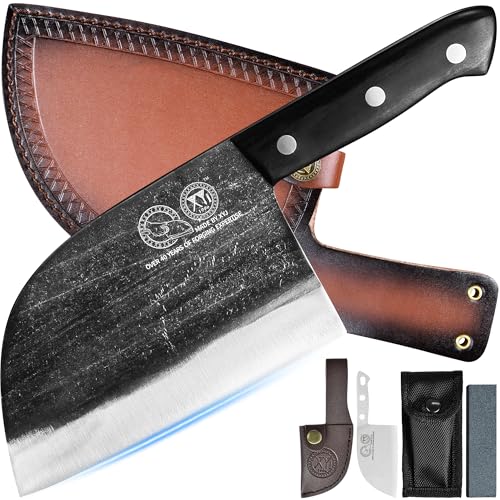 XYJ Authentic Since 1986
- 【XYJ Brand】Established in 1986, XYJ knives are a…
- 【Full Tang Ergonomic Design】XYJ knife features an ergonomic…
- 【Handmade Forging Technology】XYJ knives are sharpened manually by…
 ENOKING 7.5″ Cleaver Knife
- Our razor-sharp Serbian chef knife is forged from…
- Due to the high carbon content of the…
- This meat cleaver is designed for professional chefs…
As an Amazon Associate we earn from qualifying purchases at no extra cost to you.
Chinese-style cleaver vs. heavy meat cleaver
| Feature | Chinese-style cleaver | Heavy meat cleaver |
|---|---|---|
| Typical blade length | 7.5–9 inches | 6–8 inches |
| Typical weight | 8–16 ounces | 1.5–3.5 pounds |
| Typical spine thickness | 1.5–3 millimeters | 4–8 millimeters |
| Best edge angle | About 12–18 degrees per side | About 20–30 degrees per side |
| Best tasks | Vegetables, boneless meat, fish, herbs, garlic, scooping food | Chicken joints, ribs, cartilage, large cuts, splitting small bones |
| Typical retail range | $25–$180 | $25–$150 |
These are useful buying ranges rather than specifications for every model. A cleaver’s actual performance depends on its grind, heat treatment, handle construction, and edge geometry as much as its listed weight.
Best cleaver knives by cooking situation
Best all-purpose choice: a medium-weight Chinese-style cleaver
For most home kitchens, choose a Chinese-style cleaver weighing roughly 10–14 ounces, with a 7.5–8.5-inch blade and a comfortable full-height handle. This size is nimble enough for onions and herbs but substantial enough for cabbage, squash, boneless chicken, and pork.
Models and patterns from makers such as Mercer Culinary, Dexter Russell, and CCK illustrate the range available. Look for a relatively thin cutting edge, moderate flex, and enough blade height to protect your knuckles. This is not a bone cleaver: using it against hard bones can roll or chip its edge.
Best for vegetables and high-volume prep: a thin Chinese-style cleaver
If your cooking is mostly vegetables, stir-fry ingredients, tofu, fish, and boneless meat, prioritize low weight and thin geometry. A blade around 2 millimeters at the spine can move through food with less resistance than a heavy cleaver. The broad face also lets you transfer chopped ingredients to a pan or bowl.
Carbon steel can provide a very keen edge and may be easier to sharpen, but it develops a patina and must be dried promptly. Stainless steel is simpler for busy households, especially if several people share the kitchen. Neither steel type is automatically better; heat treatment and maintenance matter more than a “carbon” or “stainless” label alone.
Best for chicken and occasional bone work: a medium meat cleaver
For breaking down poultry, trimming joints, and handling occasional ribs, choose a medium-weight meat cleaver rather than the heaviest model available. A tool around 1.5–2 pounds offers useful momentum without becoming exhausting during a full prep session.
Dexter Russell makes several established meat-cleaver patterns, and other reputable knife manufacturers offer similar medium-duty designs. Seek a blade that is thick behind the edge but not ground into a razor-thin bevel. The edge should be durable and slightly convex or moderately obtuse, since fragile geometry is a liability when cartilage and joints are involved.
Best for frequent heavy-duty cutting: a large meat cleaver
A 2–3.5-pound cleaver is appropriate for cooks who regularly portion large quantities of meat or need a tool for poultry joints and some small-bone work. Its weight does much of the cutting, but that advantage comes with trade-offs: it requires a large, stable cutting board, more storage space, and better control.
Do not confuse a heavy meat cleaver with a tool intended to split thick beef bones. For that job, a butcher’s saw is usually more controlled and places less shock on the knife, the board, and the user’s hands.
What to compare before buying
Blade weight and balance
Weight should support your cutting motion, not substitute for technique. A Chinese-style cleaver commonly balances near the bolster or slightly forward of it, making it responsive for repeated slicing. A meat cleaver usually balances farther toward the blade, helping it drop through dense food.
Hold the knife by its handle and make a few controlled, dry cutting motions. If the blade continually pulls your wrist downward or the handle forces you to grip tightly, it is probably too heavy or poorly balanced for your use. A 2-pound cleaver can feel manageable for one cook and unwieldy for another.
Steel and edge retention
Stainless steel is the practical default for many homes because it resists rust and tolerates less-than-perfect drying. High-carbon stainless steel may offer a useful compromise between corrosion resistance, sharpening response, and edge retention. Plain carbon steel can take an exceptionally lively edge but needs immediate drying and occasional oiling.
Harder steel may hold an edge longer, but it can be less forgiving of twisting, impact, and poor sharpening. For a cleaver, a balanced heat treatment is more valuable than maximum hardness. A durable medium-hard blade is often the better choice for a shared kitchen.
Handle design
Traditional Chinese-style cleavers often have a round wooden handle secured through a metal tang. They can be comfortable and light, but wood needs hand washing and prompt drying. Modern versions may use riveted composite or synthetic handles, which are easier to maintain.
Meat cleavers commonly use a thick synthetic handle with a pronounced bolster or finger guard. Check that the grip remains secure when wet and that the handle is long enough to keep your fingers away from the heel. A smooth handle is not automatically safer: excessive slipperiness encourages a tighter, more tiring grip.
Blade height and storage
A blade height of roughly 3.5–4.5 inches gives a Chinese-style cleaver useful knuckle clearance and a large surface for scooping. Measure your knife block, drawer, or wall rack before buying; cleavers often do not fit standard narrow knife slots. Heavy cleavers should be stored where their weight cannot damage a drawer or cause the blade to contact other utensils.
A practical decision matrix
| Your situation | Recommended type | Target specification |
|---|---|---|
| New cook with limited storage | Medium Chinese-style cleaver | 8 inches, 10–14 ounces, stainless steel |
| Mostly vegetables and boneless meat | Thin Chinese-style cleaver | 7.5–8.5 inches, 8–12 ounces, thin edge |
| Weekly poultry breakdown | Medium meat cleaver | 6–8 inches, 1.5–2 pounds, thick edge |
| Frequent large-batch meat preparation | Heavy meat cleaver | 7–8 inches, 2–3.5 pounds, reinforced handle |
| Shared kitchen with inconsistent maintenance | Stainless Chinese-style cleaver | 8 inches, corrosion-resistant steel, synthetic handle |
How to keep a cleaver sharp and safe
- Use the right board. Choose end-grain or soft plastic rather than glass, stone, ceramic, or a very hard composite board. Hard surfaces accelerate edge damage.
- Match the motion to the blade. Slice and chop with a Chinese-style cleaver; do not twist it through food. With a meat cleaver, use controlled downward cuts and let the mass of the blade work.
- Sharpen before it becomes dull. A thin cleaver may need a fine whetstone touch-up every few weeks in frequent use. A meat cleaver may need less frequent sharpening but benefits from a coarser, more durable edge.
- Wash by hand. Hot detergent and dishwasher cycles can stain carbon steel, loosen wooden handles, and dull any cleaver through contact with other utensils.
- Dry immediately. Pay attention to the edge, heel, and handle junction. Carbon steel should receive a very thin food-safe protective oil layer if it will be stored for an extended period.
- Inspect for damage. Small edge rolls can often be sharpened out. Chips, cracks, loose handles, or a bent blade call for professional repair or replacement rather than more force.
Common buying mistakes
The most common mistake is buying a heavy meat cleaver because it looks powerful, then discovering that it is tiring for onions and daily vegetables. The opposite mistake is using a thin vegetable cleaver on bones, frozen food, or hard joints. Another is choosing by blade length alone: balance, spine thickness, handle security, and edge geometry have more practical impact.
For a single cleaver in a typical home kitchen, a medium Chinese-style model is the most versatile starting point. Add a medium meat cleaver only if you regularly process poultry or large cuts. Choose the heaviest design only when its specific workload justifies the extra effort, storage, and maintenance.








Write Your Review
No reviews yet. Be the first to share your experience!