

Key takeaways
- One person: 750 ml is enough for boiling water and small meals; 900 ml–1 L is more comfortable for cooking.
- Two people: choose at least 1.2 L for dehydrated meals and about 1.5–2 L for pasta, grains, or soup.
- Three people: look for 2–2.5 L, or split cooking between two pots.
- Four people: a 3 L or larger pot is more practical, but expect a car-camping-oriented set unless the group shares cookware among several packs.
The best camping cookware for lightweight meals is the set that matches your group size and stove rather than the one with the lowest advertised weight: choose a compact 1–2 person titanium or hard-anodized set for backpacking, and a larger aluminum nesting set when durability and shared meals matter more than every gram.
Our top picks


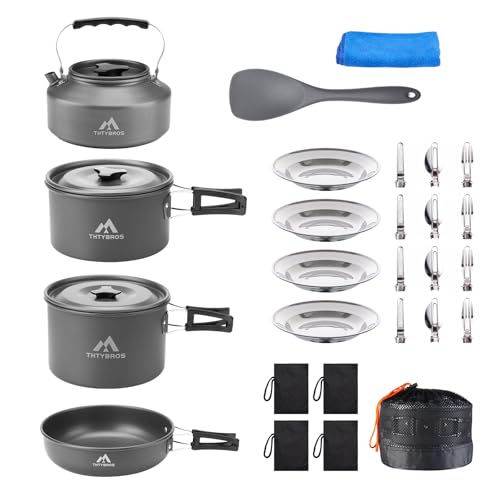
As an Amazon Associate we earn from qualifying purchases at no extra cost to you. Ratings are shown as listed on Amazon.
Best camping cookware at a glance
These are useful reference points from established camping cookware ranges. Weights can vary slightly by included accessories and regional packaging, so treat them as practical comparisons rather than laboratory measurements.
| Cookware set or type | Packed size | Approx. weight | Capacity and servings | Material | Best use |
|---|---|---|---|---|---|
| TOAKS Titanium 750 ml Pot | About 4.1 x 3.5 in / 10.5 x 9 cm | About 3.9 oz / 110 g | 750 ml; 1 person | Titanium | Minimalist boiling and dehydrated meals |
| MSR Trail Mini Duo | About 6.25 x 5.5 in / 16 x 14 cm | About 1 lb 3 oz / 540 g | 1.2 L pot plus 0.8 L pot; 1–2 people | Hard-anodized aluminum | Compact backpacking meals for two |
| Sea to Summit Alpha 2 Pot Cook Set 2.2 | About 7.2 x 5.5 in / 18.3 x 14 cm | About 1 lb 10 oz / 740 g | 2.2 L pot plus accessories; 2–3 people | Hard-anodized aluminum | More substantial meals without car-camping bulk |
| GSI Outdoors Pinnacle Dualist HS | About 7.5 x 5 in / 19 x 13 cm | About 1 lb 11 oz / 770 g | 2 L pot; 2 people | Hard-anodized aluminum with nonstick interior | Shared meals with bowls, mugs, and utensils |
| Stanley Adventure Even-Heat Pot Set | About 8.5 x 5.5 in / 22 x 14 cm | About 2 lb 5 oz / 1.05 kg | 1.9 L pot; 2–3 people | Stainless steel | Car camping and rugged repeated use |
| Basic aluminum nesting set | Usually 6–8 in / 15–20 cm long | About 1–2.5 lb / 450–1,130 g | 1.5–3 L combined; 2–4 people | Anodized or untreated aluminum | Budget camping and larger portions |
Our picks by camping situation
| Your priority | Best choice | Why | Main compromise |
|---|---|---|---|
| Lowest pack weight | 750–900 ml titanium pot | Usually under 6 oz / 170 g and nests around a small canister stove | Small cooking area and poor heat distribution |
| Two backpackers sharing one pot | MSR Trail Mini Duo or similar 1.2–1.5 L aluminum set | Good balance of volume, nesting, and heat control | Heavier than a single titanium pot |
| Comfortable meals for two or three | 2–2.2 L hard-anodized aluminum set | Enough room for pasta, grains, soup, or one-pot meals | Needs more fuel and occupies more pack space |
| Maximum toughness | Stainless-steel set | Resists dents, abrasion, and utensil damage better than thin aluminum | Often roughly twice the weight of a comparable titanium pot |
| Lowest purchase cost | Basic aluminum nesting set | Typically available in the general $25–$60 range | Less refined lids, handles, and coatings |
Head-to-head: titanium, aluminum, and stainless steel
Titanium: the weight specialist
Titanium is the easiest choice when the cooking job is mainly boiling water for dehydrated meals, coffee, or instant foods. It is light, corrosion-resistant, and strong for its weight. A 750 ml pot can weigh close to 110 g, leaving more room for food or fuel in a backpack.
The weakness is heat distribution. Titanium transfers heat less evenly than aluminum, so food can scorch directly over a strong flame even when the rest of the pot is barely simmering. It is also relatively expensive per ounce of usable capacity. For meals that require frying, simmering, or stirring, titanium is usually less forgiving.
Hard-anodized aluminum: the best all-rounder
Hard-anodized aluminum offers a practical middle ground. It is much lighter than steel, distributes heat more evenly than titanium, and is usually less expensive. A 1.2–2.2 L aluminum pot is suitable for oats, rice, pasta, soup, and simple skillet-style meals.
Hard-anodizing makes the surface more resistant to corrosion and scratches, but it does not make the pot indestructible. Avoid abrasive scouring pads, and do not store sharp fuel-canister edges or metal tools loose inside it. A nonstick interior is convenient for eggs and delicate foods, but the coating is the part most likely to fail over years of use.
Stainless steel: durable but heavy
Stainless steel is the ownership choice for car campers, family camps, and anyone who is hard on equipment. It tolerates metal utensils, high heat, and rough cleaning better than coated aluminum. Stainless pots are also less likely to take permanent dents from being packed under other gear.
The trade-off is substantial weight and slower, less even heating unless the base includes an aluminum or copper layer. For a short walk from a vehicle, that penalty may be irrelevant. For a multi-day hike, it is difficult to justify unless ruggedness is the overriding concern.
Capacity matters more than the serving label
Manufacturers’ serving claims often assume modest portions and careful water management. For a more useful estimate, allow roughly 600–750 ml of pot capacity per person when cooking a one-pot meal. This leaves space for stirring and reduces the chance of boil-over.
- One person: 750 ml is enough for boiling water and small meals; 900 ml–1 L is more comfortable for cooking.
- Two people: choose at least 1.2 L for dehydrated meals and about 1.5–2 L for pasta, grains, or soup.
- Three people: look for 2–2.5 L, or split cooking between two pots.
- Four people: a 3 L or larger pot is more practical, but expect a car-camping-oriented set unless the group shares cookware among several packs.
Capacity is not the same as usable cooking volume. A pot marked 1.2 L should not normally be filled to the rim. A working fill level of about 80 percent gives a 1.2 L pot only about 960 ml of comfortable cooking space.
Why nesting design can outweigh a small weight saving
A good nesting set is more than several pots placed inside one another. Check whether the lid locks securely, whether the handles fold flat, and whether the packed interior can hold your stove, lighter, fuel canister, sponge, or utensils. A set that saves 100 g but leaves the stove outside may use more effective pack volume than a slightly heavier complete system.
Measure the equipment you already own before buying. A common small canister stove is roughly 3.5–4.5 inches / 9–11.5 cm wide when folded, while a 100 g fuel canister is about 3 inches / 7.5 cm in diameter. Many 750 ml titanium pots can hold a compact stove and a 100 g canister, but not every lid will close with both inside. Larger sets may nest the cookware well but leave the fuel outside because the pot is too short.
Heat compatibility and stove matching
Most camping cookware is compatible with gas canister, liquid-fuel, and alcohol stoves, but the pot’s size and base design still matter. A narrow titanium pot can sit securely on a small canister stove, while a wide 2 L pot may overhang the supports and become unstable. Check the stove manufacturer’s maximum recommended pot diameter, especially for lightweight burners.
Do not assume every camping pot is suitable for induction. Stainless steel cookware may work on induction only when it has a magnetic base; aluminum and titanium generally do not. For open-fire cooking, use uncoated stainless steel or plain aluminum when the manufacturer permits it. Direct flames can discolor cookware, damage nonstick coatings, and overheat folding handles.
Ownership details that product listings leave out
- Handles wear first: Folding wire or silicone-coated handles loosen, melt, or become uncomfortable when repeatedly exposed to high heat. Keep them outside the flame.
- Lids disappear: A lid that doubles as a pan or plate is useful, but a loose lid is easy to lose. A retaining strap or mesh storage bag helps.
- Coatings need restraint: Use wood, silicone, or plastic utensils with nonstick surfaces. Once coating begins to peel, replace the cookware rather than scraping it back into service.
- Food residue is easier to prevent: Add enough water before heating dry grains or sauces, reduce the flame after boiling, and soak the pot as soon as the meal is served.
- Do not pack wet cookware: Dry the pot before nesting it. Trapped moisture can create odors and, with some metals, surface discoloration.
A simple cost-per-use check
Suppose a $40 aluminum set lasts 40 weekend trips. Its cookware cost is about $1 per trip. A $110 titanium set lasting 80 trips costs about $1.38 per trip, despite the higher initial price. If the titanium set saves 500 g from your pack on every trip, the premium may be sensible for frequent backpacking. If it will be used twice a year beside a car, the lighter set may provide little practical benefit.
Final buying recommendation
For most backpackers, the best camping cookware is a 1.2–1.5 L hard-anodized aluminum nesting set for one or two people. It cooks more evenly than titanium, weighs far less than stainless steel, and handles a wider range of meals. Choose a 750–900 ml titanium pot when every gram matters and your menu is mostly boiled water. Choose a 2–2.2 L aluminum set for generous two-person meals, and move to stainless steel when repeated rough use and vehicle-based camping matter more than packed weight.




Write Your Review
No reviews yet. Be the first to share your experience!