

Key takeaways
- 8-inch skillet: eggs, one grilled cheese sandwich, a single portion, or a small amount of spices.
- 10-inch skillet: the everyday size for two to three portions, chicken breasts, vegetables, and omelets.
- 12-inch skillet: useful for family portions, but only if the induction zone supports its base well.
- 1.5- to 2-quart saucepan: reheating, oatmeal, grains, and small sauces.
- 3-quart saucepan or sauté pan: pasta sauce, rice, vegetables, and one-pan meals.
- 6- to 8-quart stockpot: pasta, soup, blanching, and batch cooking.
The best induction cookware sets are those with fully magnetic, flat bases, useful pan sizes, comfortable handles, and oven limits that match how you cook—not necessarily the set with the most pieces.
Our top picks


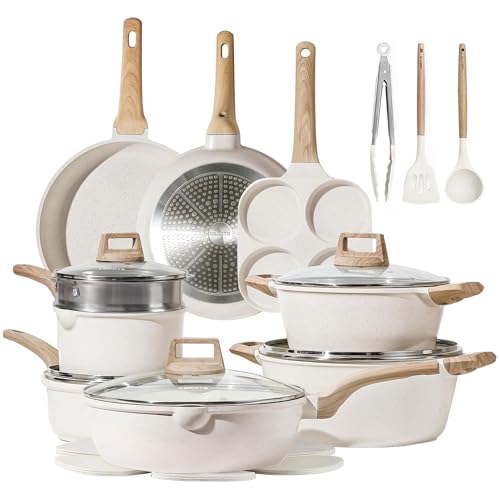

As an Amazon Associate we earn from qualifying purchases at no extra cost to you. Ratings are shown as listed on Amazon.
Best induction cookware sets at a glance
| Best for | Recommended type or set | Typical useful pieces | Oven limit to look for | General market range |
|---|---|---|---|---|
| Best all-round stainless steel | All-Clad D3 Stainless | 8- and 10-inch skillets, 1.5- and 3-quart saucepans, 3-quart sauté pan, 8-quart stockpot | Up to about 600°F for the cookware; lids and handles may differ | $500-$900 |
| Best value stainless steel | Tramontina Tri-Ply Clad | 8- and 10-inch skillets, 1.5- and 3-quart saucepans, sauté pan, stockpot | Often around 500°F, depending on the line and lid | $180-$400 |
| Best premium everyday set | Made In Stainless Clad | 8- and 10-inch skillets, 2-quart saucepan, 3-quart sauté pan, 8-quart stockpot | Typically about 500°F; verify the exact set | $400-$800 |
| Best easy-release coated option | GreenPan Valencia Pro | 8- and 10-inch fry pans, saucepans, sauté pan, stockpot, and lids | Usually up to about 600°F for the pans; lids have lower limits | $250-$500 |
| Best for browning and long-term durability | Tri-ply or five-ply stainless steel | 10- or 12-inch skillet, 3-quart saucepan, 3- or 4-quart sauté pan, 6- to 8-quart pot | 500°F or higher is useful, but check handles and lids | $150-$900 |
These are practical market ranges rather than fixed prices. Set contents, country of sale, promotions, and lid construction can change the specification. Before buying, check the manufacturer’s page for the exact model number.
What makes cookware genuinely induction-ready?
Induction works through a magnetic field, so the pan must contain magnetic material at the cooking surface. Cast iron, enameled cast iron, and magnetic stainless steel work. Aluminum and copper work only when they have a bonded magnetic plate or magnetic stainless-steel base.
For a set, the most important distinction is fully clad construction versus a magnetic disk. Fully clad pans have conductive layers running up the sides, usually stainless steel around an aluminum core. They tend to heat more evenly along the walls and are useful for sauces, braises, and sautéing. Disk-bottom pans concentrate their best heat distribution in the base, but can still perform very well for boiling, frying, and ordinary stovetop cooking.
Magnetic base coverage matters more than the word “induction”
A small magnetic disk under a wide pan can leave the outer cooking area noticeably cooler. This is especially apparent when frying several pieces of food or using a large 12-inch skillet on an induction zone.
Use this quick sizing check: measure the flat magnetic base, not the rim. A 10-inch skillet with an 8-inch magnetic base has a base-area coverage of about 64 percent compared with the pan’s nominal diameter area:
8² ÷ 10² = 0.64
That does not predict cooking performance perfectly, but it explains why two “10-inch” pans can behave differently. A flat base close to the burner’s usable diameter is preferable. Do not assume that a 12-inch pan will heat across its entire surface if your cooktop has an 8- or 9-inch induction zone.
Head-to-head: stainless steel or coated cookware?
Stainless steel
Tri-ply and five-ply stainless cookware is the stronger choice for high-heat searing, pan sauces, deglazing, and long ownership. Stainless surfaces do not rely on a coating that gradually loses release performance. They are also generally dishwasher-compatible, although hand washing preserves the finish.
The trade-off is technique. Preheat the pan over medium heat, add oil, then add food once the oil shimmers. Cold food placed into an underheated stainless pan is more likely to stick. Salt, starch, and mineral deposits can leave discoloration, but these are usually cosmetic and can be removed with a nonabrasive stainless cleaner.
Nonstick or ceramic-coated cookware
Coated pans are convenient for eggs, delicate fish, pancakes, and lower-fat cooking. GreenPan Valencia Pro is an example of a ceramic-coated induction line, while many other induction sets use traditional PTFE-style nonstick coatings.
Coatings are consumable surfaces. High heat, metal utensils, aerosol cooking sprays, abrasive scrubbers, and stacking without protection can shorten their useful life. Even when a set is labeled dishwasher-safe, hand washing with a soft sponge is usually kinder to the finish. A coated skillet is best viewed as a replacement item within an otherwise durable set, not as a lifetime pan.
Pan sizes that earn their cabinet space
A well-chosen set should cover distinct jobs rather than duplicate small pans. These sizes are more useful than a large collection of nearly identical saucepans:
- 8-inch skillet: eggs, one grilled cheese sandwich, a single portion, or a small amount of spices.
- 10-inch skillet: the everyday size for two to three portions, chicken breasts, vegetables, and omelets.
- 12-inch skillet: useful for family portions, but only if the induction zone supports its base well.
- 1.5- to 2-quart saucepan: reheating, oatmeal, grains, and small sauces.
- 3-quart saucepan or sauté pan: pasta sauce, rice, vegetables, and one-pan meals.
- 6- to 8-quart stockpot: pasta, soup, blanching, and batch cooking.
Some sets count lids, inserts, or duplicate skillets as separate pieces. A “12-piece” set may therefore contain only eight actual cooking vessels. Count pans first, lids second.
Decision matrix: which set suits your kitchen?
| Your situation | Best choice | Why | What to avoid |
|---|---|---|---|
| First induction kitchen on a budget | Tri-ply stainless set with 8- and 10-inch skillets | Covers most meals at a lower cost and tolerates high heat | Large sets with multiple tiny saucepans |
| Frequent home cooking | All-Clad D3, Made In Stainless Clad, or comparable clad steel | Durable surface, strong heat control, useful oven performance | Coated sets used for every task |
| Small kitchen or limited storage | Four- or five-piece core set | One 10-inch skillet, one saucepan, one sauté pan, and one pot cover most meals | 12-piece sets with overlapping capacities |
| Mostly eggs and delicate foods | Stainless core set plus one separate coated skillet | Preserves the long life of stainless while providing easy release | Using ceramic or nonstick pans for searing and oven broiling |
| Batch cooking for four or more | 10- or 12-inch skillet and 6- to 8-quart stockpot | Prevents crowding and leaves room for soups and pasta | Sets whose largest skillet has a small magnetic base |
Handle comfort, weight, and oven limits
Induction cookware can be heavier than expected because its base needs magnetic steel and its body may contain several bonded layers. A 10-inch stainless skillet commonly weighs roughly 2.5 to 4 pounds empty; a 12-inch model may reach 4 to 6 pounds. Add food and it can become awkward to lift with one hand.
Look for a handle that leaves enough room for an oven mitt, has a broad rather than needle-thin grip, and connects securely without wobbling. V-shaped or raised handles can stay cooler on the stovetop, but no metal handle should be assumed cool after prolonged cooking.
Oven limits need careful reading. The pan body may tolerate 500°F or 600°F while a glass lid is limited to about 350°F, or a silicone-wrapped handle may have a lower rating. Broiler use is a separate question: some manufacturers permit high oven heat but prohibit direct broiler exposure. If you regularly finish steaks or frittatas under a broiler, choose an uncoated, all-metal pan and confirm the broiler instructions.
Dishwasher compatibility and ownership costs
Stainless steel is usually dishwasher-safe, but repeated cycles can cause dulling, rainbow discoloration, and spotting from hard water. Let pans cool before washing; plunging a very hot pan into cold water can contribute to warping. Avoid abrasive powders on polished exteriors.
For coated cookware, dishwasher compatibility is less important than coating preservation. Use low or moderate heat, wooden or silicone utensils, and a soft sponge. Never heat an empty coated skillet for an extended period. Store pans with a cloth or pan protector between them.
There is also a cost-per-use difference. Suppose a $250 stainless set lasts 10 years and is used four times per week:
10 years × 52 weeks × 4 uses = 2,080 uses
$250 ÷ 2,080 = about 12 cents per use
A $350 coated set that needs replacement after four years can cost more per use despite costing less than some premium stainless sets initially. That calculation excludes energy, accessories, and replacement individual pans, but it illustrates why construction and the expected life of the cooking surface matter.
Bottom line
Choose a tri-ply stainless induction set if you want the best balance of durability, oven versatility, and cooking range. Tramontina Tri-Ply Clad is a sensible value direction; All-Clad D3 and Made In Stainless Clad are stronger premium choices. Choose a ceramic-coated induction set such as GreenPan Valencia Pro when easy release is your priority, while accepting that the coating will eventually wear.
Before checkout, verify four things on the exact set: the diameter of the magnetic base, the actual pan capacities, the lowest oven limit among the pieces you plan to use, and whether the handles and lids suit your storage and washing habits. Those details determine whether a cookware set remains useful after the novelty of a new induction cooktop wears off.






Write Your Review
No reviews yet. Be the first to share your experience!