
Our Short List of 3

- Best for: Cooks who want the lightest, most nimble knife in this group
- Blade length: 8 inches
- Blade material: CROMOVA 18 stainless steel
- Handle material: Stainless steel, dimpled and sand-filled for balance
- Construction: Stamped, one-piece design with no bolster
- Best for: Cooks who want a keen Japanese edge that is still easy to maintain
- Blade length: 8 inches
- Blade material: VG10 core with 420J stainless steel upper
- Edge: Plain edge, sharpened to 16 degrees
- Handle material: Textured polymer blend

- Best for: Buyers who want proven VG10 performance with no money spent on looks
- Blade length: 8.2 inches
- Blade material: Stainless steel with VG10 core, per the listing title
- Handle material: Stainless steel and steel handle assembly, per the listing
- Construction: Forged, per the listing
All 5 Picks at a Glance
| Product | Specs | Action |
|---|---|---|
| Global G-2 8-Inch Chef’s Knife |
| Check price on Amazon |
| Shun Sora 8-Inch Chef’s Knife |
| Check price on Amazon |
| Tojiro Professional Chef Knife 8.2-Inch |
| Check price on Amazon |
 MAC Knife Chef Series Hollow Edge Chef’s Knife 8-Inch |
| Check price on Amazon |
 Dalstrong Gladiator Series Chef Knife 8-Inch |
| Check price on Amazon |
Key takeaways
- Compare five 100-dollar chef knives from Global, Shun, Tojiro, MAC and Dalstrong by steel, edge angle, weight and handle before you pick one for home prep.
Spending at this level on a single chef knife is really a decision about trust. You are paying for an edge that stays keen for weeks instead of days, steel that resists stains and chips, and a handle that still feels secure during the last onion of a long prep session. Go too soft and you sharpen constantly; go too hard and one careless twist in a squash can damage the edge.
This shortlist suits home cooks upgrading from a block set, keen beginners buying their first serious blade, and anyone who cooks most nights and wants one knife to carry the workload. Every pick below was chosen from the name, steel and dimensions stated on its Amazon listing, and each one is an 8-inch class chef knife or gyuto, so the comparison stays honest.
Quick Picks
As an Amazon Associate we earn from qualifying purchases
| Product | Best for | Key spec from title |
|---|---|---|
| Global G-2 8-Inch Chef’s Knife | Lightweight precision cutting | 8-inch CROMOVA 18 stainless blade |
| Shun Sora 8-Inch Chef’s Knife | A fine Japanese edge with easy upkeep | VG10 core with 420J stainless upper |
| Tojiro Professional Chef Knife 8.2-Inch | Hard VG10 steel in a plain package | 8.2-inch VG10 blade, model F-808 |
| MAC Knife Chef Series Hollow Edge Chef’s Knife 8-Inch | Sticky produce that clings to flat blades | 8-inch hollow edge, model TH-80 |
| Dalstrong Gladiator Series Chef Knife 8-Inch | Cooks who prefer a heavier forged build | 8-inch German high-carbon steel, full tang |
How to Choose
Steel and hardness decide how the edge ages
Steel is the first filter at this level. Softer German-style stainless in the mid-fifties on the Rockwell scale shrugs off rough treatment, hones back quickly on a rod, and forgives contact with bone or a frozen squash. Harder Japanese steels such as VG10, used by the Shun and Tojiro picks here, hold a working edge far longer but ask for a whetstone and a little care around hard rinds. Neither direction is better in the abstract. Match the steel to your habits: frequent honing and heavy board work point one way, patient slicing and stone sharpening point the other.
Edge angle and blade profile shape every cut
Look at the angle ground into the edge and the curve of the blade belly. A 15 or 16 degree edge, common on the Japanese knives in this list, moves through onions, herbs and raw fish with very little pressure, which is why those blades feel so precise. A slightly wider angle near 18 degrees survives rock chopping and dense roots with less risk of micro-chipping. Profile matters just as much: a gentle continuous curve supports rocking through herbs, while a flatter gyuto profile rewards long push cuts and draws through proteins. Choose the geometry that matches the motion you actually use nightly.
Weight and balance change how tired your hand gets
Two knives can share a blade length and feel nothing alike. A light blade around six ounces keeps your wrist fresh through a kilo of potatoes and gives fine control at the tip, while a heavier forged knife near nine ounces lets momentum do more of the work on cabbage, squash and whole chickens. Balance point matters too. A knife that balances at the pinch grip feels agile; one that leans toward the handle feels calmer and more planted. If you cook in long sessions, weight is not a vanity spec. It decides whether the last ten minutes of prep feel as controlled as the first.
Handle material and care set the daily routine
Handles split into three camps here: all-stainless designs like the Global, textured polymer like the Shun, and wood or laminate grips like the MAC and the G10 on the Dalstrong. Stainless is seamless and easy to rinse clean, polymer stays grippy with wet hands, and wood-style handles feel warm but demand prompt drying. Care is the other half of the decision. Every knife in this roundup is a hand-wash blade according to its listing, so a buyer who relies on the dishwasher should plan a thirty-second sink routine instead. Storage counts as well, since a hard edge loose in a drawer dulls and chips quickly.
The 5 Best Options
Global G-2 8-Inch Chef’s Knife
- Best for: Cooks who want the lightest, most nimble knife in this group
- Blade length: 8 inches
- Blade material: CROMOVA 18 stainless steel
- Handle material: Stainless steel, dimpled and sand-filled for balance
- Construction: Stamped, one-piece design with no bolster
Cooks who want the lightest, most nimble knife in this group
The all-metal handle can feel slick with greasy hands, and there is no bolster
The G-2 is the pick for cooks who find German knives clumsy. It is one seamless piece of stainless steel, with a hollow handle filled with sand for balance and a dimpled surface your fingers can read even before you look down. The CROMOVA 18 blade takes an acute edge and the whole knife stays light, so tip work on garlic, herbs and chillies feels controlled rather than effortful. It suits smaller hands especially well, and the lack of seams or rivets makes cleanup simple. If your cooking leans toward vegetables, fish and precise slicing, this is the most distinctive option here.
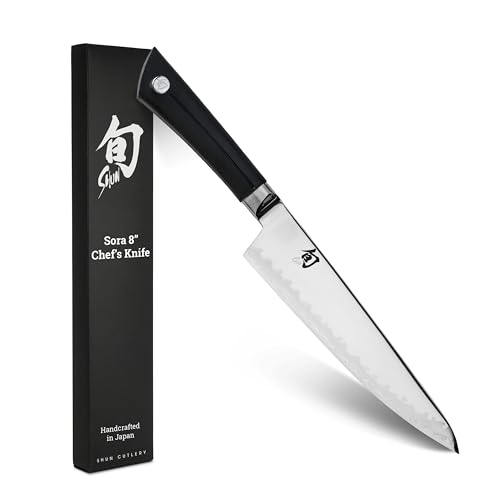
Shun Sora 8-Inch Chef’s Knife
- Best for: Cooks who want a keen Japanese edge that is still easy to maintain
- Blade length: 8 inches
- Blade material: VG10 core with 420J stainless steel upper
- Edge: Plain edge, sharpened to 16 degrees
- Handle material: Textured polymer blend
Cooks who want a keen Japanese edge that is still easy to maintain
The narrow blade gives less knuckle clearance than a tall Western profile
Shun built the Sora around a simple idea: put the expensive steel only where the cutting happens. The edge is VG10, while the upper part of the blade is 420J stainless, joined in a san mai construction that keeps the knife easier to live with than a full hard-steel blade. The profile is a narrow gyuto shape, so it slips between slicing and chopping without the tall, heavy feel of a Western chef knife. Its textured polymer handle is shaped for both left and right hands, which makes it a practical shared-household pick. Choose it for a fine edge without collector pricing.
Tojiro Professional Chef Knife 8.2-Inch
- Best for: Buyers who want proven VG10 performance with no money spent on looks
- Blade length: 8.2 inches
- Blade material: Stainless steel with VG10 core, per the listing title
- Handle material: Stainless steel and steel handle assembly, per the listing
- Construction: Forged, per the listing
Buyers who want proven VG10 performance with no money spent on looks
Hard steel can chip on bones or frozen food, so keep it for clean slicing work
This Tojiro listing, model F-808, is the well-known DP gyuto in everything but the headline name. The blade runs a little longer than the standard 8 inches and uses a VG10 core, the steel that made this model a long-running recommendation for a first Japanese knife. There is no decorative cladding or polished handle to pay for; the listing describes a plain, working knife with a stainless bolster style build and a dark handle. It rewards cooks who slice proteins and vegetables with long strokes and who are willing to sharpen on a stone. Buy it for the steel, not the styling.
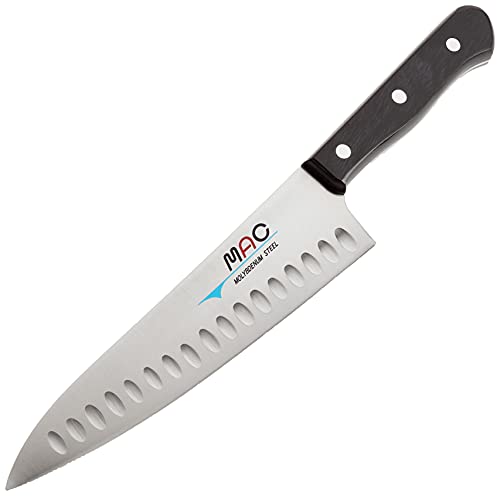
MAC Knife Chef Series Hollow Edge Chef’s Knife 8-Inch
- Best for: Vegetable-heavy prep where slices keep sticking to the blade
- Blade length: 8 inches
- Blade material: Alloy steel
- Blade edge: Hollow edge with dimples
- Handle material: Wood handle with steel, per the listing
Vegetable-heavy prep where slices keep sticking to the blade
The wood handle needs prompt drying, and the listed weight is the heaviest here
MAC takes a different route to the same money. The TH-80 pairs an 8-inch alloy steel blade with a hollow edge, meaning a row of dimples ground along the face so slices of potato, apple and cucumber release instead of suctioning onto the blade. The handle is wood, the shape is a straightforward Western chef profile, and the whole design is aimed at cooks who prep a lot of produce and hate stopping to flick slices off the blade. It is also a sensible pick for someone who wants Japanese sharpness habits, meaning a thin edge and hand washing, in a familiar shape.
Dalstrong Gladiator Series Chef Knife 8-Inch
- Best for: Cooks who prefer a weighty, forgiving German-style workhorse
- Blade length: 8 inches
- Blade material: High-carbon German stainless steel
- Hardness: 56 HRC and above, per the listing details
- Edge: Hand polished to 16 to 18 degrees per side
Cooks who prefer a weighty, forgiving German-style workhorse
The extra heft can tire smaller hands during long vegetable prep
The Gladiator is the counterweight to the Japanese picks. It uses high-carbon German steel in a forged, full tang build with a triple-riveted G10 handle, a stainless end cap and a blade polished to a 16 to 18 degree edge per side. That recipe gives you heft, a familiar curved belly for rocking, and steel that tolerates honing rods and the odd knock against a pan. Dalstrong lists it as NSF certified, and the package includes a sheath, which helps if your storage is a roll or a drawer. Pick it if your cooking is built around whole chickens, hard squash and big boards of root vegetables.
Which One Fits Your Situation
You are upgrading from a dull block set
Start with the Shun Sora or the Tojiro. Both put a genuinely hard, fine edge in your hand, which is the upgrade you will notice most after years of soft set knives. The Sora feels friendlier thanks to its textured handle and easier-care upper blade, while the Tojiro gives the longer blade and the more traditional gyuto behaviour. Either one will make a basic whetstone worth owning.
Your prep is mostly vegetables, salads and stir-fries
Choose between the MAC TH-80 and the Global G-2. The MAC earns its place when potato and cucumber slices keep gluing themselves to the blade, because the hollow edge breaks that suction. The Global wins when speed and lightness matter more, since its slim one-piece body flicks through onions and herbs with very little wrist effort. Both ask for hand washing, so the deciding factor is sticking versus sheer agility at the board.
You break down chickens and tackle hard winter squash
Take the Dalstrong Gladiator. Its forged full tang build, G10 handle and more forgiving German steel are better suited to joints, thick rinds and the occasional twist than the harder Japanese edges in this list. The weight that might annoy a salad cook becomes an asset here, driving the blade through dense flesh with less downward pressure from your arm. Keep a honing rod nearby and touch the edge up little and often.
Two cooks with different hands share one knife drawer
The Shun Sora is the safest shared pick because its handle is shaped for left and right hands and its weight sits in the middle of this group. The Global is the other candidate, with a symmetrical all-steel grip, but some cooks find metal handles slippery. If one of you rocks and the other push-cuts, the Sora’s in-between profile causes the fewest arguments, and its composite blade keeps sharpening day simple for whoever draws that job.
Common Mistakes
- Buying the hardest steel available, then using it on bones, frozen food and squash stems until the edge chips.
- Judging a knife by blade length alone and ignoring weight, balance and handle shape, which decide comfort far more.
- Putting a hand-wash blade through the dishwasher, where detergent and rattling racks dull and stain the edge.
- Storing a sharp knife loose in a cutlery drawer instead of a sheath, block or magnetic strip.
- Skipping any sharpening plan, then blaming the steel when a neglected edge stops performing after a few months.
Frequently Asked Questions
Is a knife at this level really different from a cheap supermarket blade?
Yes, and the difference shows up in three places: the edge stays working-sharp for much longer, the blade is ground thinner so it wedges less in dense food, and the handle and balance stay comfortable through a full session. You still have to sharpen it eventually, but the gap between sharpenings is where the money goes.
Should I choose a Japanese or a German style knife?
Choose Japanese if your cooking is built on slicing, fish and vegetables and you are happy sharpening on a stone. Choose German if you rock chop, work around bones and hard squash, and want steel that forgives rough handling and a quick pass on a honing rod. Many home cooks end up owning one of each, starting with the style that matches most of their weeknight cooking.
How do I keep an edge like this sharp at home?
Hone lightly and often if the steel is soft enough, and sharpen on a whetstone when honing stops restoring the bite. Keep the angle consistent rather than chasing a perfect number, dry the blade straight after washing, and store it protected. A knife at this level does not need professional sharpening unless the edge is chipped or badly neglected.
Is 8 inches the right size for a first serious knife?
For most adults and most boards, yes. An 8-inch blade is long enough for a cabbage, a chicken and a bunch of herbs, yet short enough to stay controllable for tip work. The Tojiro here runs slightly longer at 8.2 inches, which suits taller cooks and bigger boards. Only go shorter if your board is small or your hands strongly prefer a compact knife.
More from Amazon
Programs that pair well with the guide above. Offers and eligibility are set by Amazon and may change.
Set up recurring deliveries of everyday items on eligible products. Terms and savings are set by Amazon.
Explore Subscribe & SaveCollect the home and kitchen items you want in one registry that guests can shop from.
Create a wedding registryFree shipping on eligible items, Prime Video and more. Eligible new members can start with a free trial.
Start a Prime free trialAudiobooks and podcasts to listen to on the go. Eligible new members can start with a free trial.
Try Audible freeAs an Amazon Associate we earn from qualifying purchases.
Write Your Review
No reviews yet. Be the first to share your experience!