

Key takeaways
- Pop-up toaster vs toaster oven compared on toast quality, capacity, footprint, functions and cleanup, with five spec-checked picks for your counter.
Table of Contents
- Quick Verdict
- How Each Appliance Works
- Toaster vs Toaster Oven at a Glance
- Key Differences That Matter
- The Pop-Up Toaster Picks
- The Toaster Oven Picks
- Who Should Choose a Pop-Up Toaster
- Who Should Choose a Toaster Oven
- FAQ
- Conclusion
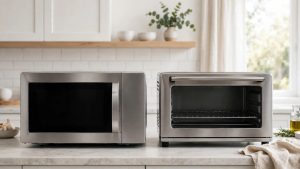
Choose a pop-up toaster if your mornings are about bread, bagels, and frozen waffles, and you want the fastest, simplest route from fridge to plate with almost no cleanup. Choose a toaster oven if you want one appliance that toasts and also bakes, broils, reheats pizza, and handles small meals without heating up your full-size oven. The two overlap at breakfast and diverge everywhere else: a pop-up toaster is a single-purpose browning machine with vertical slots, while a toaster oven is a miniature oven with a door, a rack, and room for real food. Counter space, batch size, and how much cooking you honestly do beyond toast decide which one earns the spot.
As an Amazon Associate, we earn from qualifying purchases.
Quick Verdict
- Best for pure toast speed and simplicity: a pop-up toaster. Slots surround each slice with close, intense heat, cycles are short, and there is nothing to preheat or scrub beyond an occasional crumb tray.
- Best for versatility: a toaster oven. The flat rack takes four or more slices at once, fits a small pizza or baking pan, and adds bake, broil, and keep-warm functions a slot toaster cannot offer.
- Best middle ground: a compact toaster oven with strong toast presets, or a larger oven-style model with an air fry function, if you want one appliance to cover both jobs.
How Each Appliance Works
A pop-up toaster holds bread vertically between two sets of radiant elements inside narrow slots. Because the elements sit very close to both faces of the slice, browning is fast and usually even across the surface, and a spring carriage lifts the toast when the cycle ends. Controls are minimal by design: a shade dial or slider, plus dedicated buttons for bagel, defrost, and cancel on most models. The format is brilliant at one job and incapable of almost everything else, since nothing wider than the slot, and nothing in a dish, can go in.
A toaster oven is a small insulated box with heating elements above and below a wire rack, a drop-down door, and dials or buttons for function, temperature, and time. Food lies flat, so the cavity accepts bread slices side by side, a personal pizza, an open-faced sandwich, or a small casserole. Many models add convection, where a fan circulates the hot air for faster, more even baking, and premium models add air fry, roast, proof, and dehydrate functions. The trade-off is size and patience: the cavity is far bigger than a toaster slot, so preheating and toasting take longer, and there are more surfaces to clean.
Toaster vs Toaster Oven at a Glance
| Factor | Pop-Up Toaster | Toaster Oven |
|---|---|---|
| Cooking format | Vertical slots, radiant elements | Flat rack in an enclosed cavity |
| Capacity | 2 or 4 slices per cycle | 4 to 9 slices, or a small pizza |
| Footprint | Narrow and compact | Wide; needs door clearance |
| Toast speed | Fastest; no preheat | Slower; often needs preheat |
| Beyond toast | Bagels, waffles, pastries only | Bake, broil, roast, reheat, pizza |
| Temperature control | Shade settings only | Full range, roughly 200 to 500 degrees F |
| Cleanup | Slide-out crumb tray | Crumb tray, rack, pan, interior walls |
| Best role | Dedicated breakfast browning | Small second oven |
Key Differences That Matter
Toast quality and batch size
For a single slice or a pair, a pop-up toaster is hard to beat: the elements hug the bread, cycles run short, and shade dials give repeatable results once you learn your number. Its weakness is throughput, because two slices at a time means a queue when a family eats together. A toaster oven lays four to nine slices flat, so big breakfasts finish in one batch, and models with toast-specific engineering, such as shaped elements or infrared heaters, close much of the evenness gap. The oven still asks for a short preheat on many models, and slices near the door can brown a touch lighter than slices at the back.
Versatility beyond breakfast
This is where the comparison stops being close. A pop-up toaster cannot melt cheese on an open sandwich, reheat a slice of pizza without folding it, roast vegetables, or bake muffins. A toaster oven does all of that, and larger models fit a standard 9 by 13 inch pan or a whole small chicken. If your countertop appliance has to cover weeknight cooking and not just breakfast, the toaster oven is the only candidate of the two. If it genuinely only ever makes toast, the oven’s extra functions are wasted money and wasted space.
Footprint and storage
Pop-up toasters are small in every direction, typically around eleven inches wide and seven inches tall, and they slide under upper cabinets easily. Toaster ovens start at roughly thirteen inches wide for compact four-slice models and pass twenty inches wide at the family-size end, and the door needs clear space in front to open and load safely. Measure your counter depth and the gap under your cabinets before choosing an oven, and remember that oven exteriors get hot, so they need breathing room on the sides and top that a slot toaster does not.
Speed and energy use
A pop-up toaster draws roughly 800 to 1,000 watts and finishes a cycle in a couple of minutes, which makes it the cheapest way to brown bread. A toaster oven draws 1,150 to 1,800 watts and spends part of that on heating a much larger cavity, so a single slice costs more time and energy in the oven. The math flips for bigger jobs: reheating leftovers or baking a small casserole in a toaster oven uses far less energy than firing up a full-size range, which is the comparison that matters for cooking beyond toast.
Cleanup and maintenance
The pop-up toaster wins here without a fight. Shake out or slide out the crumb tray, wipe the exterior, and you are done; there is no greasy interior because nothing but dry bread goes in. A toaster oven collects splatter from cheese, pizza, and roasted foods on its walls, rack, and pan, so it needs regular wiping to avoid baked-on residue and lingering odors. Removable crumb trays, nonstick or enamel interiors, and dishwasher-safe racks and pans are the features that make oven upkeep tolerable.
The Pop-Up Toaster Picks
Cuisinart CPT-122BK 2-Slice Compact Plastic Toaster (Budget)
The Cuisinart CPT-122BK is the straightforward slot toaster most small kitchens need. Its two slots are 1.5 inches wide, enough for bagel halves and thick sliced bread, and the high-lift carriage raises small items like English muffins high enough to grab without reaching in. A seven-setting shade dial covers the range from barely warm to dark, and separate bagel, defrost, and reheat functions adjust the cycle for each job. The compact body can sit facing forward or sideways to fit awkward counters, which suits dorms, offices, and apartments where every inch is negotiated.
Specs:
- Slices: 2, with 1.5-inch wide slots
- Wattage: 800 watts
- Shade settings: 7
- Functions: Bagel, defrost, reheat, cancel
- Housing: Plastic, matte black finish
- Dimensions: 6.5 x 11 x 7.2 inches
- Weight: 3.5 pounds
- Extras: High-lift carriage, slide-out crumb tray
- Warranty: Limited 3-year
Breville BTA720XL ‘A Bit More’ 2-Slice Toaster (Premium)
The Breville ‘A Bit More’ answers the two classic toaster frustrations: toast that comes up slightly too light, and no way to check progress without canceling the cycle. Its ‘A Bit More’ button adds a short burst of browning at the end of a cycle, and ‘Lift & Look’ raises the carriage mid-cycle so you can inspect the shade and drop it back down without restarting. The extra-wide slots self-center around thick artisanal slices and bagels, an LED indicator counts down the cycle, and the brushed stainless steel body feels a class above basic plastic models.
Specs:
- Slices: 2, extra-wide self-centering slots
- Wattage: 1,000 watts
- Browning settings: 6
- Functions: ‘A Bit More’, ‘Lift & Look’, bagel, defrost, cancel
- Housing: Brushed stainless steel
- Dimensions: 7.3 x 11.3 x 8.2 inches
- Weight: 5.1 pounds
- Extras: LED progress indicator, automatic shut-off, slide-out crumb tray
The Toaster Oven Picks
BLACK+DECKER TO1313SBD 4-Slice Toaster Oven (Budget)
The BLACK+DECKER TO1313SBD is the entry point to the toaster oven format, and it covers the essentials in a compact stainless steel cabinet. The curved interior fits four slices of bread or a 9-inch pizza, and the brand’s EvenToast element design aims heat toward the center of the cavity for more uniform browning across all four slices. Four functions (bake, broil, toast, and keep warm) are set with simple knobs, natural convection circulates air during baking, and the 30-minute timer offers a stay-on option for longer jobs plus auto shut-off for safety.
Specs:
- Capacity: 4 slices or a 9-inch pizza
- Wattage: 1,150 watts
- Functions: Bake, broil, toast, keep warm
- Temperature: Up to 450 degrees F
- Timer: 30 minutes with stay-on option and auto shut-off
- Controls: Knob dials for function, temperature, and time
- Dimensions: 15.47 x 11.18 x 8.3 inches
- Weight: 6.65 pounds
- Extras: EvenToast Technology, removable crumb tray, baking and broiler pan and toasting rack included
Panasonic FlashXpress NB-G110P Toaster Oven (Mid-Range)
The Panasonic FlashXpress takes a different route to good toast: instead of conventional elements that need preheating, it uses double infrared heating, with quartz and ceramic elements at the front and back of the cavity that reach temperature almost instantly. Six auto cook presets handle toast, waffles, rolls, pizza, reheating, and hash browns, and manual control runs from 250 to 500 degrees F with a digital timer. The baking rack is connected to the door and slides toward you as it opens, and auto shut-off ends the cycle when the timer finishes. It is the compact oven to pick when toast quality, not capacity, is the priority.
Specs:
- Capacity: 4 slices or a 9-inch pizza
- Wattage: 1,300 watts
- Heating: Double infrared (quartz and ceramic), no preheat required
- Functions: 6 auto cook presets, plus manual temperature and timer
- Temperature range: 250 to 500 degrees F
- Interior dimensions: 10.2 x 9.8 x 4.1 inches
- Dimensions: 13 x 12 x 10.25 inches
- Weight: 7.5 pounds
- Extras: Door-connected rack, interior light, removable crumb tray, 9-inch square baking tray included
Breville BOV900BSS Smart Oven Air Fryer Pro (Premium)
The Breville Smart Oven Air Fryer Pro is the toaster oven as a genuine second oven. Its one cubic foot interior toasts nine slices at once, fits a 13-inch pizza, most 9 by 13 inch pans, and a 14-pound turkey, and its Element iQ system steers power among the quartz elements to suit the selected function. Thirteen functions run from toast and bagel through roast, pizza, air fry, proof, slow cook, and dehydrate, and the two-speed super convection fan speeds up roasting and air frying. An LCD screen, an interior light, and a full accessory set (pizza pan, two racks, roasting pan, and air fry basket) complete a machine built for households that cook daily.
Specs:
- Capacity: 1 cubic foot; 9 slices, 13-inch pizza, 14-pound turkey
- Wattage: 1,800 watts
- Functions: 13, including toast, bagel, bake, roast, pizza, air fry, proof, slow cook, dehydrate
- Heating: Element iQ quartz elements with two-speed super convection
- Controls: LCD display with function and temperature dials
- Dimensions: 21.4 x 17.3 x 12.7 inches
- Extras: Interior light, 13-inch pizza pan, two wire racks, enamel roasting pan, air fry and dehydrate basket
- Warranty: 2-year limited
Who Should Choose a Pop-Up Toaster
Pick the pop-up toaster if breakfast is the whole job description. It suits singles, couples, dorm rooms, and offices where toast, bagels, and frozen waffles are the daily routine and counter space is tight. It is also the right second appliance in a kitchen that already has a good oven: it browns bread faster and cheaper than any oven, asks for almost no cleaning, and costs less in every tier than a comparable oven. The Cuisinart above covers the basics with a long warranty, while the Breville adds mid-cycle checking and extra browning control for bread enthusiasts.
Who Should Choose a Toaster Oven
Pick the toaster oven if you cook small meals often, reheat pizza and leftovers, or live without a full-size oven in a studio, rental, or RV. Families benefit from the batch capacity at breakfast, and anyone who bakes small trays of cookies, roasts vegetables for two, or melts cheese on sandwiches will use the oven daily in ways a slot toaster cannot match. Choose the compact BLACK+DECKER for basic duty, the Panasonic when fast, even toast matters most, and the Breville when the oven needs to stand in for a full range.
FAQ
Can a toaster oven replace a pop-up toaster completely?
For most households, yes, provided the oven has a dedicated toast function and you accept slightly longer cycles. A toaster oven toasts four or more slices at once and handles everything else besides, so it can be the only browning appliance on the counter. Dedicated toasters still win on speed for one or two slices, on counter space, and on cleanup, which is why toast purists and tiny kitchens often keep the slot format.
Is a toaster oven worth it if I already have a full-size oven?
It can be, because a toaster oven heats a small cavity instead of a large one, so reheating leftovers, baking a few cookies, or cooking dinner for one or two people is faster and uses less energy than preheating the range. It also frees the main oven during holiday cooking. If you rarely cook small portions and mainly make toast, the pop-up toaster is the better buy and the easier appliance to store.
What size toaster oven fits a frozen pizza?
Compact four-slice models such as the BLACK+DECKER and Panasonic above fit a 9-inch personal pizza. Mid-size ovens typically fit a 12-inch pizza, and large models like the Breville fit a 13-inch pizza along with a standard 9 by 13 inch baking pan. Check the stated pizza diameter and interior width in the specs rather than the slice count, since slice counts say nothing about round foods.
Do toaster ovens toast as evenly as pop-up toasters?
Basic toaster ovens can brown unevenly, with darker edges near the elements, because the slice lies farther from the heat than it does in a slot. Models designed around toasting, with shaped elements, convection fans, or infrared heaters like the Panasonic FlashXpress, narrow the gap considerably. A pop-up toaster remains the most consistent tool for plain sliced bread, especially across back-to-back batches at one shade setting.
Conclusion
The toaster vs toaster oven decision comes down to how much cooking your countertop appliance really does. If it is toast and bagels, morning after morning, a pop-up toaster does that job faster, smaller, and with less cleanup: the Cuisinart CPT-122BK is the value pick, and the Breville ‘A Bit More’ is the upgrade for people who fuss over shade. If the appliance also has to reheat, bake, and cook small meals, a toaster oven earns its larger footprint: the BLACK+DECKER TO1313SBD covers the basics, the Panasonic FlashXpress prioritizes fast and even toast, and the Breville Smart Oven Air Fryer Pro is the full second oven. Match the format to your routine, and either choice will serve you well for years.
More from Amazon
Programs that pair well with the guide above. Offers and eligibility are set by Amazon and may change.
Set up recurring deliveries of everyday items on eligible products. Terms and savings are set by Amazon.
Explore Subscribe & SaveCollect the home and kitchen items you want in one registry that guests can shop from.
Create a wedding registryFree shipping on eligible items, Prime Video and more. Eligible new members can start with a free trial.
Start a Prime free trialAudiobooks and podcasts to listen to on the go. Eligible new members can start with a free trial.
Try Audible freeAs an Amazon Associate we earn from qualifying purchases.

Write Your Review
No reviews yet. Be the first to share your experience!