

Key takeaways
- Microwave vs toaster oven compared on speed, browning, capacity and counter space, with five current models and full specs to help you pick the right one.
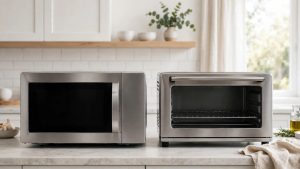
A microwave and a toaster oven sit in the same corner of the kitchen and get asked to do many of the same jobs: reheating leftovers, warming frozen snacks, and cooking small meals without firing up the full-size range. Under the door, though, they work in completely different ways. A microwave heats food with microwave energy that agitates water molecules inside the food itself, while a toaster oven is a miniature conventional oven that cooks with radiant heating elements and, on many models, a convection fan.
That single difference decides almost everything about which one belongs on your counter. Microwaves are faster and better with liquids, sauces, and steaming tasks. Toaster ovens brown, crisp, toast, and bake the way a regular oven does, just in a smaller box. This guide breaks down how each appliance handles the everyday jobs, then lines up five current models — three countertop microwaves and two toaster ovens — with their published specs so you can match the appliance to the way you actually cook.
As an Amazon Associate, we earn from qualifying purchases.
Table of Contents
- The Short Answer
- How Each Appliance Cooks
- Microwave vs Toaster Oven at a Glance
- The 5 Models Compared
- How to Choose Between a Microwave and a Toaster Oven
- Who Should Skip Each One
- Frequently Asked Questions
- Final Verdict
The Short Answer
Choose a microwave if most of your countertop cooking is reheating coffee, soup, sauces, and leftovers, defrosting ingredients, or steaming vegetables, and you want it done in a few minutes. Choose a toaster oven if you regularly toast bread, bake small batches of cookies or casseroles, roast vegetables, broil, or reheat pizza and fried foods that you want to stay crisp. Many kitchens eventually keep both, but if you only have room for one, your most frequent task should make the decision.
How Each Appliance Cooks
A microwave generates electromagnetic waves that penetrate food to a shallow depth and excite water, fat, and sugar molecules, producing heat from within the food. Because the energy acts directly on the food rather than heating the surrounding air, cooking starts almost instantly and there is no preheating. The trade-off is texture: a microwave cannot brown or crisp surfaces, so crusts stay soft and cheese melts without blistering. Traditional models cycle full power on and off to simulate lower settings, while inverter models deliver genuinely continuous low power for gentler, more even results.
A toaster oven heats air and surfaces with electric elements — quartz, metal, or infrared depending on the model — exactly like a full-size oven scaled down. Food cooks from the outside in, surfaces dry out and brown, and a convection fan, when fitted, circulates hot air to speed cooking and even out hot spots. The cost is time: most toaster ovens need a short preheat, and cooking usually takes longer than a microwave for the same portion. In exchange, you get real oven behavior, including toast, broiled tops, baked goods, and reheated foods that keep their crunch.
Microwave vs Toaster Oven at a Glance
| Factor | Microwave | Toaster Oven |
|---|---|---|
| Heating method | Microwave energy acts on the food directly | Radiant elements heat the air and food surfaces |
| Speed | Fastest option; no preheat | Slower; short preheat on most models |
| Browning and crisping | No | Yes, like a conventional oven |
| Best tasks | Reheating liquids, defrosting, steaming, melting | Toasting, baking, roasting, broiling, reheating pizza |
| Texture results | Soft, steamed | Crisp, browned, baked |
| Typical capacity | 0.7 to 2.2 cu ft countertop models | 0.5 to 1 cu ft interiors |
| Cookware limits | No metal; microwave-safe dishes only | Most oven-safe pans, including metal |
The 5 Models Compared
1. Toshiba EM131A5C-BS Countertop Microwave — Mid-Range Microwave Pick
The Toshiba EM131A5C-BS is the middle-ground microwave in this comparison: a 1.2 cubic foot cavity with 1,000 watts of cooking power and a 12.4-inch removable turntable that fits a dinner plate comfortably. Its smart humidity sensor adjusts time and power based on the steam coming off the food, which takes some of the guesswork out of the 12 auto menus. A mute function silences the beeps, ECO mode cuts standby draw, and the interior is designed for easy wiping. For a household that reheats full plates and cooks frozen meals daily, this size and power class is the practical sweet spot.
Specs:
- Type: Countertop microwave
- Capacity: 1.2 cu ft
- Power: 1,000 watts
- Turntable: 12.4-inch removable glass turntable
- Sensor: Smart humidity sensor with 12 auto menus
- Extras: Mute function, ECO mode, easy-clean interior
- Finish: Black
- Tier: Mid-range
2. BLACK+DECKER EM720CB7 Digital Microwave Oven — Budget Compact Pick
The BLACK+DECKER EM720CB7 is built for small counters and simple jobs. At 0.7 cubic feet and 700 watts, it is sized for dorm rooms, offices, and single-person households reheating mugs, bowls, and small plates rather than family casseroles. The push-button door opens with a press instead of a pull, and a child safety lock adds a layer of protection in busy homes. Digital controls and pre-programmed settings cover the basics like popcorn and defrosting by weight. It gives up capacity and raw speed compared with the larger models here, but it asks for the least counter space of any pick in this guide.
Specs:
- Type: Countertop microwave
- Capacity: 0.7 cu ft
- Power: 700 watts
- Door: Push-button release
- Safety: Child safety lock
- Turntable: Glass turntable included
- Finish: Stainless steel look
- Tier: Budget
3. Panasonic NN-SN966S Inverter Microwave — Premium Large-Capacity Pick
The Panasonic NN-SN966S is the microwave for big households and bigger dishes. Its 2.2 cubic foot interior and 16.5-inch turntable swallow large casserole dishes that compact models cannot turn, and 1,250 watts of power keeps cook times short even on full loads. The headline feature is Inverter Technology, which supplies steady, continuous power at lower settings instead of pulsing full power on and off, so delicate jobs like softening butter, poaching, and defrosting come out more evenly. The Genius Sensor measures steam to set reheating and cooking times automatically. It can sit on the counter or be built in with an optional trim kit.
Specs:
- Type: Countertop microwave, built-in capable
- Capacity: 2.2 cu ft
- Power: 1,250 watts
- Technology: Inverter Technology for continuous power delivery
- Sensor: Genius Sensor automatic cooking and reheating
- Turntable: 16.5-inch
- Finish: Stainless steel
- Tier: Premium
4. Breville Smart Oven Air Fryer Pro BOV900BSS — Premium Toaster Oven Pick
The Breville Smart Oven Air Fryer Pro is the toaster oven that tries to replace your full-size oven for everyday cooking. The 1 cubic foot interior fits a 13-inch pizza, nine slices of toast, or a 14-pound turkey, and 13 cooking functions run from toast, bagel, and bake through air fry, slow cook, proof, and dehydrate. Its Element iQ system directs power across six quartz elements depending on the function, and super convection moves a high volume of air for faster, more even results. At 1,800 watts it has the muscle for roasting, and the two-speed convection fan gives control that basic toaster ovens lack. It is wide, so measure your counter and cabinet clearance first.
Specs:
- Type: Countertop toaster oven with air fry
- Capacity: 1 cu ft; fits a 13-inch pizza and 9 slices of toast
- Power: 1,800 watts
- Functions: 13, including toast, bake, roast, pizza, air fry, proof, slow cook, dehydrate
- Heating: Element iQ system with 6 quartz elements
- Convection: Super convection, two fan speeds
- Dimensions: 21.5 x 17.5 x 12.7 inches
- Warranty: 2-year limited
- Tier: Premium
5. Cuisinart Chef’s Convection Toaster Oven TOB-260N1 — Mid-Range Toaster Oven Pick
The Cuisinart TOB-260N1 packs 15 cooking functions into a 0.95 cubic foot interior that fits a 13-inch pizza, a 9 x 13-inch baking pan, or nine slices of bread. Alongside the standard bake, broil, toast, and pizza settings, it adds Dual Cook, which runs two functions or two temperatures in sequence, and Speed Convection for when you want convection results without preheating. An Exact Heat sensor monitors the cavity and adjusts the elements to hold the set temperature, and the interior is nonstick for easier cleanup. With 1,800 watts and a limited 3-year warranty, it sits between basic toaster ovens and the premium Breville on both features and tier.
Specs:
- Type: Countertop convection toaster oven
- Capacity: 0.95 cu ft; fits a 13-inch pizza and a 9 x 13-inch pan
- Power: 1,800 watts
- Functions: 15, including Dual Cook and Speed Convection
- Sensor: Exact Heat temperature monitoring
- Interior: Nonstick
- Dimensions: 20.87 x 16.93 x 11.42 inches
- Warranty: Limited 3-year
- Tier: Mid-range
How to Choose Between a Microwave and a Toaster Oven
Start with your three most common countertop tasks. If they are reheating drinks and soups, defrosting meat, and steaming vegetables or rice, a microwave does all three faster and with less energy than any oven. If they are toast, baked potatoes with crisp skins, roasted vegetables, and reheated pizza, a toaster oven is the only one of the two that can do them properly.
Next, measure your space honestly. Countertop microwaves range from compact 0.7 cubic foot models to family-size 2.2 cubic foot units, and the biggest toaster ovens are wider than many microwaves even though their cavities are smaller. Check door swing on a microwave and top clearance on a toaster oven, since toaster oven exteriors get hot during long bakes.
Then think about capacity in terms of dishes, not just cubic feet. A turntable needs room to rotate, so a microwave’s usable width is set by its turntable diameter. A toaster oven’s usable size is set by what fits on the rack: pizza diameter and pan size are the practical limits. Finally, consider texture. If soggy reheated crusts and unbrowned cheese disappoint you, that is a toaster oven calling. If waiting for an oven to preheat just to warm a bowl of soup sounds worse, that is the microwave.
Who Should Skip Each One
Skip the microwave if you rarely reheat liquids and most of your small-appliance cooking involves baking, roasting, or crisping — a toaster oven covers those jobs and a microwave would mostly duplicate your range. Skip the toaster oven if your reheating is dominated by soups, sauces, beverages, and frozen meals you want ready in minutes, because a toaster oven will always be the slower tool for those. And skip both if your full-size oven already handles your baking and you reheat leftovers happily on the stovetop; counter space is a feature too.
Frequently Asked Questions
Can a toaster oven replace a microwave for reheating leftovers?
For solid foods, yes — and pizza, fries, and baked dishes usually reheat better in a toaster oven because they stay crisp. For soups, sauces, and drinks, a toaster oven is slower, needs an oven-safe container, and heats less evenly, so a microwave remains the better tool for liquids.
Can a microwave brown or crisp food like a toaster oven?
A standard microwave cannot brown or crisp because it heats food with microwave energy rather than hot air and radiant heat, so surfaces stay moist. Combination microwave-convection models exist, but a plain microwave will always steam more than it bakes, which is why toast and pizza crusts need an oven-style appliance.
Which appliance takes up less counter space?
It depends on the model class. A compact 0.7 cubic foot microwave has one of the smallest footprints of any countertop appliance, while large toaster ovens like the 1 cubic foot class can be wider than a family-size microwave. Always compare the exterior dimensions of the specific models you are considering against your counter depth and cabinet height.
Is a toaster oven better than a microwave for a small kitchen?
Only if your cooking leans toward baking, toasting, and roasting small portions, where one appliance can stand in for a full-size oven. If you mostly reheat and defrost, a microwave serves a small kitchen better. The deciding factor is your task list, not the size of the room.
Final Verdict
Microwave vs toaster oven is not a contest with one winner; it is a question of which kind of heat your cooking needs. The microwave wins on speed, liquids, defrosting, and effortless reheating, and the Toshiba EM131A5C-BS covers that role well for most homes, with the compact BLACK+DECKER EM720CB7 for small spaces and the Panasonic NN-SN966S for large families who want inverter cooking. The toaster oven wins on browning, baking, and texture, with the Cuisinart TOB-260N1 as the versatile mid-range choice and the Breville Smart Oven Air Fryer Pro as the premium, full-featured option. Pick by your most common task and you will use the one you chose every day.
More from Amazon
Programs that pair well with the guide above. Offers and eligibility are set by Amazon and may change.
Set up recurring deliveries of everyday items on eligible products. Terms and savings are set by Amazon.
Explore Subscribe & SaveCollect the home and kitchen items you want in one registry that guests can shop from.
Create a wedding registryFree shipping on eligible items, Prime Video and more. Eligible new members can start with a free trial.
Start a Prime free trialAudiobooks and podcasts to listen to on the go. Eligible new members can start with a free trial.
Try Audible freeAs an Amazon Associate we earn from qualifying purchases.

Write Your Review
No reviews yet. Be the first to share your experience!