

The best nylon utensil set for nonstick cookware is the OXO Good Grips Nylon Tool Set for most kitchens, because its rounded nylon heads, comfortable non-slip handles, useful everyday shapes, and heat resistance up to about 400°F cover routine stovetop cooking without abrading a coated pan.
It is not automatically the right choice for every cook, however. A compact three-piece set suits a small kitchen, a longer-handled set works better with deep cookware, and a nylon-and-silicone combination offers softer edges when protecting older or heavily used nonstick surfaces matters most. The comparison below focuses on the details that product listings often leave vague: head shape, edge finish, handle control, washing, storage, and what happens after months of use.
Our top picks
 Glad Cooking Kitchen Utensils Set
- This 7-piece value set includes a turner, slotted…
- Durable with a nylon coating, these cooking utensils…
- These sturdy everyday kitchen gadgets are strong enough…
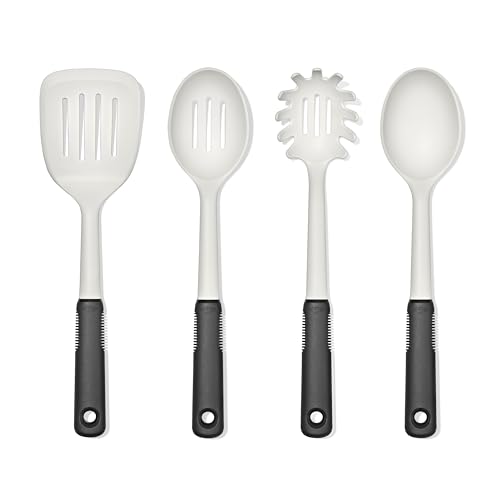 OXO Good Grips 4‑Piece Nylon Utensil Set
- Versatile everyday tools: This thoughtfully designed cooking utensil…
- Gentle on cookware surfaces: Made as nylon utensils…
- Made to last: Durable construction resists warping and…
| Product | Key specs | |
|---|---|---|
| Glad Cooking Kitchen Utensils Set | This 7-piece value set includes a turner, slotted… Durable with a nylon coating, these cooking utensils… These sturdy everyday kitchen gadgets are strong enough… | Check price |
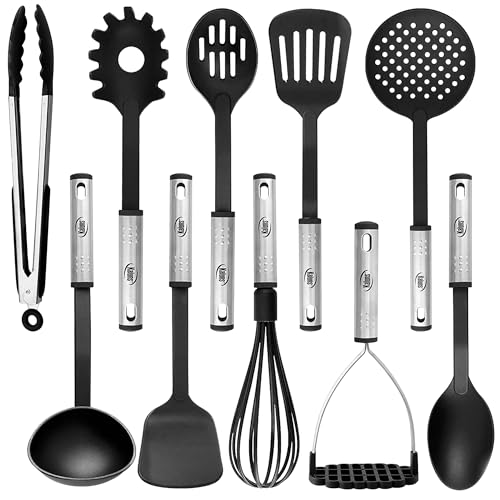 Kitchen Utensils Set Kitchen Utensils Set | Check price | |
| OXO Good Grips 4‑Piece Nylon Utensil Set | Versatile everyday tools: This thoughtfully designed cooking utensil… Gentle on cookware surfaces: Made as nylon utensils… Made to last: Durable construction resists warping and… | Check price |
 Joseph Joseph Duo 3-Piece Utensil Set with Joseph Joseph Duo 3-Piece Utensil Set with | Includes Solid Spoon, Slotted Spoon and Slotted Turner… Improves hygiene and reduces mess Nylon tool heads heat-resistant up to 200°C/392°F | Check price |
As an Amazon Associate we earn from qualifying purchases at no extra cost to you.
Quick comparison of the leading options
| Set or utensil type | Typical heat limit | Useful pieces | Approx. length | Dishwasher suitability | Best for |
|---|---|---|---|---|---|
| OXO Good Grips Nylon Tool Set | Up to 400°F / 204°C | Turner, spoon, slotted spoon, spatula or similar core tools | 12–13 inches | Usually dishwasher safe; check the specific set | Most everyday nonstick cooking |
| Cuisinart nylon utensil set | Usually up to 400°F / 204°C | Often includes turner, ladle, spoon, pasta fork, and skimmer | 12–14 inches | Commonly dishwasher safe | Value and larger piece counts |
| Le Creuset nylon tools | Typically around 392°F / 200°C | Turner, spoon, ladle, and slotted tools sold individually or in sets | 12–13 inches | Often dishwasher safe | Buyers who want heavier, coordinated tools |
| Nylon-and-silicone hybrid set | About 400–600°F, depending on the silicone | Turner, spoon, tongs, scraper, and ladle | 11–14 inches | Usually dishwasher safe | Maximum edge softness and flexibility |
| Compact three-piece nylon set | About 400°F / 204°C | Solid turner, cooking spoon, slotted spoon | 10–12 inches | Often dishwasher safe | Small drawers, occasional cooking, lower cost |
Heat limits are approximate category ranges rather than a reason to leave a utensil in a hot pan. The stated limit normally applies to the head, not necessarily the handle, and direct contact with a heating element, grill grate, broiler, or the base of an empty pan can exceed it quickly.
Why OXO is the best all-round choice
The OXO Good Grips nylon range gets the important compromises right. Nylon is stiffer than many silicone tools, so a turner can slide beneath eggs, fish, pancakes, and vegetables without folding excessively. At the same time, a properly rounded nylon edge is far less likely to scratch a coated cooking surface than stainless steel.
The handles are the main advantage over inexpensive loose utensils. OXO’s Good Grips design uses a broad, cushioned grip with a shape that is easier to control when hands are wet or greasy. That matters when lifting a full omelet or scraping a thick sauce, where a narrow cylindrical handle can rotate in the hand.
Look for the version containing at least these three shapes:
- Slotted turner: the most useful piece for fried eggs, fish, burgers, and draining oil while lifting food.
- Solid cooking spoon: better for risotto, sauces, oatmeal, and stirring ingredients that might fall through slots.
- Slotted spoon: useful for removing vegetables, dumplings, and poached food while leaving liquid behind.
A set that replaces the turner with a narrow spatula may look versatile but is less useful for nonstick frying pans. Conversely, a large ladle is helpful for soup yet does little for everyday skillet work. For a first purchase, prioritize shapes over piece count.
Head-to-head: nylon versus silicone
Nylon wins on rigidity and precision. It is usually thin enough to reach under delicate food and firm enough to stir dense mixtures. It also tends to be less floppy at room temperature than silicone. Its weakness is that the edge can soften, warp, or develop a roughened surface if repeatedly exposed to excessive heat.
Silicone wins on softness and heat tolerance, especially when bonded over a rigid internal core. A silicone-coated turner is a strong option for a pan with an older coating, because its edge compresses rather than dragging a hard plastic corner across the surface. Silicone can feel less exact when turning very thin food, and low-quality versions may split where the head joins the handle.
For the safest combination, choose nylon for a thin turner and silicone for scraping, stirring, and utensils that rest in the pan. Avoid any tool with a sharp molded seam, exposed metal, or a visibly hard corner at the working edge.
Choosing by cooking situation
| Your situation | Best configuration | Why |
|---|---|---|
| Budget under about $25 | Three-piece nylon set | Covers the essential skillet and saucepan jobs without paying for duplicate tools. |
| Daily cooking for two to four people | Four- or five-piece set with a slotted turner | Provides enough variety without filling a utensil crock with rarely used pieces. |
| Deep sauté pan or stockpot | 12–14-inch tools, preferably with a hanging hole | Longer handles keep hands farther from steam and hot pan walls. |
| Small drawer or limited counter space | Three-piece nesting set or hanging set | Nesting reduces drawer width; hanging storage keeps tools off the worktop. |
| Older or delicate nonstick coating | Rounded nylon or nylon-and-silicone tools | Soft, continuous edges reduce the chance of catching a worn spot. |
| Frequent high-heat searing | High-temperature silicone or manufacturer-approved specialty tools | Nylon’s heat margin is smaller, particularly when left against a hot pan wall. |
Edge softness matters more than the word “nonstick”
Two nylon turners can both be advertised as safe for nonstick cookware while behaving differently. Inspect the working edge before buying. The preferred edge is rounded, smooth, and continuous, with no abrupt step where the head meets the rim. A slightly flexible tip is useful, but excessive flex makes it difficult to lift food cleanly.
Do not use a utensil after its edge becomes jagged, blistered, or rough. Those defects can catch on the coating and are also a sign that the plastic has been overheated. A nylon utensil that has changed color, smells burnt, or remains bent after cooling should be replaced.
Dishwasher safety and ownership costs
Most mainstream nylon sets are dishwasher safe, but dishwasher safe does not mean damage-proof. Repeated high-temperature cycles can fade handles, loosen a two-piece construction, and accelerate warping. Place utensils where the head cannot touch the dishwasher heating element, and use a gentler cycle when practical.
Hand washing takes little time and can extend the useful life of nylon. Rinse sauce or caramel before it hardens, wash with a soft sponge, and dry the handle joint thoroughly. Avoid abrasive scouring pads and do not soak a utensil indefinitely if water can enter a hollow handle.
A simple ownership calculation helps explain why a smaller set can be better value. Suppose a $24 three-piece set is used four times per week for two years: 4 × 52 × 2 equals 416 cooking sessions, or about 6 cents per session for the set. A $60 eight-piece set used just as often costs about 14 cents per session, before accounting for tools that remain unused. The larger set makes sense only if its extra shapes replace separate purchases.
Storage: hanging holes versus a utensil crock
Hanging holes are practical if the tools are stored on a rail or wall-mounted rack. They keep wet heads separated and make it easy to grab the turner without rummaging through a drawer. The disadvantage is that exposed utensils collect grease and dust, so wash them before use if they have been hanging near the cooktop.
A crock protects tools from airborne grime but can crowd handles together and trap moisture around the heads. If you use a crock, choose one at least 6 inches wide for a five-piece set, keep the heaviest tools at the back, and let washed utensils dry before putting them away.
Common mistakes that shorten a set’s life
- Leaving nylon resting on the rim of a hot pan for several minutes.
- Using a turner to cut food directly in the pan.
- Putting a nylon tool under a broiler or on a grill grate.
- Assuming “dishwasher safe” means the handle can tolerate every heat-dry cycle indefinitely.
- Choosing a large set with several ladles but no thin, rounded slotted turner.
Final verdict
Choose the OXO Good Grips Nylon Tool Set if you want the best balance of heat resistance, comfortable handling, practical shapes, dishwasher convenience, and nonstick-friendly edges. Choose a Cuisinart nylon set when price and piece count matter more than premium grip design. Choose Le Creuset tools for a heavier coordinated collection, or a nylon-and-silicone hybrid if protecting a well-used coating is the top priority.
Whichever set you buy, confirm the manufacturer’s temperature limit, inspect the edge for seams and sharp corners, and replace any utensil that warps or becomes rough. Those habits protect the pan more reliably than the label alone.








Write Your Review
No reviews yet. Be the first to share your experience!