
Key takeaways
- Looking for the best push knife? Compare four compact fist-grip defensive blades, from the Benchmade SOCP to the KA-BAR TDI series, with specs and carry notes.
A push knife is a compact fixed blade gripped in a closed fist, with the blade projecting forward between the fingers. The classic form is the T-handle push dagger, a design with a long history in close-quarters defense. Modern versions keep the same idea but vary the grip: a T-bar handle, a skeletonized bar with a finger ring, or an angled handle that lines the blade up with the forearm. That narrow focus is also what makes shopping for one tricky. Push knives are single-purpose tools, not camp knives or utility blades. The best push knife fits the hand securely, draws cleanly from its sheath, and disappears on the belt or in a pocket until it is needed. Blade steel, edge style, overall length, and sheath design all matter more here than on a larger fixed blade, because there is so little knife to work with.


This guide compares four push knives with verified Amazon listings: a premium skeletonized dagger, the original TDI design, and two TDI variants.
As an Amazon Associate, we earn from qualifying purchases.
Quick Picks
Our Short List of 3
- Blade: 3.22-inch double-edge spear point, 440C stainless steel, 58-60 HRC
- Overall length: 7.25 inches
- Weight: 2.2 ounces
- Handle: skeletonized one-piece 440C with integrated finger ring
- Blade: 2.31-inch drop point, AUS-8A stainless steel, 57-59 HRC
- Overall length: 5.63 inches
- Weight: about 3.2 ounces
- Handle: glass-reinforced nylon (Zytel), black

- Blade: 3.19-inch drop point, AUS-8 stainless steel, hollow grind
- Overall length: 7.75 inches
- Weight: 6.4 ounces
- Handle: nylon and fiberglass, black
All 4 Picks at a Glance
| Product | Specs | Action |
|---|---|---|
| 1. Benchmade SOCP Dagger 176BK |
| Check price on Amazon |
| 2. KA-BAR TDI Law Enforcement Knife 1480 |
| Check price on Amazon |
| 3. KA-BAR TDI Pocket Strike 2491 |
| Check price on Amazon |
 4. KA-BAR TDI Hinderer Hell Fire 2486 |
| Check price on Amazon |
1. Benchmade SOCP Dagger 176BK
- Blade: 3.22-inch double-edge spear point, 440C stainless steel, 58-60 HRC
- Overall length: 7.25 inches
- Weight: 2.2 ounces
- Handle: skeletonized one-piece 440C with integrated finger ring
The Benchmade SOCP Dagger 176BK is the best-known push-style defensive blade in this group. Designed by Greg Thompson for the Special Operations Combatives Program (SOCP), it is a single piece of 440C stainless steel, skeletonized to cut weight, with a black powder-coat finish and an integrated finger ring that keeps the knife indexed in the hand.
The 3.22-inch blade has a double-edge spear-point profile with a plain edge. Both edges are sharpened for strong piercing ability from either side, and the spear point keeps the tip centered on the line of the thrust. The steel is hardened to 58-60 HRC, balancing edge retention with resistance to chipping. At 2.2 ounces and 7.25 inches overall, it adds almost nothing to a belt or vest setup.
What sets the SOCP apart is the grip system. The skeletonized handle is a single bar of steel with finger grooves and a ring at the end, which sits over a finger and lets the user hold other objects or control a wrist without putting the knife down. The injection-molded black sheath is MOLLE compatible and includes a clip, so the dagger can ride on a belt, a vest, or a pack strap.
The trade-offs follow from the design. A skeletonized steel handle has no scales or cushioning, so it feels hard in the hand during extended handling. The double edge also makes the SOCP a poor utility knife, and sharpening two edges takes more care than sharpening one.
Key specs:
Pros:
Cons:
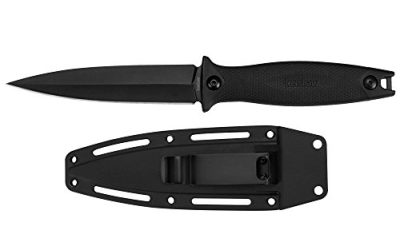
2. KA-BAR TDI Law Enforcement Knife 1480
- Blade: 2.31-inch drop point, AUS-8A stainless steel, 57-59 HRC
- Overall length: 5.63 inches
- Weight: about 3.2 ounces
- Handle: glass-reinforced nylon (Zytel), black
The KA-BAR TDI Law Enforcement Knife 1480 is the original TDI design, created by John Benner, founder of the Tactical Defense Institute. It is the smallest and most discreet knife in this guide, with a 2.31-inch drop-point blade and a 5.63-inch overall length. The TDI concept is a fixed blade with an angled handle that positions the blade forward of the fist, so a natural punch drives the point where the hand is already going.
The blade is AUS-8A stainless steel with a black matte finish and a plain edge, hardened to 57-59 HRC. A drop point is practical at this size: the tip is strong, the edge is easy to control, and the single edge is simpler to maintain than a double edge. The handle is glass-reinforced nylon (Zytel), shaped to fill the palm and textured for grip. The knife weighs about 3.2 ounces and ships with a hard plastic sheath and a reversible black metal belt clip.
Carry is where the 1480 earns its place. The sheath clips to a belt and the knife sits flat and close to the body, easy to conceal under a shirt. The reversible clip works for left- or right-hand carry, and the compact size means the knife does not print the way a larger fixed blade can.
The limits are the other side of the same coin. A 2.31-inch blade has short reach, and the small handle can feel cramped for larger hands. The AUS-8A steel is a solid mid-range stainless that sharpens easily and resists corrosion, but it will not hold an edge as long as premium steel.
Key specs:
Pros:
Cons:
3. KA-BAR TDI Pocket Strike 2491
- Blade: 3.19-inch drop point, AUS-8 stainless steel, hollow grind
- Overall length: 7.75 inches
- Weight: 6.4 ounces
- Handle: nylon and fiberglass, black
The KA-BAR TDI Pocket Strike 2491 takes the TDI idea in a different direction: a longer blade and a sheath built for pocket carry. The blade is a 3.19-inch drop point in AUS-8 stainless steel, with a plain edge and a hollow grind. Overall length is 7.75 inches, and the knife weighs 6.4 ounces, the heaviest pick in this guide but also the one with the most blade to work with.
The handle is textured glass-filled nylon, sized for a full four-finger grip. The TDI angle is still there, so the blade points forward from the fist, but the longer handle and blade make the Pocket Strike feel more like a conventional compact fixed blade than the 1480 does.
The sheath is the defining feature. It is a hard plastic sheath with a pocket clip, so the knife can be carried inside a pocket like a folding knife, and a ring loop on the sheath allows a fast one-handed draw. The ring gives the user something to hook a finger on while pulling the knife free, keeping the draw consistent even under stress. For someone who does not want a belt-mounted fixed blade, pocket carry is the most discreet option in this guide.
The trade-off for the longer blade and heavier build is bulk. At 7.75 inches overall and 6.4 ounces, the Pocket Strike takes up more pocket space than a folding knife. The AUS-8 steel is a dependable mid-range stainless, easy to sharpen and resistant to rust, but it needs more frequent touch-ups than a premium steel.
Key specs:
Pros:
Cons:
4. KA-BAR TDI Hinderer Hell Fire 2486
- Blade: 3.56-inch tanto point, 1095 Cro-Van carbon steel, hollow grind
- Overall length: 7.25 inches
- Weight: about 7 ounces
- Handle: Ultramid, black
The KA-BAR TDI Hinderer Hell Fire 2486 is the hardest-hitting knife in this guide. It pairs the TDI angled-grip concept with a 3.56-inch tanto blade in 1095 Cro-Van carbon steel, a collaboration between Tactical Defense Institute founder John Benner and custom knifemaker Rick Hinderer. The tanto point gives a reinforced tip, and the 1095 Cro-Van steel is known for toughness and ease of sharpening.
The blade has a hollow grind and a plain edge, with a black finish. Overall length is 7.25 inches and the listed item weight is 0.2 kilograms, about 7 ounces. The handle is Ultramid, a tough glass-filled nylon, shaped with the TDI angle so the blade lines up with the forearm in a fist grip. The sheath is a locking hard plastic sheath with a reversible black metal belt clip, so the knife can be carried on either side and will not slip out until deliberately drawn.
The Hell Fire suits buyers who want the strongest blade steel in this group and a piercing tip. The 1095 Cro-Van steel takes a keen edge and is easy to bring back with a basic sharpening setup, and the tanto geometry puts extra steel behind the point. The locking sheath is also a plus for active carry, adding retention beyond friction alone.
Carbon steel brings one clear responsibility: it can rust if left wet or dirty. The black finish helps, but the edge and any worn spots need to be kept clean and dry, with a light coat of oil after use in wet conditions. The tanto tip is excellent for piercing but less versatile for slicing than a drop point.
Key specs:
Pros:
Cons:
Buying Guide: How to Choose the Best Push Knife
Grip style and hand fit
A push knife lives or dies on its grip. The classic T-handle push dagger puts a bar across the palm, while the knives in this guide vary the idea: the SOCP uses a skeletonized bar with a finger ring, and the TDI family uses an angled handle that lines the blade up with the forearm. Consider hand size first. A compact model like the TDI 1480 disappears on the belt but can feel small in a large hand, while the Pocket Strike and Hell Fire offer full-size grips. The grip should fill the palm, and the knife should not twist when pressure is applied to the point.
Blade length and edge type
Push knife blades here run from 2.31 inches to 3.56 inches. Shorter blades conceal better and draw faster, while longer blades add reach and cutting edge. Double-edge blades, like the SOCP, pierce well from either side but are harder to sharpen and less useful for everyday cutting. Single-edge drop points are easier to maintain, while a tanto point, like the Hell Fire, reinforces the tip for piercing at the cost of slicing versatility. Match the edge to the role: for a dedicated defensive blade, piercing geometry matters most; for a knife that may also cut cord, a single-edge drop point is the more practical shape.
Blade steel
Steel choice is a trade between edge retention, toughness, and maintenance. The SOCP uses 440C stainless at 58-60 HRC, with good edge retention and solid corrosion resistance. The TDI 1480 and Pocket Strike use AUS-8 and AUS-8A stainless, which sharpen easily and resist rust but need more frequent touch-ups. The Hell Fire uses 1095 Cro-Van carbon steel, tough and keen-edged but it must be kept clean and dry to prevent rust. Stainless is the lower-maintenance choice for a knife that sits in a sheath for long periods, while carbon steel rewards buyers who maintain their blades.
Sheath and carry method
A push knife is only useful if it can be carried comfortably and drawn reliably, so the sheath deserves as much attention as the blade. Look for a hard sheath that holds the knife through movement but releases with a clean pull. Belt clips should be reversible for left- or right-hand carry, and MOLLE compatibility is useful for vest or pack mounting. The Pocket Strike adds a pocket-clip option for buyers who prefer not to wear a fixed blade on the belt, and the Hell Fire adds a locking sheath for extra security. Practice with the sheath until the draw is smooth and repeatable.
Size, weight, and concealment
Weight matters more on a push knife than on most fixed blades because the knife is carried close to the body all day. The SOCP weighs 2.2 ounces and the TDI 1480 about 3.2 ounces, while the Pocket Strike and Hell Fire are around 6.4 and 7 ounces. Lighter knives print less and are easier to forget, which is the point of a discreet defensive blade. Heavier knives offer more blade and a fuller grip, but they demand a sturdier belt. Anything under about 6 inches overall hides easily, while knives approaching 8 inches need more thought about placement.
Legality and safe handling
Push knives and push daggers are restricted in some states, cities, and countries, and rules can cover possession, carry in public, and blade length. Check local laws before buying or carrying any knife in this guide, and check the rules for any place it will be taken, including workplaces and venues. Always store the knife in its sheath, keep it out of reach of children, and practice draws with care. A training blade or a non-sharpened replica is a sensible way to learn grip and draw technique without risk. Never carry a push knife where it is prohibited, and never use a knife except in lawful self-defense.
Frequently Asked Questions
What is a push knife?
A push knife, also called a push dagger, is a compact fixed blade gripped in a closed fist with the blade projecting forward between the fingers. The classic form has a T-shaped handle, while modern designs like the Benchmade SOCP and the KA-BAR TDI family use a finger ring or an angled handle to achieve the same fist-forward grip. The design favors short, direct thrusts in close quarters.
Are push knives legal to carry?
It depends on where the knife is carried. Laws on push knives and daggers vary by country, state, and city, and some places restrict possession or public carry of double-edged blades or fixed blades of a certain length. Always check the laws where the knife will be owned and carried, and check venue and workplace rules as well.
What is the best blade length for a push knife?
Most push knives have blades between 2 and 4 inches. Shorter blades around 2.3 inches, like the KA-BAR TDI 1480, conceal easily and draw fast, while longer blades around 3.2 to 3.6 inches, like the Benchmade SOCP and the TDI Hell Fire, add reach and piercing power. The right length depends on hand size, carry method, and discretion.
How do I maintain a push knife?
Keep the blade clean and dry after use, and store the knife in its sheath in a dry place. Stainless blades like 440C and AUS-8 need only occasional cleaning and a light coat of oil, while carbon steel blades like 1095 Cro-Van need to be dried promptly and oiled to prevent rust. Inspect the sheath regularly for cracks or loose retention.
Conclusion
The best push knife is the one that fits the hand, carries discreetly, and draws cleanly every time. The Benchmade SOCP Dagger 176BK is the premium pick, with a one-piece 440C build, a finger ring, and a MOLLE-compatible sheath. The KA-BAR TDI 1480 is the compact pick, small and light enough to disappear on a belt with the proven TDI grip angle. The KA-BAR TDI Pocket Strike 2491 suits pocket carry, with a longer drop-point blade and a ring-assisted draw. The KA-BAR TDI Hinderer Hell Fire 2486 is the hardest-hitting pick, pairing a reinforced tanto tip with 1095 Cro-Van steel and a locking sheath.
Whichever model fits best, check local laws first, choose a comfortable carry method, and practice the draw until it is smooth. A push knife is a narrow, single-purpose tool, and its value comes from being there, secure in the hand, when it is needed. Check current price on Amazon for the model that matches the hand and carry style, and keep the blade clean, sheathed, and stored safely.
More from Amazon
Programs that pair well with the guide above. Offers and eligibility are set by Amazon and may change.
Set up recurring deliveries of everyday items on eligible products. Terms and savings are set by Amazon.
Explore Subscribe & SaveCollect the home and kitchen items you want in one registry that guests can shop from.
Create a wedding registryFree shipping on eligible items, Prime Video and more. Eligible new members can start with a free trial.
Start a Prime free trialAudiobooks and podcasts to listen to on the go. Eligible new members can start with a free trial.
Try Audible freeAs an Amazon Associate we earn from qualifying purchases.
Write Your Review
No reviews yet. Be the first to share your experience!