
Our Short List of 3

- Blade length: 3.24 in
- Blade steel: CPM-S30V stainless, 58–60 HRC
- Blade style: drop point, plain edge
- Locking mechanism: AXIS crossbar lock

- Blade length: 3.6 in
- Blade steel: AUS-8 stainless
- Blade style: drop point, plain edge
- Locking mechanism: liner lock

- Blade length: 3.4 in
- Blade steel: Sandvik 14C28N stainless, black Cerakote finish
- Blade style: recurve drop point, plain edge
- Opening: SpeedSafe assisted opening, thumb stud
All 3 Picks at a Glance
| Product | Specs | Action |
|---|---|---|
| Benchmade Bugout 535 |
| Check price on Amazon |
| Ontario RAT Model I (8848) |
| Check price on Amazon |
| Kershaw Blur 1670OLBLK (Olive and Black) |
| Check price on Amazon |
Key takeaways
- Folding knives built for bug-out bags compared: Benchmade Bugout, Ontario RAT Model I, Cold Steel SR1 and Kershaw Blur, with published specs and tips.
A bug-out bag has to earn its space. Every item inside it is there because it might be needed on the worst day, not the average one, and the knife slot is no exception. One point of wording first, because it shapes this whole guide: “bugout” appears in knife catalogues in two ways. It is the name of a well-known Benchmade folder, and it is also shorthand for the bug-out use case itself — a knife packed into an emergency kit, a vehicle glove box or a go-bag, ready for shelter building, food preparation, cord cutting, first-aid improvisation and the hundred small cutting jobs that appear when normal routines break down. This article uses the second meaning. Every knife below is a folding knife published for hard outdoor, survival or utility work, and each one folds closed, which matters in a packed bag: a folder carries safely against other gear, takes up little room, and can ride in a pocket the moment the bag comes off your back.
Fixed blades have their own following for this role, and they are covered in other guides. Here the focus stays on folders, because a folding knife is what most emergency kits actually carry — compact, sheathed by its own handle, and quick to open with one hand. The four knives below span the main design philosophies for the job: an ultralight premium folder, a proven workhorse pattern, a heavy-duty folder built around an exceptionally strong lock, and a fast assisted opener. Between them they cover most of what a bug-out knife needs to do.
Disclosure: As an Amazon Associate, we earn from qualifying purchases made through links on this page, at no extra cost to you.
The Folding Knives That Earn a Place in the Bag
Benchmade Bugout 535
- Blade length: 3.24 in
- Blade steel: CPM-S30V stainless, 58–60 HRC
- Blade style: drop point, plain edge
- Locking mechanism: AXIS crossbar lock
The Benchmade Bugout is the knife that gave this category its name, and it remains the reference point for a lightweight emergency folder. It was designed from the start for people who count grams: the published weight is just 1.85 ounces, which is remarkable for a full-size folder with a 3.24-inch blade. In a bug-out bag that may be carried for miles, that lightness is the whole argument — the Bugout disappears into a kit or a pocket and is simply there when needed, rather than being one more heavy item competing for space.
The blade is CPM-S30V stainless steel, a powdered steel long used in premium folders, hardened to 58–60 HRC and ground as a plain-edge drop point. A drop point suits emergency work well: the tip is strong, the belly handles slicing through cordage, packaging and food, and the shape is easy to control for finer tasks like feathering a fire stick. The handle is textured Grivory, a glass-filled nylon that keeps weight down while staying rigid, and the knife uses Benchmade’s AXIS lock, a crossbar mechanism that can be operated with either hand and keeps fingers away from the blade path when closing. A reversible deep-carry pocket clip lets it ride low and discreet. For a kit that prioritises low weight and corrosion resistance above brute strength, the Bugout 535 is the natural first pick.
Ontario RAT Model I (8848)
- Blade length: 3.6 in
- Blade steel: AUS-8 stainless
- Blade style: drop point, plain edge
- Locking mechanism: liner lock
If the Bugout is the specialist, the Ontario RAT Model I is the general-purpose workhorse. Designed by Randall’s Adventure & Training — the survival school behind the RAT name — it has been a staple of outdoor and emergency kits for years, and its appeal is straightforward: a large, simple, strong folder with a 3.6-inch blade and a full-size handle that fills the hand even with gloves on. At 8.5 inches overall, it is the kind of knife that can handle shelter work, baton-assisted splitting of small kindling and food preparation for a group without feeling undersized.
The blade is AUS-8 stainless steel in a drop-point profile. AUS-8 is not an exotic steel, and that is partly the point for an emergency tool: it resists corrosion, shrugs off hard use, and — critically, far from home — it sharpens quickly on almost any stone, rod or improvised abrasive. A liner lock secures the blade, the handle scales are nylon over steel liners, and the pocket clip can be mounted in four positions, so the knife can be set up for tip-up or tip-down carry on either side. In a bug-out context the RAT Model I suits the main-kit role: one dependable folder that does everything reasonably well, packed in the bag itself rather than carried daily.
Cold Steel SR1 (62L)
The Cold Steel SR1 sits at the opposite end of the folding-knife spectrum from the Bugout: it is a folder built to approach fixed-blade workloads. Designed by Andrew Demko, the SR1 takes its name and its brief from Cold Steel’s SRK survival line — SR stands for Survival Rescue — and applies it to a folding format. The blade is 4 inches of CPM-S35VN stainless steel in a clip-point profile, and at 4.8 mm thick it carries far more stock than a typical folder, which translates into a tip and spine that tolerate prying, digging and heavy batoning far better than slimmer knives.
The lock is the other half of the design. Cold Steel’s Tri-Ad lock is a self-adjusting lockback variant built around a stop pin, and it is widely regarded as one of the strongest locking mechanisms fitted to any production folder — a meaningful trait when a knife in an emergency kit may be asked to do jobs well beyond slicing. The handle is G-10 with heat-treated nested steel liners, shaped without ornament for a secure grip, and the whole knife opens to 9 3/8 inches. At a published 7.3 ounces it is no pocket featherweight, and that weight is the trade-off to accept consciously: the SR1 belongs in the bag, the vehicle kit or a belt pouch, where its strength is available when the situation turns serious.
Specs
- Blade length: 4 in
- Blade steel: CPM-S35VN stainless
- Blade thickness: 4.8 mm
- Blade style: clip point, plain edge
- Locking mechanism: Tri-Ad lock
- Handle: G-10 with nested steel liners
- Overall length: 9 3/8 in
- Weight: 7.3 oz
Kershaw Blur 1670OLBLK (Olive and Black)
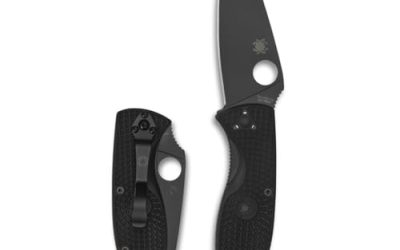
- Blade length: 3.4 in
- Blade steel: Sandvik 14C28N stainless, black Cerakote finish
- Blade style: recurve drop point, plain edge
- Opening: SpeedSafe assisted opening, thumb stud
The Kershaw Blur answers a different emergency requirement: speed. Its SpeedSafe assisted-opening mechanism drives the blade open as soon as the thumb stud is pushed past its initial resistance, so the knife deploys fully with one hand — useful when the other hand is holding a rope, a bandage, a torch or a frightened child’s hand. The Blur has been in production for many years, is made in the USA, and its slightly recurved 3.4-inch blade is a shape with real utility for kit work: the curved belly pulls material into the edge, which makes cutting cord, webbing, hose and packaging noticeably efficient.
The blade steel is Sandvik 14C28N, a fine-grained stainless developed for knife blades, finished here with a black Cerakote coating that adds corrosion protection and cuts glare. The handle is 6061-T6 anodised aluminium with Trac-Tec grip inserts, so it stays secure in wet or gloved hands, and a liner lock holds the blade open. At 3.9 ounces and 4.5 inches closed, the Blur splits the difference between the ultralight Bugout and the heavy SR1 — light enough for a pocket, substantial enough for sustained cutting, and fast to bring into use. For a vehicle kit or a personal go-bag where one-handed access matters most, it is a strong candidate.
How to Choose a Folding Knife for a Bug-Out Bag
Start with the role. A bug-out knife is a general tool, not a specialist blade, so a versatile blade shape matters more than any single extreme trait. Drop points and clip points between roughly 3.25 and 4 inches cover the widest range of work: food preparation, cord and webbing cutting, whittling, opening packaging, preparing tinder and light shelter tasks. Much shorter blades struggle with food and wood; much longer blades become awkward for controlled, close work and add weight.
Weight is the second decision, and it cuts both ways. An ultralight folder like the Bugout encourages you to actually carry the kit and adds capability almost for free, but its slim stock is meant for cutting, not prying. A heavy folder like the SR1 tolerates abuse that would damage a light knife, yet every ounce competes with water, food and clothing in the same bag. Many prepared kits solve this by pairing: a light folder in the pocket or top pouch and a stronger tool deeper in the pack. If only one knife goes in, choose based on the failures you most expect — being caught without a blade at all, or facing a task that bends a light one.
Lock strength deserves attention because folding knives fail at the lock or the pivot, not usually at the blade. Crossbar locks such as the AXIS, lockbacks such as the Tri-Ad, and well-made liner locks all have long track records; what matters is choosing a mechanism from a maker with a reputation to protect, and checking that the lock engages fully with no blade play before the knife goes into the kit. One-handed opening is worth having — assisted opening, thumb studs or a flipper all qualify — because emergencies rarely offer two free hands.
Blade steel is a balance between edge retention and field maintenance. Premium powdered steels such as CPM-S30V and CPM-S35VN hold an edge through long use and resist corrosion, which suits a knife that may sit in a bag for months and then work hard. Mid-range stainless steels such as AUS-8 and 14C28N give up some edge life but sharpen quickly on simple equipment, which suits a kit that includes only a small stone. Either approach works; what does not work is a knife whose steel is unnamed, because its behaviour in the field is unpredictable. Stainless is strongly preferred for a stored kit knife, since it tolerates damp storage that would spot a carbon-steel blade.
Finally, think about carry and upkeep. A pocket clip that can be repositioned lets the knife move between pocket, pack strap and waistband. Textured handles — Grivory, G-10 or rubberised inserts — keep control in rain and cold. Before packing, open and close the knife, confirm the lock, add a drop of oil to the pivot, and store it clean and dry with a simple sharpener in the same pouch. A bug-out knife is insurance: it should need nothing on the day it is finally used.
Frequently Asked Questions
Is a folding knife enough for a bug-out bag, or is a fixed blade required?
A good folder covers the large majority of cutting tasks an emergency kit faces: food preparation, cordage, packaging, first-aid improvisation and light wood work. A fixed blade is stronger for heavy batoning and prying, and some kits carry both. If space or weight allows only one, a well-built folder in the 3.25 to 4 inch range is a reasonable single choice, especially paired with a small saw or multi-tool for the heaviest jobs.
What blade length works best in an emergency kit?
Between about 3.25 and 4 inches is the practical window. Shorter blades are easy to carry but slow down food preparation and kindling work; longer blades add weight, can be clumsy for fine tasks, and may fall foul of local blade-length rules. The knives in this guide sit inside that window, from the Bugout at 3.24 inches to the SR1 at 4 inches.
Which lock type is strongest for hard use?
Among common production mechanisms, the Tri-Ad lock fitted to the Cold Steel SR1 is widely considered one of the strongest fitted to any folder, and crossbar locks such as Benchmade’s AXIS are also known for high strength with easy one-handed use. A quality liner lock, as on the RAT Model I and the Blur, is entirely adequate for cutting tasks. Whichever type you choose, engagement quality from a reputable maker matters more than the mechanism’s name.
How should a kit knife be stored so it is ready after months in a bag?
Clean and dry the blade, work a drop of oil into the pivot, and confirm the lock engages fully before packing. Store the knife closed, ideally in its own pouch or a dedicated pocket so the edge and mechanism stay free of grit. Check it whenever the kit is rotated — the same schedule used for food, batteries and medication — and touch up the edge then, rather than discovering a dull or stiff knife during an emergency.
Conclusion
The best bugout knife is the one that matches how your kit will actually be used. Choose the Benchmade Bugout 535 when every ounce counts and the knife must vanish into a light pack. Choose the Ontario RAT Model I for a proven, glove-friendly workhorse that sharpens easily in the field. Choose the Cold Steel SR1 when the folder may have to stand in for a fixed blade, and the Kershaw Blur when fast one-handed opening is the priority. Any of the four will serve an emergency kit well — the important step is packing one, checking it on a schedule, and knowing exactly where it sits in the bag before the day it is needed.
More from Amazon
Programs that pair well with the guide above. Offers and eligibility are set by Amazon and may change.
Set up recurring deliveries of everyday items on eligible products. Terms and savings are set by Amazon.
Explore Subscribe & SaveCollect the home and kitchen items you want in one registry that guests can shop from.
Create a wedding registryFree shipping on eligible items, Prime Video and more. Eligible new members can start with a free trial.
Start a Prime free trialAudiobooks and podcasts to listen to on the go. Eligible new members can start with a free trial.
Try Audible freeAs an Amazon Associate we earn from qualifying purchases.
Write Your Review
No reviews yet. Be the first to share your experience!