
Our Short List of 3

- Best for: Hunters who want one premium-steel folder that handles both the gutting cut and general skinning work.
- Blade length: 3.63 inches
- Blade steel: S35VN stainless steel
- Blade shape: Drop point with guthook
- Closed length: 5 inches
- Best for: Hunters who dress several animals a season and would rather swap a blade than stop and sharpen.
- Knife blade: 3.5 inches, replaceable
- Gut blade: 3.1 inches
- Overall length: 8.0 inches
- Razor blade steel: Japanese 420J2 stainless

- Best for: Hunters who break down game at home or camp and want boning and gutting blades in one folding kit.
- Blade steel: Japanese 420J2 stainless
- Included blades: Three 3.5-inch drop point, two 5-inch boning/fillet, one gutting blade
- Overall length: 9.4 inches with boning blade fitted
- Weight: 6.4 ounces
All 3 Picks at a Glance
| Product | Specs | Action |
|---|---|---|
| Buck Knives 660 Pursuit Pro Folding Guthook |
| Check price on Amazon |
| OUTDOOR EDGE RazorPro Double Blade |
| Check price on Amazon |
| OUTDOOR EDGE RazorBone |
| Check price on Amazon |
Key takeaways
- Compare the best folding gut hook knives for field dressing, with blade steel, lock type, hook design and carry specs for deer and big game hunters.
A folding gut hook knife has to solve two problems at once: it must open a deer cleanly without the point wandering into the stomach, and it must fold down small enough to ride in a pocket or a pack hip belt for the walk in. A fixed blade does the first job well but carries bulky, so the real decision is which folding design keeps the hook keen, the lock trustworthy, and the pivot easy to clean once the work is done.
That choice lands differently for different buyers. A whitetail hunter who dresses one or two deer a season needs a simple folder with the hook ground into the main blade. A hunter who processes several animals needs premium steel that holds an edge, or a replaceable-blade system that never asks for a sharpening stone in the field. The three picks below were chosen from their Amazon listing names and specifications, and every one folds and carries a genuine gut hook or gutting blade.
Quick Picks
As an Amazon Associate we earn from qualifying purchases.
| Product | Best for | Key spec from title |
|---|---|---|
| Buck Knives 660 Pursuit Pro Folding Guthook | Premium steel in a light, simple folder | 3-5/8 inch S35VN stainless blade with guthook |
| OUTDOOR EDGE RazorPro Double Blade | A separate gutting blade plus a folding saw | Replaceable razor blade and gutting blade, six blades included |
| OUTDOOR EDGE RazorBone | Swapping blade styles for each task | Six blades in three styles, including a gutting blade |
How to Choose
Hook Design and Placement
The hook is the whole point of this knife type, so study how it is built before anything else. On a single-blade folder the hook is a sharpened notch cut into the spine near the tip, and it should sit deep enough to bite under hide and hair without skating across the surface. On multi-blade designs the hook becomes its own gutting blade that opens on a separate pivot, which keeps the main edge free for skinning and trimming. A hook placed close to the handle shortens your pulling stroke, while one near the tip, or a full-length gutting blade, gives a longer and steadier draw through the belly wall.
Blade Steel and Edge Care
Steel decides how often you stop to sharpen and how well the blade survives blood, fat and moisture. Premium powder steels such as S35VN hold an edge through several animals and shrug off corrosion, but when they finally dull they ask for a diamond stone or a ceramic rod rather than a pocket sharpener. Softer stainless steels like 420J2 take a keen edge quickly on almost any stone, yet they surrender that edge sooner against hide and hair. Replaceable-blade systems step around the question entirely by swapping in a fresh factory edge. Match the steel to your habits: carry a sharpener, or carry spare blades.
Lock Strength and Opening Style
A folder used for field dressing gets pulled toward the body with real force, so the lock is a safety component rather than a convenience. A lockback gives a strong, simple joint that tolerates grit and is easy to verify with a firm thumb press before each cut. A liner lock is lighter and quick to close one-handed, but its recessed liner traps fat and hair and needs a closer look after messy work. Thumb studs, thumb holes and nail nicks all work with cold fingers, though studs are easiest to find while wearing thin gloves. Whatever the mechanism, the opened blade should seat fully with no side-to-side play at the pivot.
Carry, Sheath and Cleaning
A folding gut hook knife earns its place by disappearing until it is needed, so closed length and weight matter on long walks and steep climbs. Most hunting folders ride in a belt sheath rather than a pocket, because nobody wants dried blood on a pocket clip or inside a trouser pocket. Bright handle scales help you spot the knife when you set it down in leaves, grass or snow in the middle of a job. Cleaning is the folder’s honest weak point: the pivot traps tissue and moisture, so favor designs you can rinse under a tap, shake dry and oil at home on the same day.
The 3 Best Options
Buck Knives 660 Pursuit Pro Folding Guthook
- Best for: Hunters who want one premium-steel folder that handles both the gutting cut and general skinning work.
- Blade length: 3.63 inches
- Blade steel: S35VN stainless steel
- Blade shape: Drop point with guthook
- Closed length: 5 inches
Hunters who want one premium-steel folder that handles both the gutting cut and general skinning work.
The hook shares the main blade, so it dulls with the edge and needs a round file or tapered rod to sharpen its inner curve.
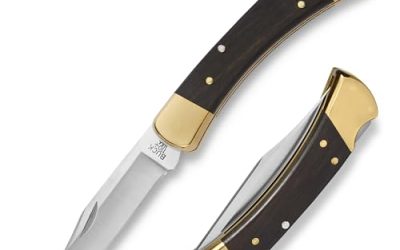
The Pursuit Pro 660 is the traditional answer to this category: a single lockback folder whose drop point blade carries a proper gut hook on its spine. Its S35VN stainless blade is the premium steel in this roundup, picked for edge retention across a full season of dressing and skinning work, and the blaze orange handle pairs a reinforced nylon core with a Versaflex rubber overmold that keeps its grip when hands are wet. At well under four ounces with a five-inch closed length, it rides in the included polyester sheath without announcing itself on the belt, and the mid-position lockback stays simple to rinse clean.
Watch out for: The hook shares the main blade, so it dulls with the edge and needs a round file or tapered rod to sharpen its inner curve.
OUTDOOR EDGE RazorPro Double Blade
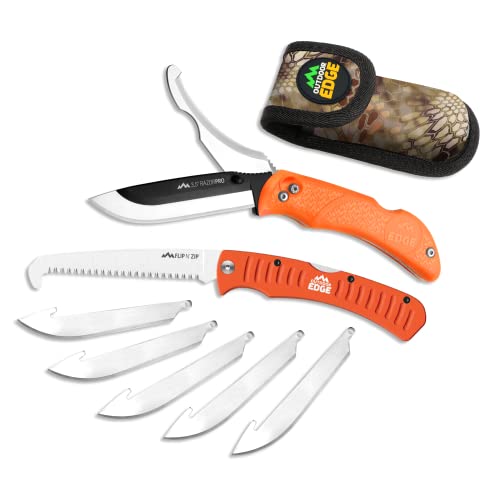
- Best for: Hunters who dress several animals a season and would rather swap a blade than stop and sharpen.
- Knife blade: 3.5 inches, replaceable
- Gut blade: 3.1 inches
- Overall length: 8.0 inches
- Razor blade steel: Japanese 420J2 stainless
Hunters who dress several animals a season and would rather swap a blade than stop and sharpen.
The replaceable blades are a running cost in a proprietary fit, so running out of spares mid-season leaves the main blade unusable until more arrive.
The RazorPro takes the opposite approach to edge care: instead of sharpening, you press a button and swap in a fresh replaceable razor blade. One side of the folder holds a 3.5-inch drop point razor blade in a black-oxide coated holder, while the other side folds out a separate gutting blade that opens game like a zipper, cutting beneath the skin without slicing hair or piercing organs. The blaze orange rubberized TPR handle is reinforced with stainless steel liners, and this saw-combo version adds a folding bone saw in the camo nylon sheath, which also carries the six included replacement blades.
Watch out for: The replaceable blades are a running cost in a proprietary fit, so running out of spares mid-season leaves the main blade unusable until more arrive.
OUTDOOR EDGE RazorBone
- Best for: Hunters who break down game at home or camp and want boning and gutting blades in one folding kit.
- Blade steel: Japanese 420J2 stainless
- Included blades: Three 3.5-inch drop point, two 5-inch boning/fillet, one gutting blade
- Overall length: 9.4 inches with boning blade fitted
- Weight: 6.4 ounces
Hunters who break down game at home or camp and want boning and gutting blades in one folding kit.
With six loose blades to track, losing the gutting blade leaves you skinning with a drop point and opening bellies the slow, careful way.
The RazorBone stretches the replaceable idea further, turning one folding handle into a small processing kit. Six Japanese 420J2 stainless blades come in the sheath: three 3.5-inch drop points for skinning, two flexible 5-inch boning and fillet blades, and one gutting blade that opens game like a zipper without piercing organs. Blades change with a push of the lock release button, the blaze orange handle uses rubberized TPR insets over a Grivory frame, and a pocket clip plus a blade storage box keep the spares organized. Its listing details were confirmed through a single retail mirror of the Amazon page, so check the live listing before ordering.
Watch out for: With six loose blades to track, losing the gutting blade leaves you skinning with a drop point and opening bellies the slow, careful way.
Which One Fits Your Situation
You Dress One or Two Deer a Season
A single-blade folder with the hook ground into the spine is the simplest tool for occasional use. It asks for nothing beyond a rinse, a dry and an occasional touch-up, and there are no spare blades to stock, sort or lose. The Buck 660 fits this pattern with room to spare, and its light weight lets it live in the pack all season, unnoticed until the moment it is needed.
You Process Several Animals Each Fall
Volume changes the math on edges. A replaceable-blade folder keeps a factory edge ready for every animal, and a separate gutting blade means the opening cut never dulls the skinning edge you rely on next. The RazorPro is built for exactly this rhythm, provided you keep a blade pack in the sheath and a second pack at home so a dull swap never catches you short in the field.
You Break Down Game at Camp or at Home
Field dressing is only the first stage for hunters who bone out and portion their own meat. A folding kit with interchangeable boning and fillet blades covers that second stage without a separate butcher set, and the gutting blade still handles the opening cut at the kill site. The RazorBone suits this two-stage workflow, as long as its blade box stays packed with the knife rather than in a drawer at home.
Your Hands Are Small or Often Gloved
Grip security decides how confidently you can pull a hook through hide. Look for finger grooves, rubber overmolds and a handle long enough for a full four-finger hold, and check that the studs or release buttons can be found by feel alone. A lockback you can verify with a thumb press is easier to trust than a liner you cannot see beneath a glove, especially with cold, wet hands at last light.
Common Mistakes
- Buying a folding hunting knife with no hook and assuming a plain drop point will open a belly as safely as a true gut hook.
- Choosing a folder with a liner lock for messy work, then never checking the liner recess for trapped fat and hair afterward.
- Forgetting that a folder’s pivot traps moisture, then storing the knife closed and damp until the following season.
- Picking a replaceable-blade model without confirming that spare blades are stocked where you actually shop.
- Judging by blade length alone and ignoring closed length, which is what decides whether the knife actually gets carried.
Frequently Asked Questions
Is a folding gut hook knife as strong as a fixed blade?
A sound lockback folder is strong enough for the pulling cuts of field dressing, which load the blade along its length rather than sideways. A fixed blade still wins for prying at joints or splitting a sternum. Stay within the folder’s design brief, opening bellies and skinning, and the lock is not the weak point of the job.
How do you sharpen the gut hook itself?
The hook’s inner curve is sharpened with a small round file, a tapered diamond rod or a ceramic crock stick that matches the radius of the curve. A flat stone cannot reach the inner edge. A few light strokes per side usually restore the bite, because the hook dulls mainly from hair and hide rather than from bone contact.
Can one folding knife handle both gutting and skinning?
Yes, and that versatility is the appeal of the type. A drop point blade with a spine hook covers the opening cut and most skinning strokes, while double-blade and interchangeable-blade folders split the jobs between a gutting blade and a main edge. Fine caping work around the head is still easier with a smaller blade, but one folder handles the bulk of a deer.
How should a folding gut hook knife be cleaned after use?
Rinse the open knife under clean water, work the pivot back and forth to flush out debris, and scrub the hook notch with an old toothbrush. Dry everything fully, including inside the handle channel, then add a drop of food-safe oil to the pivot and blade. Never store the knife closed while damp, and never put it in a dishwasher.
More from Amazon
Programs that pair well with the guide above. Offers and eligibility are set by Amazon and may change.
Set up recurring deliveries of everyday items on eligible products. Terms and savings are set by Amazon.
Explore Subscribe & SaveCollect the home and kitchen items you want in one registry that guests can shop from.
Create a wedding registryFree shipping on eligible items, Prime Video and more. Eligible new members can start with a free trial.
Start a Prime free trialAudiobooks and podcasts to listen to on the go. Eligible new members can start with a free trial.
Try Audible freeAs an Amazon Associate we earn from qualifying purchases.
Write Your Review
No reviews yet. Be the first to share your experience!