
Key takeaways
- Find the best Japanese petty knife for precise prep. Compare blade length, steel, handle style, and edge care before choosing your next small utility knife.
A best Japanese petty knife is the small blade that fills the gap between a paring knife and a chef knife. It is long enough for board work, short enough for in-hand trimming, and narrow enough for precise cuts around fruit, vegetables, herbs, and small cuts of meat. In Japanese kitchens, the petty is a daily companion rather than a specialist tool, and in a home kitchen it often stays out on the counter because it handles so many small jobs without the weight of a larger blade.


If you are choosing your first petty knife, start with a 120 to 150 mm blade in stainless steel, with a comfortable handle and a double-bevel edge. The Sakai Takayuki 15004 Petty Knife gives you the classic 150 mm shape in a plain, light form. The MAC Professional Paring and Utility Knife in the 5 inch size is the nimble choice for in-hand work. The Yoshihiro Inox AUS-10 Ice Hardened Petty Knife and the Shun Classic Blonde Master Utility Knife add layered steel and handles shaped for longer prep sessions. The Kai Seki Magoroku Petty Knife in 120 mm is the compact Japanese-made choice for peeling and detail work.
This guide explains what a petty knife is, how blade length, steel, handle shape, and edge geometry change the way it feels, and which models suit different hands and habits. Every pick below is a Japanese petty knife or a Japanese utility knife in petty size, so you can compare like with like.
Quick Picks
Our Short List of 3
All 5 Picks at a Glance
| Product | Specs | Action |
|---|---|---|
| Sakai Takayuki 15004 Petty Knife (B0013CZYD2) | Check price on Amazon | |
| MAC Professional Paring and Utility Knife 5 Inch (B000N5FDQI) | Check price on Amazon | |
 Yoshihiro Inox AUS-10 Ice Hardened Petty Knife 6 Inch (B00BUAFVOY) | Check price on Amazon | |
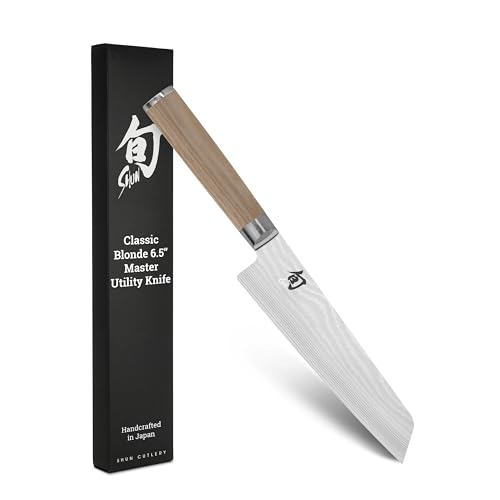 Shun Classic Blonde 6.5 Inch Master Utility Knife (B09J21V99K) | Check price on Amazon | |
 Kai Seki Magoroku Petty Knife 120 mm (B08XXBT357) | Check price on Amazon |
How to Choose
Blade Length: 120 mm or 150 mm
Blade length is the first choice to make, because it decides whether the knife feels like a paring knife or a small chef knife. A 120 mm petty, about 4.7 inches, is well suited to peeling, trimming, hulling strawberries, and segmenting citrus in the hand. It turns easily and suits cooks who already own a gyuto or santoku for larger board work.
A 150 mm petty, about 6 inches, adds reach for slicing small vegetables, mincing garlic and herbs, and trimming small pieces of meat on the board. If you want one petty knife to cover both in-hand work and light board work, 150 mm is the most versatile length.
Steel Type and Edge Retention
Japanese petty knives use a wide range of steels, and the steel decides how long the edge stays keen, how easily it sharpens, and how much care it needs. Stainless steels such as VG-10, VG-MAX, AUS-10, and molybdenum vanadium stainless are the most practical choices for a home kitchen. They resist rust in normal use and hold a fine edge well.
Harder cores, often listed around 60 to 61 on the Rockwell scale, hold a finer edge for longer, but they can chip if twisted in a cut, used on bone, or stored loose in a drawer. Softer stainless steels are more forgiving, but they need sharpening more often. For a first petty knife, a stainless core in the high 50s to low 60s is a sensible balance.
Edge Geometry and Bevel
Most Japanese petty knives sold for home use have a double-bevel edge, sharpened on both sides, so they suit right-handed and left-handed cooks. The edge angle is usually finer than on a Western utility knife, often around 15 to 16 degrees per side, which helps the blade glide through tomato skin and citrus membrane with little pressure.
A thin blade behind the edge matters as much as the angle. Thin petty knives wedge less in firm vegetables such as carrots and apples, and they feel more precise when trimming fat. A slightly thicker blade feels sturdier for meat, but it can feel clumsy for fine detail work. Check for a double-bevel edge and a symmetric grind if you are left-handed, because some traditional Japanese knives are ground for right-handed use only.
Handle Style: Western or Japanese
Handle style changes balance, grip, and comfort more than many buyers expect. Western-style handles, often made from Pakkawood, laminated wood, or a composite material, are usually riveted to a full tang and feel familiar to cooks who use Western chef knives. They tend to be heavier at the handle, which can balance a longer blade.
Japanese-style handles, often called wa handles, are usually made from magnolia or another light wood, sometimes with a ferrule, and they are lighter than Western handles. That shifts the balance forward and makes the knife feel nimble, which suits peeling and detail work. Some cooks find a wa handle less secure when their hands are wet. If you have large hands, look for a handle with enough length and girth to fill the palm.
Weight and Balance
A petty knife should feel light and responsive, not heavy or handle-bound. Most of the models in this guide weigh well under 150 grams, and the lightest are closer to 80 grams. Balance matters as much as weight: a knife that balances near the bolster feels stable on the board, while one that balances toward the tip feels quicker in the hand.
Hold the knife in a pinch grip, with thumb and forefinger on the blade just ahead of the handle, and see whether the tip feels easy to guide. If the handle feels too thick, too slim, or too short, the knife will tire your hand during longer prep.
Care, Sharpening, and Storage
A Japanese petty knife rewards simple, consistent care. Hand washing with mild soap and drying at once keeps the edge and handle in good condition. Avoid the dishwasher, because heat, detergent, and contact with other utensils can dull the edge and damage a wooden handle. Use a wood or soft plastic board instead of glass, stone, ceramic, or metal.
Sharpening is part of owning a Japanese knife. A whetstone in the 1000 grit range, followed by a finer stone for polishing, restores a keen edge without removing too much steel. A honing rod can realign a slightly dulled edge between sessions, but it does not replace sharpening. Store the knife in a block, on a magnetic strip, in a blade guard, or in a saya if one is supplied.
The Best Japanese Petty Knife Reviewed
Sakai Takayuki 15004 Petty Knife (B0013CZYD2)
The Sakai Takayuki 15004 Petty Knife is the classic choice in this guide, and it is the one to consider first if you want a straightforward 150 mm petty without decorative cladding or a premium finish. Sakai is a long-established knife-making city in Japan, and this model keeps the focus on shape, steel, and balance rather than on appearance.
The 150 mm blade is long enough for board work and short enough for in-hand trimming. It suits slicing cucumbers, mincing garlic, segmenting oranges, and cutting small pieces of chicken or fish. The stainless steel is easy to care for, and the Western-style handle gives a familiar grip for cooks moving from a Western paring or utility knife to a Japanese petty.
This knife suits a cook who wants a single, versatile petty for everyday prep and who prefers a plain, light tool over a decorative one. Cooks who want a harder core steel, a Damascus finish, or a traditional Japanese handle should look at the Yoshihiro or Shun picks below instead.
MAC Professional Paring and Utility Knife 5 Inch (B000N5FDQI)
The MAC Professional Paring and Utility Knife in the 5 inch size is the nimble pick in this guide. MAC is known for thin blades, and that thinness is easy to feel when you slice a tomato or peel an apple in the hand. The blade moves through food with little wedging, and the light build keeps your hand relaxed during detail work.
At 5 inches, this knife sits at the short end of the petty range, close to a paring knife in length but with a straighter profile and more edge for board work. It is a strong choice for peeling, hulling, trimming herbs, and cutting small fruit. It also works well as a second small knife for cooks who already own a 150 mm petty.
This knife suits cooks with smaller hands, cooks who do a lot of in-hand prep, and cooks who value a thin, light blade over a heavier, more decorative one. Cooks who need more board length or more knuckle clearance should choose a 150 mm or 6 inch model instead, because the short blade and light handle are designed for control rather than reach.
Yoshihiro Inox AUS-10 Ice Hardened Petty Knife 6 Inch (B00BUAFVOY)
The Yoshihiro Inox AUS-10 Ice Hardened Petty Knife brings a more refined steel and a traditional handle to the 6 inch petty size. Yoshihiro is a Japanese maker known for hand-finished knives, and this model uses AUS-10 stainless steel, chosen for edge retention and stain resistance.
The 6 inch blade gives you the reach of a 150 mm petty for slicing and trimming on the board. The wooden handle gives the knife a traditional Japanese feel and a light, forward balance that suits detail work.
This knife suits a cook who wants a step up in steel and finish from a plain stainless petty, and who likes a traditional handle and a hand-finished look. Cooks who prefer a heavier Western handle or a full tang with rivets should choose a Western-handled model instead.
Shun Classic Blonde 6.5 Inch Master Utility Knife (B09J21V99K)
The Shun Classic Blonde 6.5 Inch Master Utility Knife is the longest and most premium pick in this guide. Shun is one of the best-known Japanese knife makers in North America, and the Classic line pairs a VG-MAX core with Damascus cladding and a Pakkawood handle. The Blonde version uses a lighter Pakkawood handle, which gives the knife a distinct look.
At 6.5 inches, this knife covers more board work than a standard petty. It slices sandwiches, trims meat, cuts small vegetables, and handles herbs and citrus with ease, while still feeling lighter than a chef knife. The VG-MAX core supports a fine 16-degree edge, and the Damascus cladding adds stain resistance and a layered pattern.
This knife suits a cook who wants one longer petty-style knife to bridge the gap between a paring knife and a chef knife, and who values fit, finish, and presentation. It also suits a cook buying a gift. Cooks with large hands should check the handle fit, because the D-shaped Pakkawood handle is slim and shaped for a right-handed grip. Cooks who want a compact 120 mm petty for peeling should choose the Kai model below instead.
Kai Seki Magoroku Petty Knife 120 mm (B08XXBT357)
The Kai Seki Magoroku Petty Knife in 120 mm is the compact Japanese-made choice in this guide. Kai Corporation is based in Seki City, Japan, and the Seki Magoroku line is made in Japan from molybdenum vanadium stainless steel. The hammered finish helps reduce food sticking, and the laminated wood handle gives a secure grip.
The 120 mm blade is the classic short petty length. It is well suited to peeling, trimming, coring, and hulling in the hand or on a small board. It turns easily around curved shapes, and it feels controlled when you are working close to your fingers. The overall length is compact, so it stores easily in a block or a knife roll.
This knife suits a cook who wants a true short petty rather than a longer utility knife, and who values Japanese manufacture and a simple, practical design. It suits cooks with smaller hands and cooks who do a lot of peeling and trimming. Cooks who need more length for slicing or trimming larger pieces of meat should choose a 150 mm model instead.
What to Check Before You Buy
Before you buy a best Japanese petty knife, check the blade length in millimetres as well as in inches, because a 120 mm knife feels very different from a 150 mm knife. Check whether the edge is double-bevel and suitable for your dominant hand, and check the handle material and shape, because a handle that looks good in a photograph may feel too slim or too short in your hand.
Check the steel and the hardness if the maker lists them, and think about how you will sharpen the knife. A harder steel holds an edge longer but needs a whetstone, while a softer stainless steel needs sharpening more often.
Check the care instructions before you buy. Most Japanese petty knives are hand-wash only, and they should be dried at once after washing. Finally, check that the listing names the exact model, blade length, and steel you expect, because similar models from the same maker can differ in length, handle, and finish while looking alike in a photograph.
FAQ
What is a Japanese petty knife used for?
A Japanese petty knife is a small utility knife used for peeling, trimming, slicing small fruit and vegetables, mincing garlic and herbs, segmenting citrus, and cutting small pieces of meat and fish. It fills the gap between a paring knife, which is best for in-hand work, and a chef knife, which is best for larger board work. A petty is not suitable for cutting through bone, frozen food, or hard squash.
What size petty knife should I buy first?
For most home cooks, a 150 mm petty, about 6 inches, is the best first size, because it covers both light board work and in-hand trimming. If you already own a larger utility knife, a 120 mm petty, about 4.7 inches, is a better second knife. If you want one knife to bridge the gap to a chef knife, a 6.5 inch master utility knife gives you extra reach without the weight of a full chef knife.
Is a petty knife the same as a paring knife?
A petty knife and a paring knife are related but not identical. A paring knife is usually shorter, often 3 to 4 inches, and it is designed mainly for in-hand peeling and trimming. A petty knife is usually 120 to 150 mm, and it is designed for both in-hand work and light board work, with a longer, straighter edge and more knuckle clearance.
How do I sharpen a Japanese petty knife?
Use a whetstone, starting with a medium grit stone around 1000 grit to restore the edge, then finishing with a finer stone around 3000 to 6000 grit to polish it. Keep a consistent angle, usually around 15 degrees per side, and work both sides evenly. A honing rod can realign a slightly dulled edge between sessions, but it does not replace sharpening on a stone. Avoid pull-through sharpeners on a fine Japanese edge.
How should I care for a Japanese petty knife?
Hand wash the knife with mild soap and warm water, dry it at once, and store it in a block, on a magnetic strip, in a blade guard, or in a saya. Avoid the dishwasher, avoid cutting on glass, stone, or ceramic boards, and avoid twisting the blade or using it on bone or frozen food.
Bottom Line
The best Japanese petty knife for most home cooks is a 150 mm stainless petty with a double-bevel edge and a comfortable handle, because it covers the widest range of small prep tasks without feeling heavy or awkward. The Sakai Takayuki 15004 Petty Knife is the clearest expression of that idea, with a classic shape and a versatile length. If you want a shorter knife for in-hand work, the MAC Professional 5 inch model and the Kai Seki Magoroku 120 mm model are the nimble choices. If you want a more refined steel and a traditional handle, the Yoshihiro AUS-10 petty is the step up. If you want a longer petty-style knife with a premium finish, the Shun Classic Blonde Master Utility Knife gives you reach and a fine VG-MAX edge.
Choose on length and handle fit first, then on steel and finish. A petty knife that feels comfortable in a pinch grip, that you will hand wash and dry at once, and that you will sharpen on a whetstone will serve you far better than a more expensive knife that feels awkward. Pick the length that matches your prep, pick the handle that fits your hand, and let the steel support the edge.
Disclosure: As an Amazon Associate, we may earn from qualifying purchases.
More from Amazon
Programs that pair well with the guide above. Offers and eligibility are set by Amazon and may change.
Set up recurring deliveries of everyday items on eligible products. Terms and savings are set by Amazon.
Explore Subscribe & SaveCollect the home and kitchen items you want in one registry that guests can shop from.
Create a wedding registryFree shipping on eligible items, Prime Video and more. Eligible new members can start with a free trial.
Start a Prime free trialAudiobooks and podcasts to listen to on the go. Eligible new members can start with a free trial.
Try Audible freeAs an Amazon Associate we earn from qualifying purchases.
Write Your Review
No reviews yet. Be the first to share your experience!