

The best bread proofer for home baking is the Brød & Taylor Folding Proofer for most frequent bakers, while a covered plastic box with a warm-water container is the better value for occasional use and the Sourdough Home is the best compact choice for one small starter or dough portion.
Our top picks
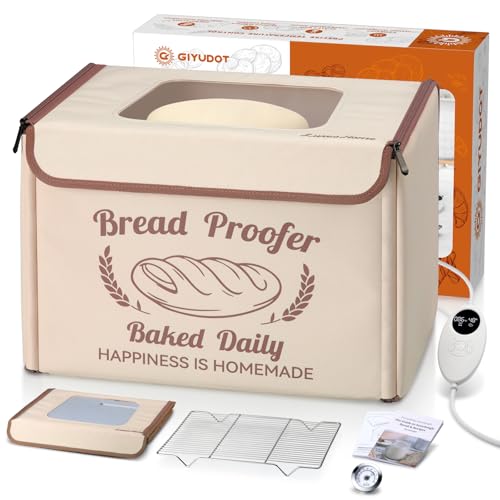 GIYUDOT Folding Bread Proofing Box with 50-113℉
- Achieve perfect dough every time with our bread…
- Designed for compact kitchens yet spacious enough for…
- Constructed with 5 layers of insulating materials, our…
 Folding Bread Proofing Box with 50-113℉ Temp
- Achieve perfect dough every time with our bread…
- Foldable & Dual-View Design: Designed for compact kitchens,…
- Constructed with 5 layers of insulating materials, our…
 Sourdough Silicone Bread Sling for Dutch Oven
- Longer Handle Design: Smartinest upgrades the classic bread…
- Non-Stick & Easy to Clean: The smooth non-stick…
- Reusable & Eco-Friendly: Crafted from food-grade, BPA-free silicone,…
As an Amazon Associate we earn from qualifying purchases at no extra cost to you.
Our picks by baking situation
| Best for | Recommended type or product | Useful capacity | Temperature control | Main compromise |
|---|---|---|---|---|
| Regular bread and sourdough baking | Brød & Taylor Folding Proofer | About 13 × 16 × 8.5 inches of interior space | Approximately 70–120°F, or 21–49°C | Higher purchase price and limited height for very tall dough |
| One jar of starter or a small preferment | Brød & Taylor Sourdough Home | Designed for a single small container | Low-temperature control intended for starter maintenance | Not a replacement for a full-size dough proofer |
| Infrequent baking on a tight budget | Insulated food-storage box with warm water | Choose a box at least 16 × 12 × 8 inches | Indirect and variable | Requires monitoring and has no built-in humidity control |
| Large batches or tall enriched dough | Temperature-controlled proofing cabinet | Usually larger than 2 cubic feet | Often adjustable with a fan and water reservoir | More counter space, noise, weight, and power use |
Why the Brød & Taylor Folding Proofer is the best all-rounder
The Folding Proofer solves the two problems that make improvised proofing unreliable: temperature swings and lack of usable space. Its thermostat keeps dough in a controlled low-temperature environment, and the included water tray can raise humidity so the surface does not form a dry skin before the loaf has finished expanding.
The approximately 13-by-16-inch footprint inside is large enough for a standard mixing bowl, a covered banneton, or a loaf pan. It can usually accommodate one substantial batch made with about 500–1,000 grams of flour, depending on the bowl and how much the dough is expected to rise. It is less suitable for two very large bowls at once or for a tall stockpot.
Its folding design is particularly valuable in a normal home kitchen. When collapsed, the unit is only a few inches thick rather than remaining a permanent appliance on the counter. That storage advantage is more significant than it sounds: a proofer used twice a week should not consume a full shelf or counter corner between bakes.
Temperature and humidity: what matters in practice
Most yeasted doughs do not need a hot environment. A setting around 75–82°F, or 24–28°C, is suitable for many lean breads, rolls, and sourdough doughs. Warmer settings can accelerate fermentation, but they also make timing less forgiving. Enriched doughs containing butter or eggs may benefit from a gently warm, stable environment, while sourdough often benefits from a cooler and slower rise.
The proofer does not need to create tropical humidity. A small amount of water in its tray is normally enough to reduce surface drying. Covering the bowl or banneton remains good practice, particularly during a long bulk fermentation. Too much water can produce condensation on the lid, dampen cloth covers, and make cleaning more troublesome.
How much dough will fit?
Choose by container dimensions, not by the advertised exterior size. A 1-kilogram dough batch can expand substantially, and a bowl that fits before fermentation may touch the lid after doubling. Measure the widest part of your preferred bowl or banneton and leave roughly 2 inches of clearance around it when possible.
- One 500-gram flour batch: Usually an easy fit in a folding proofer with a medium bowl or banneton.
- One 1-kilogram flour batch: Often fits as a single large bowl, but check the dough’s expected expansion and container height.
- Two loaves in bannetons: Possible if the baskets are narrow and arranged carefully; two large round baskets may not fit.
- Sandwich loaves: One standard loaf pan generally fits, but tall pans can approach the lid.
- Pizza dough balls: Several small dough portions can fit in a covered tray, provided the tray is no wider than the interior.
For a household that routinely bakes three or four large loaves at once, a cabinet-style proofer is a better physical match. A compact folding model is optimized for one normal home batch, not production-scale baking.
Foldable proofer versus improvised proofing box
An insulated storage box is the lowest-cost solution. Place the covered dough inside with a mug or jar of warm water, close the lid, and replace the water when the box cools. This can work well, especially in a warm kitchen, but the temperature may vary considerably from the center to the edges. The water also adds humidity without giving you a way to measure it.
A useful test is to place a small digital thermometer inside the empty box for 30 minutes. If the temperature rises above your target or falls quickly, adjust the water temperature and amount. Avoid placing the dough directly beside hot water: localized heat can ferment one side faster than the other.
The folding proofer costs more, but its thermostat reduces supervision. That matters when a recipe calls for a two- or three-hour bulk fermentation and your room temperature changes during the day. It also gives repeatable conditions for comparing recipes, which is difficult with a switched-off oven or a warm windowsill.
Power use, noise, and ownership costs
A low-wattage proofer is inexpensive to run because it warms a small insulated space rather than heating an entire oven. As a worked example, a 36-watt unit running continuously for three hours uses:
0.036 kilowatts × 3 hours = 0.108 kilowatt-hours.
At an electricity rate of $0.20 per kilowatt-hour, that is about 2 cents for one three-hour proof. Real consumption may be lower because the heater cycles on and off after reaching the target temperature. The purchase price, not electricity, is the main cost of ownership.
Most folding proofers are effectively quiet because they use a low-power heating element rather than a large circulating fan. A cabinet with an active fan may distribute heat more evenly but can add a constant hum. If your kitchen shares a living space, check whether the product uses a fan before choosing a larger cabinet.
Typical market pricing is roughly $150–$250 for a dedicated folding proofer, around $100–$180 for a compact starter-focused appliance, and $20–$60 for a suitable storage-box setup. Prices vary by region and included accessories.
Decision matrix for choosing the right setup
| Your situation | Best choice | Why |
|---|---|---|
| You bake once or twice a month and have a stable room temperature | Improvised insulated box | Lowest cost; manual monitoring is unlikely to become burdensome |
| You bake weekly and want repeatable sourdough timing | Folding proofer | Controlled warmth, humidity support, and compact storage |
| You mostly maintain starter rather than proof loaves | Starter-focused compact appliance | Uses less space and is sized for a jar instead of a mixing bowl |
| You bake multiple large batches at once | Proofing cabinet | Greater vertical and shelf capacity outweighs its size |
| Your kitchen has little storage but you bake often | Folding proofer | It can be stored flat between uses |
Setup and cleaning details that affect results
- Place the proofer on a level, dry surface. Do not block its vents or place it beside a hot oven where external heat can confuse the thermostat.
- Preheat the empty chamber briefly. This removes the initial temperature rise from the dough’s fermentation time and reveals whether your selected setting is appropriate.
- Use a covered container. The water tray helps humidity, but a lid, shower cap, or reusable cover prevents drafts and protects the dough surface.
- Keep water away from the electronics. Fill only the intended tray, and wipe spills immediately.
- Dry the interior after baking. Remove the water tray, wipe condensation, and leave the unit open until fully dry before folding it.
The parts most likely to show wear are the folding hinges, fabric or plastic panels, temperature-control dial, and water tray. Avoid forcing the unit shut around a bowl, dragging it while assembled, or storing it damp. If a dough spill reaches a seam, clean it promptly with a lightly damp cloth rather than saturating the insulation. Do not use the proofer as a cooking appliance or place an uncovered metal pan containing hot food inside it.
Final verdict
For most home bakers, the best bread proofer for home baking is a foldable, thermostat-controlled model with enough room for one large bowl or two modest loaves. The Brød & Taylor Folding Proofer is the strongest fit because it combines usable capacity, low running cost, quiet operation, humidity support, and storage that does not permanently take over the kitchen.
Choose an improvised box if you bake occasionally and are comfortable checking temperature. Choose a starter-focused appliance only when your main need is maintaining a small culture. If your normal batch exceeds one large home recipe, skip the compact format and buy a cabinet with shelves, accepting the extra space and cost.








Write Your Review
No reviews yet. Be the first to share your experience!