

Key takeaways
- Compare the best vacuum sealers for bulk buying, meal prep and sous vide, with picks for roll storage, moist-food modes and compact counters.
- Top Pick: FoodSaver FM2000 Vacuum Sealer Machine with Starter Bags and Rolls
- Runner-up: Nesco VS-12 Deluxe Vacuum Sealer
- Also consider: Bonsenkitchen Vacuum Sealer Machine (VS2000)
Freezer burn is not really a freezer problem. It is an air problem. The frost that creeps over a loosely wrapped steak is moisture that escaped the food and froze on its surface, and every bit of air left in the bag speeds that process up while dulling flavor and texture. A vacuum sealer attacks the cause: it pulls the air out of a textured bag, then heat-seals the opening so the food sits in a tight, low-oxygen package that resists freezer burn far longer than wrap or a zipper bag.
The five machines below are all external vacuum sealers, the countertop type that clamps onto the open end of a bag. They differ in the ways that matter day to day: how wide a bag they can seal, whether they store a roll and cut bags to size, and how they treat moist food.
As an Amazon Associate, we earn from qualifying purchases.
Quick Answer
The FoodSaver FM2000 is the safest all-round pick, with a removable drip tray and a seal-only mode for making bags from rolls. The Nesco VS-12 adds a double heat seal and pulse control for moist foods, the Anova Precision suits small kitchens and sous vide, and the Potane VS5736 brings a cutter and roll storage.
Why Air Is the Enemy in Your Freezer
Three things degrade frozen and refrigerated food: oxygen, moisture migration, and odor transfer. Oxygen drives oxidation, which turns fats rancid and fades color. Moisture leaves the surface of the food whenever the surrounding air is drier, and that slow dehydration is freezer burn. A standard bag or wrap traps a pocket of air against the food, so all three processes keep running.
An external vacuum sealer removes most of that air before sealing. The bags are part of the system: embossed channels let the pump draw air out along the full width, and the multi-layer film resists punctures from bone edges and ice crystals better than thin storage bags. The heat seal then fuses the layers into a single barrier. Liquids are the one weakness of this design, because a strong pump can pull juices toward the seal area and weaken it, which is why moist-food modes, drip trays, and pulse controls show up again and again in the picks below.
Five Vacuum Sealers Worth the Counter Space
FoodSaver FM2000 Vacuum Sealer Machine with Starter Bags and Rolls

FoodSaver is the brand most people picture first, and the FM2000 shows why it holds that spot. It is a straightforward clamp-down sealer with two jobs done well: a vacuum-and-seal cycle for filled bags, and a seal-only mode that lets you close one end of a cut piece of roll, fill it, then seal the other end, so bags are always the size the food needs. The patented drip tray pulls out for washing, which matters more than it sounds, because the tray is where marinade and meat juices collect after a messy session.
An accessory port extends the machine beyond bags. With the matching hose and jar attachment, the same pump pulls air out of mason jars and FoodSaver containers, which suits dry goods, coffee, and marinades. The starter kit bundles bags and rolls so the machine is useful out of the box.
Specs
- Model: FM2000-FFP
- Power: 120 watts
- Seal bar: 11 inches
- Dimensions: 16.3 x 9.2 x 4 inches
- Weight: 5.3 pounds
- Features: removable drip tray, seal-only mode, accessory port, starter bags and rolls included
Nesco VS-12 Deluxe Vacuum Sealer

The VS-12 is the pick for people who seal a lot of moist food: garden produce blanched for the freezer, marinated chicken, fresh fish. Its headline feature is a double heat seal, two fused lines instead of one, which gives a weak or slightly damp seal a second barrier. A pulse vacuum button hands control back to you, pulling air out in short bursts so soft foods and liquids stop short of being crushed or drawn into the seal area.
The clear viewing lid makes it easy to confirm the bag edge sits flat and fully inside the vacuum chamber before the cycle starts, a small detail that prevents most failed seals. One-touch automatic operation covers routine dry goods, an accessory port handles canisters and jars, and the starter kit means the first bulk run can happen the day it arrives. At 130 watts it is one of the stronger home pumps in this group.
Specs
- Model: VS-12
- Power: 130 watts
- Seal: double heat seal
- Controls: one-touch automatic, pulse vacuum, seal only
- Features: viewing lid, accessory port, starter kit bags included
- Color: silver
Anova Precision Vacuum Sealer
Anova built its name on sous vide circulators, and this sealer is designed as their partner. It is the slimmest machine here by a wide margin, a low bar that slides into a drawer or stands in a narrow gap beside the fridge, which makes it the natural choice for small kitchens where a full-size sealer would live in a closet and never get used. Operation is deliberately simple: vacuum and seal, seal only, and a pulse mode for delicate items.
The trade-off for the size is speed. The pump moves about 4 liters of air per minute, slower than the bigger machines, so a long run of bulk bags takes patience. In exchange you get a light unit that handles a few bags at a time beautifully, plus ten pre-cut bags in the box and a two-year warranty. For sous vide cooks sealing dinner portions a few times a week, that balance is exactly right.
Specs
- Model: ANVS01-US00
- Dimensions: 16.73 x 4.8 x 3.14 inches
- Weight: 2.3 pounds
- Extraction rate: 4 liters per minute
- Modes: vacuum and seal, seal only, pulse
- Includes: 10 pre-cut bags
- Warranty: 2 years
Bonsenkitchen Vacuum Sealer Machine (VS2000)

The VS2000 covers the budget end of this roundup without stripping the feature list to the frame. Its control panel offers five functions: dry and moist food modes, a seal-only setting, a vacuum-seal cycle, and an external vacuum mode that works through the included suction hose for jars, containers, and wine stoppers. That last mode is unusual at this level and stretches the machine well past bags.
Five pre-cut bags and the hose are in the box, so the first session needs nothing extra. The base cycle suits pantry and freezer staples, coffee beans, cheese, and portioned meats, while the moist mode adjusts the seal for wetter loads. The trade-offs are expected: a lighter build and no roll storage or built-in cutter, so bags come from pre-cut stock or a roll trimmed with scissors.
Specs
- Model: VS2000
- Functions: dry, moist, seal only, vacuum seal, external vacuum
- Includes: 5 vacuum seal bags, air suction hose
- Operation: automatic, one-touch controls
- Color: black
Potane Precision Vacuum Sealer Machine (VS5736)
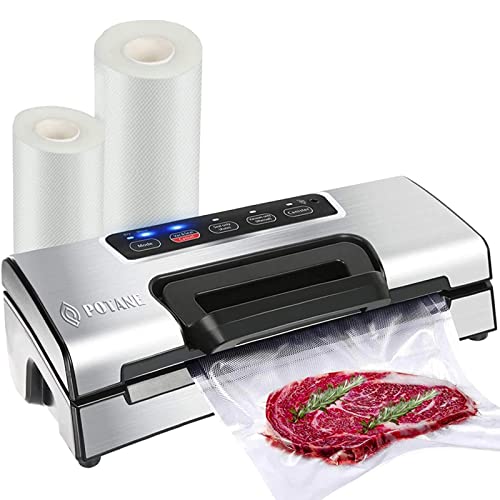
The VS5736 is the most kitchen-counter-serious machine in this group, with a stainless steel finish, a built-in cutter, and storage for a bag roll inside the housing. Keeping the roll on board changes the rhythm of a big sealing day: pull, cut, seal one end, fill, seal the other, without hunting for scissors or a separate roll box. The easy-lock handle closes the lid with a firm, positive latch, which helps keep pressure even across the seal bar.
Dry and moist modes adjust the cycle for the load, and automatic and manual sealing options let you stop the vacuum early for soft foods like bread or ripe fruit. At 120 watts the pump sits in the same class as the other full-size machines here, and the 4.6-pound body feels planted rather than plasticky. If one machine has to handle weekly meal prep plus warehouse-club bulk runs, this is the one built for that workload.
Specs
- Model: VS5736
- Power: 120 watts
- Material: stainless steel finish
- Weight: 4.6 pounds
- Features: built-in cutter, roll storage, easy-lock handle, dry and moist modes, auto and manual sealing
How to Choose
Start with bag width. Most home sealers take bags and rolls up to about 11 inches wide, which covers quart and gallon bags and most cuts of meat. If you regularly seal wide items like briskets or whole racks of ribs, look for a wider seal bar and accept the bigger footprint that comes with it.
Next, decide how you will feed the machine. Pre-cut bags are grab-and-go simple but cost more per bag and fix your sizes in advance. Rolls are cheaper per bag and cut to any length, and a machine with roll storage and a built-in cutter makes that workflow nearly as fast. Occasional users do fine with pre-cut bags; weekly sealers should buy the cutter.
Moist food handling is the third decision. If you seal marinated meat, fish, or soups, prioritize a moist mode, a pulse control, or a double seal, plus a drip tray you can wash. A practical technique helps any machine: freeze liquids and very wet foods until just firm before sealing, so the pump cannot pull juice into the seal area.
Finally, check the extras. An accessory port adds jars and canisters, and a pulse mode protects delicate foods. Also confirm the bag style, since external sealers require textured, embossed bags to work at all.
Who Should Skip a Vacuum Sealer
Skip it if your freezer turns over every week or two. Vacuum sealing pays off over months of storage, and for food you will eat this week, a plain bag with the air pressed out by hand does nearly as well. Skip it if you mostly store liquids in bulk: chamber sealers handle those far better, and they are a different, larger machine class than anything here. And skip it if counter and cabinet space are already gone, because a sealer you have to excavate is one you will stop using, unless you pick the slim Anova above, designed for exactly that problem.
Frequently Asked Questions
Can I use regular plastic bags in a vacuum sealer?
No. External vacuum sealers need textured bags with embossed air channels, because smooth film collapses flat and traps air pockets the pump cannot reach. Rolls and pre-cut bags made for vacuum sealing work in any brand of external machine with a matching width.
How long does vacuum-sealed food last in the freezer?
Much longer than wrapped food, because the two main causes of decline, air exposure and moisture loss, are largely removed. Exact times depend on the food and freezer temperature, but meat that would show freezer burn within a few months in wrap commonly keeps its quality for a year or more when sealed well.
Why does my sealer sometimes fail to seal properly?
The usual causes are moisture or food particles in the seal area, a bag edge that is wrinkled or not lying flat, or sealing too many bags back to back and overheating the seal bar. Wipe the seal area dry, leave headroom at the top of the bag, and give the machine short rests during long runs.
Are vacuum sealer bags reusable?
Bags that held dry goods can often be washed, dried fully, and reused, though each cut makes them shorter. Bags that held raw meat, fish, or oily foods should be thrown away, since the seams and channels are hard to clean completely.
Final Verdict
For most kitchens, the FoodSaver FM2000 is the balanced default: proven design, washable drip tray, and an accessory port for jars. Choose the Nesco VS-12 if moist food and double seals matter most, the Anova Precision if space is tight and sous vide is the main job, the Bonsenkitchen VS2000 for the lowest-cost route in, and the Potane VS5736 if roll storage, a cutter, and a stainless finish will earn their keep across heavy weekly use.

More from Amazon
Programs that pair well with the guide above. Offers and eligibility are set by Amazon and may change.
Set up recurring deliveries of everyday items on eligible products. Terms and savings are set by Amazon.
Explore Subscribe & SaveCollect the home and kitchen items you want in one registry that guests can shop from.
Create a wedding registryFree shipping on eligible items, Prime Video and more. Eligible new members can start with a free trial.
Start a Prime free trialAudiobooks and podcasts to listen to on the go. Eligible new members can start with a free trial.
Try Audible freeAs an Amazon Associate we earn from qualifying purchases.


Write Your Review
No reviews yet. Be the first to share your experience!