

Key takeaways
- Compare five electric donut makers by batch size, wattage, donut size, and cleanup, with picks for small counters, big batches, and tight budgets.
An electric donut maker is a countertop press with two heated, ring-shaped plates. You spoon or pipe in a cake-style batter, close the lid, and a few minutes later you have a batch of baked donuts with no pot of oil, no deep fryer to drain, and no oven heating up the whole kitchen. Every model in this guide works the same basic way, so the real differences are batch size, donut size, wattage, and how the machine stores when it is not in use.
The five picks below cover the main shapes this category takes: a seven-donut all-rounder, a twelve-donut batch machine, a small six-donut classic, an upright-storing model for tight cupboards, and a budget press with basic safety shutoff protection. All of them bake rather than fry, so expect a cake donut texture, closer to a muffin top than to a raised yeast donut from a bakery case.
As an Amazon Associate, we earn from qualifying purchases.
Quick Answer
For most home bakers, the Dash Mini Donut Maker is the easiest place to start: seven mini donuts per batch, 760 watts, and a footprint smaller than a dinner plate. Bakers feeding a crowd should look at the 12-donut Baker’s Friend, while the Babycakes, CucinaPro, and Brentwood cover smaller batches, upright storage, and budget counters.
Baked, Not Fried: How These Machines Actually Work
Each plate carries a set of ring molds, and both plates heat at once, so the batter cooks from the top and bottom without flipping. Most home models run at a fixed temperature with a power light and a ready light rather than a dial, which means doneness is judged by time and by the color of the first test batch. A typical batch takes roughly three to five minutes depending on the batter.
Because there is no frying oil, the batter has to bring its own structure and moisture. Cake batters, boxed cake mixes, and brownie batters all work; a risen yeast dough does not, because the closed plates leave it no room to proof and it bakes up dense. Nonstick plates are standard across the category, and on most models they are fixed in place, so cleanup is a wipe with a damp cloth once the unit cools rather than a sink wash.
Dash Mini Donut Maker — Best Overall for Most Kitchens
The Dash is the reference point for this category: a 760-watt press that bakes seven mini donuts at a time on dual nonstick plates. At 8.7 by 10.6 inches it takes up about as much counter as a hardcover cookbook, and at just over three pounds it is easy to move in and out of a cupboard. Operation is a single step — plug it in, wait for it to heat, add batter — with no temperature dial to manage.
The included recipe guide and recipe database access give new owners a starting batter, and boxed mixes work without adjustment beyond watching the first batch for timing. The Aqua finish is one of several color options on the listing; the donut-print variant is a separate listing with the same seven-donut format.
Specs
- Capacity: 7 mini donuts per batch
- Power: 760 watts, 120 volts
- Dimensions: 8.7 x 10.6 x 3.9 inches
- Weight: 3.26 pounds
- Model: DDM007GBAQ04 (Aqua)
- Plates: fixed, dual-sided nonstick
- Included: recipe guide, recipe database access, 1-year manufacturer warranty
Baker’s Friend Mini Donut Maker Machine — Best for Bigger Batches

Where most mini donut makers stop at seven, the Baker’s Friend bakes twelve mini donuts in one batch, and it backs that capacity with 1,200 watts — the highest power figure in this guide. That combination suits bake sales, birthday parties, and classroom treats, where running a seven-donut press six times turns a quick project into an afternoon shift.
The trade-off is counter space and a longer preheat than the smaller units, and twelve rings to fill evenly means a piping bag or a batter bottle earns its keep here. The nonstick plates follow the same wipe-clean routine as the rest of the category. For a household that regularly bakes for a group, this is the premium pick in the lineup; for a couple making a weekend snack, it is more machine than the job needs.
Specs
- Capacity: 12 mini donuts per batch
- Power: 1,200 watts, 120 volts
- Model: BF-DM01
- Color: Aqua
- Plates: fixed nonstick
- Typical batch time: about 3 to 5 minutes
Babycakes Nonstick Donut Maker — The Compact Classic

The Babycakes is one of the longest-running designs in this category, and it keeps things deliberately small: six mini donuts per batch at 350 watts, the lowest power draw here. A batch takes about four minutes, and the lower wattage makes it a reasonable pick for older kitchen wiring, dorm-adjacent setups, and anyone who wants a machine that sips rather than pulls power.
Six at a time is a snack-sized output, so this is a machine for one or two people, or for a parent and child decorating a small plate of donuts together. The nonstick plates release the rings cleanly, and the compact body stores in a drawer-height space that the bigger presses cannot use. Buyers who regularly cook for four or more should step up to a seven- or twelve-donut model instead.
Specs
- Capacity: 6 mini donuts per batch
- Power: 350 watts
- Typical batch time: about 4 minutes
- Plates: fixed nonstick
- Brand: Babycakes (Select Brands)
CucinaPro Mini Donut Maker — Best for Upright Storage

The CucinaPro bakes seven small donuts per batch, matching the Dash on capacity, and its distinguishing feature is storage: the unit stands upright on end, so it slides into the narrow gap beside a cutting board or inside a shallow cupboard instead of claiming a full shelf. For small kitchens, that storage shape can matter more than any cooking specification.
The nonstick cooking surface handles release and cleanup the same way as the other presses here, and the box includes an instruction manual with a recipe guide covering vanilla glazed, chocolate, cinnamon sugar, and apple donuts. It is a mid-range pick that makes the most sense for buyers whose main complaint about countertop appliances is where they live between uses.
Specs
- Capacity: 7 small donuts per batch
- Dimensions: about 10 x 8 x 4.5 inches
- Weight: about 3.3 pounds
- Plates: fixed nonstick
- Storage: stands upright on end
- Included: instruction manual and recipe guide
Brentwood TS-250 Mini Donut Maker — Best Budget Pick
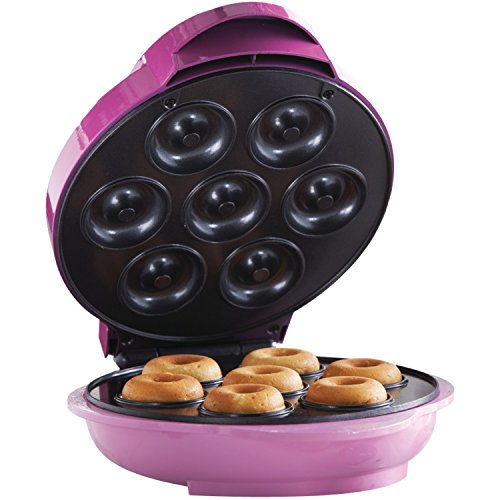
The Brentwood TS-250 is the budget entry in this guide: a 750-watt, seven-donut press in pink with preheat indicator lights and an overheat cutoff, a safety feature the other budget presses here do not list. It stores on end to save cupboard space and weighs about three pounds.
There is no temperature control, so bake time is judged by the ready light and a look at the first batch, which is normal for this price tier across the category. The cool-touch handle is a practical touch on a machine that gets opened and closed every few minutes during a baking session. Buyers who want the lowest-commitment way to find out whether donut making sticks as a habit will find this the sensible starting point.
Specs
- Capacity: 7 mini donuts per batch
- Power: 750 watts
- Weight: 3.1 pounds
- Color: Pink
- Model: TS-250
- Features: preheat indicator lights, overheat cutoff, cool-touch handle, stores on end
How to Choose an Electric Donut Maker
Start with batch size. Six or seven mini donuts suits one to three people. Twelve at a time only pays off if you regularly bake for parties or bake sales, because a bigger plate also means a bigger machine to store.
Check the donut size, not just the count. Every model here makes mini donuts, roughly two-bite rings. If you want full-size donuts, this category will not give them to you; that job belongs to a donut pan in a conventional oven.
Read wattage as a speed hint, not a quality score. Higher wattage generally means a faster preheat and quicker recovery between batches. The 1,200-watt Baker’s Friend recovers fastest; the 350-watt Babycakes is slower but gentler on a loaded circuit.
Decide how the machine will be stored. Two of these five stand upright on end. Measure the cupboard or shelf the machine will actually live in before choosing, because a press that has to stay on the counter often stops being used.
Plan your batter workflow. Fixed plates cannot go in the sink, so all of these are wipe-clean appliances. A piping bag or squeeze bottle makes filling the small rings faster and neater on every model, and it matters most on the twelve-donut plate.
Who Should Skip an Electric Donut Maker
Skip this category entirely if what you want is a raised, yeasty donut with a fried crust. These machines bake cake batter in a closed mold, and no setting on any of them reproduces deep frying. A donut pan plus a stand mixer is also the better route for bakers who already own both and only make donuts a few times a year; the pan stores flat and costs the oven a few minutes of heat.
Commercial and near-commercial volumes are out of scope as well. Even the twelve-donut machine here is a home appliance with a home duty cycle, and a bake sale producing hundreds of donuts in a morning calls for rental or commercial equipment rather than any countertop press.
Frequently Asked Questions
Do electric donut makers fry or bake the donuts?
They bake. The batter cooks between two heated nonstick plates with ring-shaped molds, and no oil bath is involved. The result is a cake-style donut with a soft crumb, ready for glaze, frosting, or a coating of cinnamon sugar once it cools slightly.
Can boxed cake mix be used in a donut maker?
Yes. Boxed cake mix is one of the most common batters for these machines and needs no change to the mixing directions on the box. Fill each ring about two-thirds full, and check the first batch early, because mixes brown at slightly different speeds.
How long does one batch take in a mini donut maker?
Most batches bake in about three to five minutes after the machine has preheated. Denser batters and fuller rings sit at the long end of that range, and the first batch in a cold machine usually takes a little longer than the batches that follow it.
How are the plates cleaned after baking?
Let the machine cool completely, then wipe the plates with a damp cloth or a soft sponge. The plates on home models are fixed rather than removable, so the unit should never be immersed in water. A light brush of oil before the first batch of a session helps any stubborn batter release.
Final Verdict
For a first electric donut maker, the Dash is the balanced choice: seven donuts, moderate wattage, a small footprint, and a recipe guide in the box. The Baker’s Friend is the step up for anyone baking for groups, the Babycakes suits small households and low power draw, the CucinaPro earns its place in cupboards where upright storage matters, and the Brentwood TS-250 is the budget way in, with an overheat cutoff the other low-cost presses skip. Match the batch size to the number of people you actually feed, and any of the five will do the job it was picked for.

More from Amazon
Programs that pair well with the guide above. Offers and eligibility are set by Amazon and may change.
Set up recurring deliveries of everyday items on eligible products. Terms and savings are set by Amazon.
Explore Subscribe & SaveCollect the home and kitchen items you want in one registry that guests can shop from.
Create a wedding registryFree shipping on eligible items, Prime Video and more. Eligible new members can start with a free trial.
Start a Prime free trialAudiobooks and podcasts to listen to on the go. Eligible new members can start with a free trial.
Try Audible freeAs an Amazon Associate we earn from qualifying purchases.


Write Your Review
No reviews yet. Be the first to share your experience!