

The best telescope eyepieces are the ones whose focal length, field of view, eye relief, and barrel size suit both your telescope and the way you observe.
A high-priced eyepiece will not automatically produce a sharper image: magnification depends on your telescope, atmospheric conditions often set the practical limit, and an eyepiece with an enormous field of view may be less useful than a comfortable, well-corrected design. For most observers, a useful set includes a low-power wide-view eyepiece, a medium-power general-purpose eyepiece, and one higher-power option for the Moon, planets, and double stars.
Our top picks
 Starboosa 1.25-Inch Telescope Eyepiece Set with Barlow
- **Comprehensive Eyepiece Set:** This 1.25-inch (31.7mm) eyepiece set…
- **Added Filters for Optimal Viewing:** The set comes…
- **Upgraded Eyepieces with Soft Eyecups:** The eyepieces are…
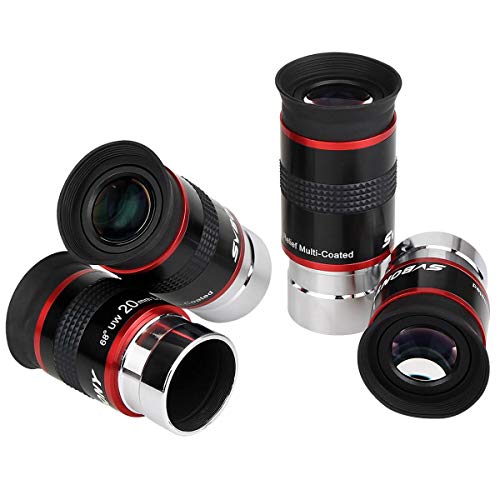 SVBONY Telescope Eyepiece 68° Ultra Wide Angle
- Super wide 68 degree apparent field of view;gets…
- Fully multi coated lens;broadband green film optical glass…
- Multi-element design delivers sharp images;highly achromatic with good…
 Starboosa 1.25-Inch Telescope Eyepiece Set
- 1.25 inch (31.7mm) diameter eyepiece for astronomical telescopes
- Focal length: 4mm 10mm 20mm Three sets, you…
- Upgraded Lens has better imaging effect, chromatic aberration…
| Product | Key specs | |
|---|---|---|
| Starboosa 1.25-Inch Telescope Eyepiece Set with Barlow | **Comprehensive Eyepiece Set:** This 1.25-inch (31.7mm) eyepiece set… **Added Filters for Optimal Viewing:** The set comes… **Upgraded Eyepieces with Soft Eyecups:** The eyepieces are… | Check price |
| SVBONY Telescope Eyepiece 68° Ultra Wide Angle | Super wide 68 degree apparent field of view;gets… Fully multi coated lens;broadband green film optical glass… Multi-element design delivers sharp images;highly achromatic with good… | Check price |
| Starboosa 1.25-Inch Telescope Eyepiece Set | 1.25 inch (31.7mm) diameter eyepiece for astronomical telescopes Focal length: 4mm 10mm 20mm Three sets, you… Upgraded Lens has better imaging effect, chromatic aberration… | Check price |
 Celestron 8-24mm Zoom Telescope Eyepiece with Fully Celestron 8-24mm Zoom Telescope Eyepiece with Fully | Go from low to high power in an… LOW POWER OR HIGH POWER? YOU CHOOSE: Instead… WORKS WITH ALL TELESCOPES THAT ACCEPT STANDARD 1.25"… | Check price |
As an Amazon Associate we earn from qualifying purchases at no extra cost to you.
Quick comparison of popular eyepiece types
| Eyepiece type or example | Common focal lengths | Approx. apparent field of view | Typical eye relief | Best use | Typical market range |
|---|---|---|---|---|---|
| Standard Plossl, such as Celestron Omni Plossl | 6–40 mm | About 50° | About 4–30 mm, depending on focal length | Affordable general-purpose observing | $25–$80 |
| Long-eye-relief planetary design, such as Celestron X-Cel LX | 5–25 mm | About 60° | About 16–20 mm | Moon, planets, glasses wearers | $70–$120 |
| Wide-angle 82° design, such as Explore Scientific 82° Series | 4.7–30 mm | 82° | Roughly 13–20 mm, depending on focal length | Deep-sky objects and immersive views | $160–$400 |
| Premium wide-angle, such as Tele Vue Nagler | 2.5–31 mm | 82° | Varies widely by focal length | Well-corrected views, especially in fast telescopes | $350–$900 |
| Premium long-eye-relief, such as Tele Vue Delos | 3.5–17.3 mm | 72° | 20 mm | High-power viewing with maximum comfort | $400–$500 |
Prices are broad market ranges and vary by focal length, condition, and country. The specifications also vary within each product family, so check the manufacturer’s listing for the exact model before buying.
Choose focal length before choosing a brand
Magnification is calculated by dividing the telescope’s focal length by the eyepiece’s focal length:
Magnification = telescope focal length ÷ eyepiece focal length
For example, a 1,000 mm telescope used with a 25 mm eyepiece produces 40× magnification. The same telescope with a 10 mm eyepiece produces 100×.
A practical three-eyepiece set for that telescope might be:
- 32 mm: 31× for locating objects, large star clusters, and wide nebulae.
- 18–20 mm: 50–56× for galaxies, globular clusters, and general deep-sky observing.
- 10 mm: 100× for the Moon, planets, and compact objects on steady nights.
Do not assume that the shortest available focal length is the best choice. At very high magnification, the image becomes dimmer, vibrations are more noticeable, and atmospheric turbulence can erase fine detail. A useful rule of thumb is to begin around 30–50× per inch of aperture and increase power only when the image remains crisp. Telescope design, optical quality, collimation, and local seeing all affect the final limit.
Apparent field of view: wider is not always better
Apparent field of view, or AFOV, describes how wide the view appears through the eyepiece. A 50° Plossl gives a traditional, moderate view. A 68°–72° eyepiece feels noticeably more spacious, while an 82° model can make an object remain visible longer before Earth’s rotation carries it across the field.
The true field of view can be estimated by dividing AFOV by magnification. With a 25 mm, 50° eyepiece at 40×, the true field is approximately 1.25°. A 25 mm eyepiece with a 68° apparent field at the same magnification gives roughly 1.7°.
That wider view is valuable for open clusters, large nebulae, and manually tracking a Dobsonian telescope. However, wide-angle eyepieces are usually larger, heavier, and more expensive. Some budget wide-angle models also show distorted stars near the edge when used in a fast telescope with a low focal ratio.
Eye relief determines comfort
Eye relief is the distance your eye can sit from the eyepiece’s eye lens while still seeing the entire field. Around 15–20 mm is comfortable for many observers, particularly anyone who observes while wearing glasses. Short focal-length Plossls can have very tight eye relief: a 6 mm Plossl may be difficult to use comfortably even though its optics can be sound.
Long-eye-relief designs such as the Celestron X-Cel LX and Tele Vue Delos are easier to view for extended periods. They commonly include adjustable eyecups, which help position the eye and block stray light. If only one person uses the telescope and glasses are not needed, a compact short-eye-relief eyepiece may be acceptable; for family use, public viewing, or astigmatism-correcting glasses, prioritize generous eye relief.
Compatibility checks that prevent expensive mistakes
Barrel size
Most amateur telescopes accept either a 1.25-inch or 2-inch barrel. A 1.25-inch eyepiece is the normal starting point and works with many beginner refractors, Maksutov-Cassegrains, Schmidt-Cassegrains, and small Dobsonian telescopes. Two-inch eyepieces can provide wider low-power views, but the telescope must have a 2-inch focuser or a suitable diagonal.
A 2-inch eyepiece does not automatically produce more magnification or sharper images. Its main advantage is accommodating a larger field stop, which can create a wider true field at low power.
Telescope focal ratio
Fast telescopes, such as an f/4.5 Dobsonian, demand more from an eyepiece than a slower f/10 Schmidt-Cassegrain. In a fast telescope, inexpensive wide-angle eyepieces may show astigmatic or comatic-looking stars toward the edge. Premium wide-angle designs, including Tele Vue Nagler models and well-corrected Explore Scientific 82° models, are better suited to edge-of-field performance, although the telescope’s coma may still remain visible.
Back focus and accessories
Binoviewers, filters, focal reducers, and some diagonals can change the required focus position. If you use a focal reducer, calculate magnification from the telescope’s reduced focal length rather than its original specification. A 0.63× reducer changes a 2,000 mm telescope to approximately 1,260 mm, so a 20 mm eyepiece changes from 100× to about 63×.
Best eyepieces by observing situation
| Your priority | Most sensible choice | Why | Trade-off |
|---|---|---|---|
| Lowest cost | 25 mm and 10 mm Plossls | Sharp central views and broad compatibility | Short eye relief at high power; approximately 50° AFOV |
| Manual Dobsonian tracking | 68°–82° eyepiece in the medium-power range | Objects take longer to cross the field | More weight and cost |
| Glasses or shared family use | 15–20 mm eye-relief design | Comfortable viewing and easier eye placement | Often bulkier than a Plossl |
| Fast Dobsonian | Well-corrected 68°–82° eyepiece | Better edge stars than basic wide-angle designs | Premium models can cost several hundred dollars |
| Planetary detail on a budget | 8–12 mm long-eye-relief planetary eyepiece | Comfortable high power without extremely short eye relief | Requires steady air and accurate telescope alignment |
How to build a useful set without buying too much
- Record the telescope’s focal length, aperture, focal ratio, and focuser size. These determine magnification, brightness, edge correction needs, and physical fit.
- Buy one low-power eyepiece first. A 25–32 mm 1.25-inch model is a flexible starting point for many telescopes. For a 2-inch focuser, consider a 30–40 mm wide-field design if the telescope and mount can handle its weight.
- Add a medium-power eyepiece. Choose a focal length that gives approximately 50–100× for routine viewing.
- Add high power only after using the first two. A 7–12 mm eyepiece is often more useful than an extremely short 4 mm model, because local atmospheric conditions may rarely support extreme magnification.
- Check balance and clearance. Heavy 2-inch eyepieces can make a small Dobsonian or alt-azimuth mount tip or drift. A parfocal or similar-height set can also reduce refocusing between eyepieces.
Ownership realities: cleaning, weight, and wear
Eyepieces have no consumable parts, but their coatings and internal alignment benefit from careful handling. Store them with both caps fitted, avoid touching the eye lens, and let a cold eyepiece warm gradually in a closed case to reduce condensation. Dust can usually be removed with a blower; repeated dry wiping can drag grit across the coating.
When cleaning is necessary, use optical cleaning fluid and clean lens tissue or a manufacturer-approved method. Do not use household glass cleaner. The parts most likely to cause trouble are the rubber eyecup, which can crack or detach, and the set-screw undercuts or barrel surfaces, which can collect grime. A heavy eyepiece can also loosen a diagonal or strain a lightweight mount, so weight is a compatibility specification, not merely a convenience.
Final buying recommendation
For a first telescope, start with a comfortable 25–32 mm eyepiece, then add a 10–15 mm model with at least moderate eye relief. Choose 68°–82° apparent fields if you manually track objects or own a fast Dobsonian; choose a simpler Plossl if low price and compact size matter most. Move to premium designs only when you know which focal lengths you use frequently and can identify the limitation you want to solve—tight eye relief, soft edge stars, narrow tracking time, or uncomfortable viewing. That approach produces the best telescope eyepieces for your actual telescope rather than the most impressive specifications on a product page.








Write Your Review
No reviews yet. Be the first to share your experience!