

Key takeaways
- When someone searches for pots, not pans, for an induction cooktop, the job is usually liquid: boiling pasta, simmering soup, building a stock.
When someone searches for pots, not pans, for an induction cooktop, the job is usually liquid: boiling pasta, simmering soup, building a stock, or steaming a batch of dumplings. That is different from choosing a skillet, because volume and base size start to matter as much as magnetic compatibility. A pot that is far too large for the burner heats unevenly at the rim, while one that is too small for the zone wastes the cooktop’s power. Capacity, base diameter, and lid fit become the practical decision points.
This guide covers six options for 2026: a pair of 6-piece stainless sets with several pot sizes, a mid-sized tri-ply stockpot, an 8-quart pot, a very large 20-quart pot, and a dual-sided hot pot with a divider. Each is described strictly from its listing title, so use the notes below to shortlist, then confirm the base diameter and weight limits on the product page, especially for the largest pot, which may overhang a standard burner ring.
Quick Picks
Our top picks




As an Amazon Associate we earn from qualifying purchases at no extra cost to you.
| Product | Best for | Key spec taken from the product title |
|---|---|---|
| 6-Piece Stainless Nonstick Induction Set | Small kitchens needing several pot sizes | 6 pieces, works with induction, electric and gas |
| Kirecoo 8-Quart Stainless Stock Pot | Everyday soups and pasta | 8 quarts, visible lid, thick nonstick base |
| NutriChef 20-Quart Stockpot | Large batches and gatherings | 20 quarts, stainless lid, induction, gas and electric |
| SHEUMNT 6-Piece Stainless Set | Pots with glass lids for monitoring | 6 pieces, glass lids, induction, non toxic |
| Tri-Ply Stainless 6.5-Quart Stock Pot | Heavy-duty single pot with visible lid | 6.5 quarts, tri-ply, double handle |
| CAROTE 4.5-Quart Divider Stockpot | Hot pot meals with two flavors | 4.5 quarts, dual-sided nonstick, glass lid |
How to Choose
Pick capacity by how you cook
A 3 to 4 quart saucepan covers sauces, grains, and single-serving soup. A 6 to 8 quart stockpot handles a family pot of pasta or chili. Past about 12 quarts you are into canning, seafood boils, or party batches, and the pot may be heavier than a cooktop is meant to support when full. Match volume to your habits: a very large pot that lives in the back of a cabinet is a poor trade for a mid-sized one you use weekly.
Check magnetic base and burner fit
The base must attract a magnet, which is why listings emphasize induction compatibility. After that, compare the flat base diameter with your burner zone. A base close to the ring size heats efficiently, a much smaller one heats slowly, and a much larger pot overhangs and may trip an automatic shutoff. Tri-ply and thick encapsulated bases spread heat well, so liquids come to a boil evenly without hot spots that scorch thick soups.
Lids, handles, and weight
Glass lids let you watch a simmer without releasing steam, while solid stainless lids hold heat better. Look for double handles on large pots so you can lift them safely when full, and remember that a 20-quart pot filled with water is a serious load. Riveted or well-welded handles are a durability signal. If you pour from the pot often, check that the lid has a vent or strainer notch.
What to ignore and where budget pots cut corners
Skip decorative claims and focus on the base: thin single-layer bases warp, and warped pots spin on glass. Nonstick pot interiors, where listed, wear faster than bare stainless and should not be used with metal ladles. A dishwasher-safe label is convenient, but handwashing preserves finishes longer. And do not buy a giant set if you only need two good pots. A single well-built stockpot plus a saucepan often outperforms a dozen thin pieces that you will rarely use.
The 6 Best Options
6-Piece Stainless Nonstick Induction Set
This set advertises that it works with induction, electric, and gas cooktops and is dishwasher safe, pairing stainless construction with nonstick language. With six pieces it covers a couple of pot sizes plus a pan, which is plenty for an apartment or dorm. It is an easy answer for someone who wants versatility without buying individual pots. A set like this also keeps the cookware matched, so lids and handles look and feel the same, and it is simple to replace the whole group at once when it eventually wears out.
- Strength: compatibility across all three stove types makes it future-proof for moves.
- Strength: dishwasher-safe wording suits busy kitchens.
- Trade-off: the set will not provide a very large stockpot for crowd-size batches.
Skip it if you want a dedicated big pot for canning or seafood boils.
Kirecoo 8-Quart Stainless Stock Pot
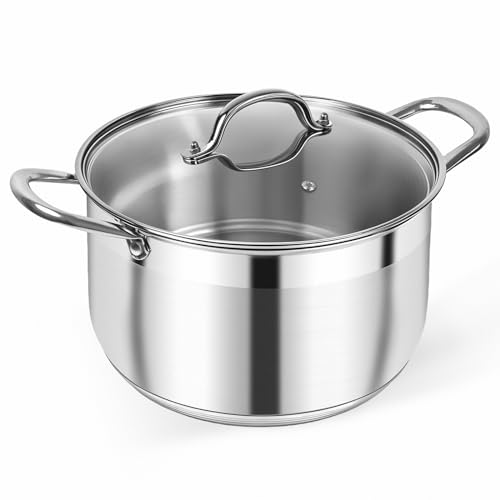
This 8-quart stainless pot is listed with a visible lid, heavy-duty build, even heat, and a thick nonstick base, aimed at soups, pasta, and spaghetti. Eight quarts is a family-sized capacity that still fits comfortably on a standard burner, making it the practical pick for weekly batch cooking. The visible lid lets you check boil-over risk without lifting. For cooks who make a big pot of soup on Sunday and eat from it all week, this is the capacity that tends to match real habits better than a tiny saucepan or a giant canner.
- Strength: eight quarts is large enough for a family without overwhelming the cooktop.
- Strength: the visible lid reduces lifting and keeps heat in.
- Trade-off: a nonstick base inside a pot calls for non-metal ladles and gentle cleaning.
Skip it if you want a smaller everyday pot or a pot for canning-scale batches.
NutriChef 20-Quart Stockpot
The NutriChef is a heavy-duty 20-quart pot with a stainless lid that is stated to work on induction, gas, and electric cooktops. It is meant for large gatherings, big-batch stocks, and cooks who freeze meals. Twenty quarts is more than most home burners handle comfortably, so it suits those with a large burner zone and the space to store a very big pot. Think of it as the occasional-use specialist: it earns its shelf space at holidays, block parties, and batch-cooking weekends, not on an ordinary Tuesday night.
- Strength: a 20-quart capacity serves party-size batches and stock making.
- Strength: it states compatibility with induction and other stovetops.
- Trade-off: a full pot is heavy and may overhang a typical induction zone.
Skip it if you rarely cook for more than a handful of people or have limited storage.
SHEUMNT 6-Piece Stainless Set
This set offers six stainless pieces with glass lids, listed for induction, electric, and gas cooktops, and described as non toxic with kitchen utensils included. Glass lids appeal to cooks who like to monitor a simmer, and the set gives several pot sizes in a compact package. It suits renters who want a matching group instead of a mixed collection. The included kitchen utensils mentioned in the title are a small bonus, since a new cook gets what is needed to stir, serve, and flip without a separate shopping trip.
- Strength: glass lids let you watch food without lifting them.
- Strength: induction, electric, and gas compatibility covers any stove you may use.
- Trade-off: a six-piece set has limited capacity for very big batches.
Skip it if you want one big pot instead of a set of small ones.
Tri-Ply Stainless 6.5-Quart Stock Pot
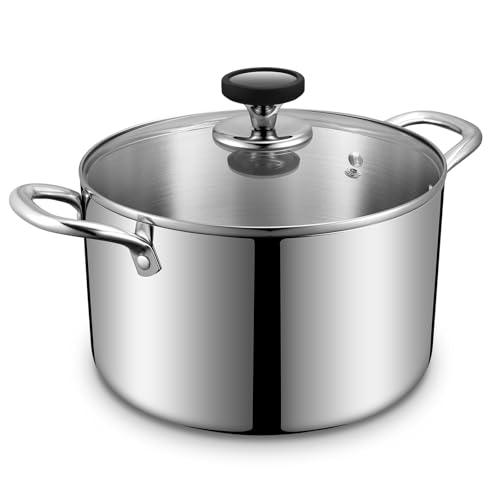
This heavy-duty pot uses tri-ply stainless construction, comes with a visible lid, and has sturdy double handles, aimed at pasta, soup, and spaghetti. At 6.5 quarts it sits in the sweet spot for most households: big enough for a family pasta night, small enough for a normal burner. Tri-ply layers are well matched to induction because they spread heat evenly across the base. Cooks who simmer tomato sauce, chili, or thick stews will notice the value of that construction most, since thick liquids are the ones most likely to scorch on a thin pot.
- Strength: tri-ply construction supports even heating on induction burners.
- Strength: double handles make a full pot safer to carry.
- Trade-off: it is a single pot, so you still need others for sauces and sides.
Skip it if you want multiple pot sizes in a single purchase.
CAROTE 4.5-Quart Divider Stockpot
This white granite stockpot features a divider for double flavor, dual-sided nonstick, a glass lid, and induction support, and it doubles as a braiser or hot pot. It is the specialty pick for shared meals where two broths cook side by side, such as spicy and mild. The 4.5-quart size keeps the footprint modest on a typical burner. Because it is a niche design, it works best as a second pot alongside a conventional one, and it suits households that gather around the table for slow, shared dinners rather than quick weeknight meals.
- Strength: the divider allows two flavors in a single pot, which is ideal for hot pot nights.
- Strength: dual-sided nonstick eases cleanup after sticky or starchy dishes.
- Trade-off: the divider limits capacity for one large batch, so it is a poor stock pot.
Skip it if you want a standard pot for pasta or large batches.
Which One Fits Your Situation
You cook pasta and soup for a family weekly
The Kirecoo 8-Quart Stainless Stock Pot or the Tri-Ply Stainless 6.5-Quart Stock Pot will cover it. Choose the 8-quart for larger households and the tri-ply for a slightly smaller, more heat-focused pot.
You host big gatherings or make stock in bulk
The NutriChef 20-Quart Stockpot is built for volume, as long as your burner zone and storage space can handle it.
You are equipping a small kitchen from scratch
The SHEUMNT 6-Piece Stainless Set or the 6-Piece Stainless Nonstick Induction Set gives you multiple sizes without crowding a cabinet.
You love hot pot or shared-broth dinners
The CAROTE 4.5-Quart Divider Stockpot lets two flavors share one pot, which no standard stockpot can do.
Common Mistakes
- Buying a pot far bigger than the burner zone and then wondering why the rim barely heats.
- Filling a very large pot to the top and lifting it with one hand.
- Using metal ladles on a nonstick pot interior.
- Assuming a stainless pot works on induction without a magnet test.
- Ignoring lid fit, which lets steam escape and slows boiling.
Specs and Terms Explained
Quart capacity
Quarts measure total volume to the brim, but you can only fill a pot about two thirds to three quarters before boiling over. A 4.5-quart pot realistically holds enough for a pasta portion for two; a 6.5-quart pot suits a family; an 8-quart pot is the usual stock pot size; and a 20-quart vessel is for crowds and batch cooking.
Tri-ply
The Tri-Ply Stainless 6.5-Quart Stock Pot uses this term, which means three bonded layers, typically steel outside, aluminum inside the wall, and steel on the cooking face. The point is more even heat and a base that responds to induction.
Divider pot
The CAROTE 4.5-Quart Divider Stockpot has a partition so two liquids can share one burner, which suits hot pot and soups with different broths. Look at whether the divider is removable or fixed, since that decides how easily you can clean it.
Burner zone size
Induction zones are drawn as rings. A pot whose base matches the ring heats efficiently; a very large pot such as the NutriChef 20-Quart Stockpot may overhang the zone and heat unevenly or draw less from the burner.
Setup and Care Tips
- Start boiling on a medium-high setting, then lower it. Induction responds fast and a rolling boil needs less power than many expect.
- If you hear a faint hum or buzz, it is typically harmless and caused by the vibration of layered bases.
- Lift pots rather than sliding them across the glass, which can leave scratches.
- For stainless pots, a paste of baking soda and water lifts scorched residue without damaging the surface.
- Dry stainless fully after washing to avoid water spots.
- Do not heat an empty pot on induction; thin bases can overheat in moments.
Who Should Skip These
If you only boil a pot of water once a week, the 20-quart size is unnecessary and awkward to store, and the Kirecoo 8-Quart Stainless Stock Pot is a more sensible ceiling. People who want a single large pot should skip the multi-piece 6-Piece Stainless Nonstick Induction Set or the SHEUMNT 6-Piece Stainless Set, which are better for a mixed kitchen. And anyone with a compact hob should confirm the pot base fits before ordering.
Sizing and Compatibility Checklist
- Match the pot to the dish: pasta and soup for four want roughly six quarts, while a single sauce wants far less.
- Measure your largest induction zone and keep the pot base within it, with a little room to spare.
- Try a magnet on the base of any pot you already own before assuming you must replace it.
- Check that the lid fits snugly and that the handles clear the neighboring burner.
- Check cabinet height; a tall stock pot with its lid on may need a lower shelf.
Related guides
- How To Clean Copper Cookware Without Damaging Tin Lining
- Carbon Steel Woks For Gas Stoves 14 Inch
- How To Season A Carbon Steel Wok Step By Step
Frequently Asked Questions
What size pot is best for an induction cooktop?
For most households a 6 to 8 quart stockpot plus a 3 to 4 quart saucepan covers daily cooking. Larger pots make sense only for canning, seafood boils, or party batches.
Will a pot larger than the burner work?
It can, but the rim will heat slowly and some cooktops shut off if the base overhangs the sensor zone. Aim for a base near the ring size.
Do I need a glass lid?
Not necessarily. Glass lets you watch a simmer without releasing steam, while solid stainless lids hold heat slightly better. It is a preference, not a requirement.
Is tri-ply worth it for a stockpot?
Often yes. The layered base spreads heat evenly, which reduces scorching in thick soups and sauces on induction.
Write Your Review
No reviews yet. Be the first to share your experience!