

The best outdoor post lights for driveways and paths are low-voltage wired fixtures when you need dependable brightness, while solar post lights are the easier choice for light-duty paths, rental homes, and locations where trenching is impractical.
The right fixture depends less on appearance than on four practical questions: how much light the route needs, how tall the post should be, whether the ground can be wired, and how much maintenance you are willing to accept. Use the comparison below as a starting point, then match the fixture to your site rather than choosing by decorative style alone.
Our top picks
 PASAMIC Solar Post Lights Outdoor
- 【Automatic On/Off】Four high-efficiency solar panels charge the solar…
- 【Durable & Weatherproof】IP44 waterproof rating protects these solar…
- 【Light Up Your Outdoor Spaces】With a Warm White…
 Dynaming 4x4 Solar Post Cap Lights Outdoor
- This set of 6 post lights is designed…
- This solar deck post cap features warm white…
- 6 pack modern post cap lights powered by…
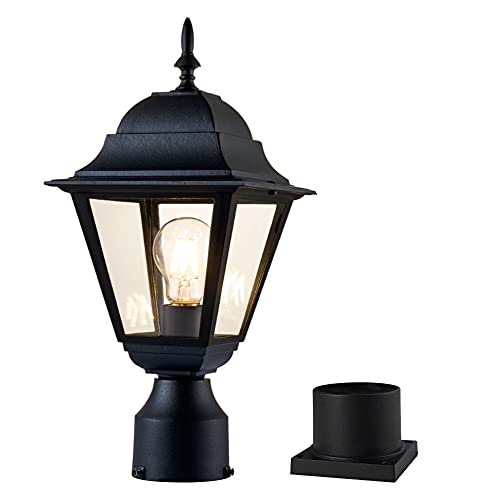 Windben Outdoor Post Light
- Outdoor post light is made of aluminum and…
- The size of the post light outdoor is…
- Lamp post light fixture rated voltage 110-120V, uses…
| Product | Key specs | |
|---|---|---|
| PASAMIC Solar Post Lights Outdoor | 【Automatic On/Off】Four high-efficiency solar panels charge the solar… 【Durable & Weatherproof】IP44 waterproof rating protects these solar… 【Light Up Your Outdoor Spaces】With a Warm White… | Check price |
| Dynaming 4x4 Solar Post Cap Lights Outdoor | This set of 6 post lights is designed… This solar deck post cap features warm white… 6 pack modern post cap lights powered by… | Check price |
| Windben Outdoor Post Light | Outdoor post light is made of aluminum and… The size of the post light outdoor is… Lamp post light fixture rated voltage 110-120V, uses… | Check price |
 WISBEAM Outdoor Post Light WISBEAM Outdoor Post Light | Medium Size: The outdoor post lampis H 15… Light Source: The outdoor Post Light supports all… Easy to Install: The outdoor pole light is… | Check price |
As an Amazon Associate we earn from qualifying purchases at no extra cost to you.
Best outdoor post lights by situation
| Situation | Best choice | Target specification | Why it fits |
|---|---|---|---|
| Long driveway or frequent nighttime use | Wired low-voltage post light | 500–1,200 lumens; 3,000K; 6–7 ft post | Consistent output and better control over spacing |
| Short garden path or occasional use | Solar post light | 80–250 lumens; 2,700–3,000K; 3–5 ft post | No trenching or outdoor electrical connection required |
| Dark entrance where faces and steps matter | Wired LED lantern or downward-shielded fixture | 700–1,500 lumens; 2,700–3,000K; high color rendering | More usable illumination and less dependence on moonlight |
| Rental property or temporary improvement | Rechargeable solar fixture | 150–300 lumens; replaceable battery preferred | Can be installed without permanent wiring |
| Coastal, snowy, or sprinkler-exposed location | Sealed metal or treated composite fixture | IP65 or higher; corrosion-resistant finish | Better protection against water, dust, and repeated wetting |
Wired versus solar: which power source wins?
Low-voltage wired lights
Wired low-voltage lighting is the stronger all-purpose option for a driveway. A transformer reduces household power to a safer outdoor lighting voltage, and the cable can run beneath the soil to several fixtures. Quality LED units commonly use 4–15 watts each and produce roughly 300–1,200 lumens, depending on the design.
The main advantage is predictable performance. Brightness does not fall after a cloudy day, and the lights can operate for as long as your timer or photocell is set. Wired fixtures also make sense when the route must remain visible every night, such as a sloped driveway, a path used by older visitors, or an entrance with steps.
Installation takes more planning. You may need a suitable outdoor-rated transformer, buried cable, weatherproof connectors, and a trench. Before digging, check local requirements and identify buried utilities. A licensed electrician may be appropriate if the installation involves new mains-voltage wiring, a new outdoor circuit, or work beyond a simple low-voltage system.
Solar post lights
Solar lights are convenient because the panel, battery, controller, and LED are integrated into one fixture. They are a good fit for paths that receive several hours of direct sunlight and do not need high illumination. Most residential solar post lights produce about 50–300 lumens; brighter models may advertise more, but output often varies substantially as the battery discharges.
The trade-off is runtime. A solar unit may claim up to 8–12 hours after a full charge, but winter sun, shade, dirt on the panel, cold temperatures, and an aging battery can reduce that figure. A light placed beneath trees or on the north side of a building may never recharge reliably.
Choose solar when avoiding excavation matters more than maximum brightness. For a main driveway or a security-sensitive entrance, wired lighting is usually the more dependable choice.
Brightness and spacing: avoid both glare and dark gaps
Lumens measure light output, but they do not tell you how evenly a fixture illuminates the ground. A clear glass lantern may appear bright while creating glare, whereas a frosted or downward-shielded lens can put more usable light on the path.
- 50–150 lumens: decorative marker lighting for garden edges and short paths.
- 150–400 lumens: useful for ordinary walkways and small entrances.
- 400–800 lumens: a practical range for many driveway post lights.
- 800–1,500 lumens: suitable for larger entrances, steps, and areas needing stronger visibility.
As a starting point, space 3–5 ft decorative solar lights about 8–12 ft apart. Brighter 6–7 ft wired posts can often be spaced 12–20 ft apart, depending on the lens and the desired uniformity. Staggering lights on opposite sides of a path generally reduces harsh shadows better than placing them in a straight line.
A simple coverage calculation
Suppose a 60 ft driveway needs light near both edges, with a post approximately every 15 ft. Dividing 60 by 15 gives four intervals, so you need roughly five positions along one side if both endpoints are lit. A two-sided layout would require about ten fixtures, although a brighter central or alternating arrangement may reduce that number.
This calculation is only a layout estimate. Trees, bends, slopes, walls, and the fixture’s beam pattern can change the result. Do not compensate for poor placement by buying an excessively bright, glaring lamp.
Color temperature: warm light is usually the better outdoor choice
For residential paths and driveways, 2,700K to 3,000K usually gives a warm, comfortable appearance and reduces the stark blue-white look associated with many inexpensive LEDs. Around 3,000K is a useful compromise when you want clearer visibility without making the property look commercial.
Choose 2,200K–2,700K for a softer garden atmosphere. Consider 3,000K–4,000K only where a crisper appearance is specifically wanted, such as a modern exterior or a work area. Very cool light can produce more apparent glare and may be less pleasant near bedroom windows.
If the fixture will illuminate house colors, plants, or architectural materials, look for a color-rendering index of 80 or higher. A higher CRI can make surfaces look more natural even when the lumen rating is unchanged.
Post height and fixture proportions
| Post height | Best use | Typical spacing | Watch for |
|---|---|---|---|
| 18–30 in | Garden borders and low path markers | 6–10 ft | Easy to obscure with plants or snow |
| 36–48 in | Walkways and small front gardens | 8–14 ft | May look undersized beside a wide driveway |
| 60–72 in | Driveways, entrances, and estate-style paths | 12–20 ft | Needs a stable footing in exposed locations |
| 84 in or more | Large properties and prominent gate approaches | 16–25 ft | More wind load and a more demanding installation |
For a narrow path, a tall post can feel visually heavy and may shine into windows. For a driveway, a short fixture can disappear behind vehicles, shrubs, or snowbanks. Check the overall fixture width as well as height: a large lantern on a narrow post can look top-heavy and catch more wind.
Weather ratings and materials that affect ownership
Look for an IP rating rather than relying on phrases such as “weather resistant.” IP44 protects against splashing water and may suit a sheltered location. IP54 or IP55 offers better general outdoor protection, while IP65 provides strong protection against dust and water jets. An IP rating does not automatically prove that a fixture is suitable for immersion, flooding, or corrosive salt air.
- Aluminum: lightweight and common, but the finish can deteriorate if scratched or exposed to salt.
- Powder-coated steel: sturdy and attractive, but exposed chips can become rust points.
- Copper or brass: durable and repairable, with a natural patina that changes appearance.
- Composite or plastic: resistant to rust and often affordable, though some products can fade or become brittle in strong sun.
- Glass: gives a premium appearance but can crack from impact, thermal shock, or careless cleaning.
The parts that usually wear first are solar batteries, exterior seals, clear finishes, and plastic lenses. Solar rechargeable batteries often need replacement after roughly 2–5 years, depending on chemistry, climate, charge cycles, and quality. A model with a replaceable battery is usually easier to keep in service than a sealed unit that must be discarded when runtime collapses.
Installation checklist for a reliable result
- Mark the lighting zones. Walk the route after dark and identify turns, steps, driveway edges, and areas where shadows hide obstacles.
- Check the sun before choosing solar. Observe the proposed panel location across the day. Several hours of direct sun is more important than a high advertised lumen figure.
- Confirm the base and soil. Tall posts need a firm footing. Soft soil, frost movement, and high wind may require a deeper or poured base.
- Keep water away from connections. Use outdoor-rated connectors, create a drip loop where appropriate, and do not leave cable junctions sitting in a low puddle.
- Test spacing before permanent installation. Temporarily position the fixtures, switch them on, and check for glare from normal walking and driving angles.
- Set the timer or sensor conservatively. A photocell or dusk-to-dawn setting is convenient, while a shorter schedule can reduce energy use and extend solar battery life.
Common buying mistakes
Do not compare solar and wired lights solely by their headline lumen numbers. Solar output can be measured under conditions that do not represent late-night operation, while wired LED output is usually more consistent. Also avoid installing the brightest possible fixture beside a path: excessive glare can make nearby darker areas harder to see.
Another frequent mistake is buying a decorative post with no replacement parts or serviceable battery. Before ordering, check whether the LED module, battery, glass, and mounting hardware can be replaced. For wired systems, confirm the transformer’s capacity: if ten fixtures use 8 watts each, the load is 80 watts, and a transformer should have spare capacity rather than operating continuously at its limit.
Bottom line
Choose a 500–1,200-lumen, 2,700–3,000K wired LED post light for a driveway that must remain consistently usable. Choose a 100–300-lumen solar fixture for a sunny garden path where simple installation matters most. In either case, prioritize a suitable post height, downward-controlled light, an IP rating appropriate to the exposure, corrosion-resistant materials, and replaceable components over decorative details or an inflated brightness claim.








Write Your Review
No reviews yet. Be the first to share your experience!