

The best French blue steel pans for most home cooks are a 28 cm (11-inch) de Buyer Mineral B or Mauviel M’Steel skillet: both offer fast heat response, a naturally nonstick surface after seasoning, and considerably less weight than cast iron.
“Blue steel” describes heat-treated carbon steel with a blue-grey oxide finish, not a separate nonstick coating. French-made pans in this category are thin enough to respond quickly on a domestic hob, but thick enough to hold a strong searing temperature. The right choice depends less on the colour of the steel than on diameter, thickness, handle design, weight and how often you are willing to maintain the seasoning.
Our top picks
 de Buyer
- Superior quality, professional performance at an exceptional value
- Wash with hot water and a scrub brush…
- Lighter, more heat responsive than cast iron &…
 de Buyer Blue Carbon Steel Crepe &
- This pan is perfect for making or reheating…
- Wash with hot water and a scrub brush…
- Lighter, more heat responsive than cast iron &…
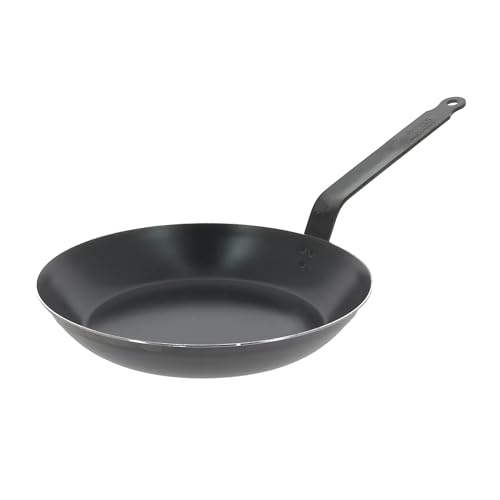 de Buyer
- Superior quality, professional performance at an exceptional value
- Wash with hot water and a scrub brush…
- Lighter, more heat responsive than cast iron &…
| Product | Key specs | |
|---|---|---|
| de Buyer | Superior quality, professional performance at an exceptional value Wash with hot water and a scrub brush… Lighter, more heat responsive than cast iron &… | Check price |
| de Buyer Blue Carbon Steel Crepe & | This pan is perfect for making or reheating… Wash with hot water and a scrub brush… Lighter, more heat responsive than cast iron &… | Check price |
| de Buyer | Superior quality, professional performance at an exceptional value Wash with hot water and a scrub brush… Lighter, more heat responsive than cast iron &… | Check price |
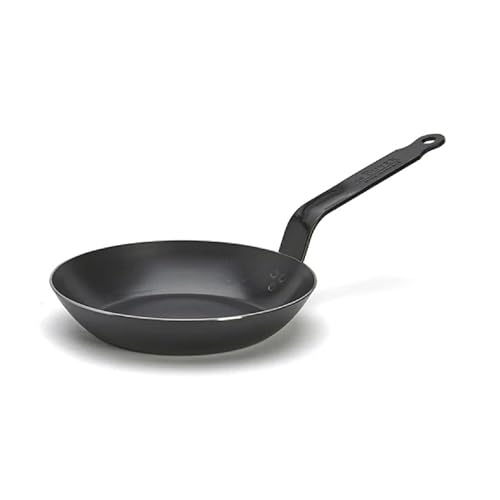 de Buyer de Buyer | Superior quality, professional performance at an exceptional value Wash with hot water and a scrub brush… Lighter, more heat responsive than cast iron &… | Check price |
As an Amazon Associate we earn from qualifying purchases at no extra cost to you.
Best choices by cooking situation
| Best for | Recommended type or model | Useful size | Typical weight | Why choose it |
|---|---|---|---|---|
| One everyday skillet | de Buyer Mineral B or Mauviel M’Steel | 28 cm / 11 in | 1.8–2.2 kg | Good balance of cooking area, manoeuvrability and heat retention |
| Best value large pan | de Buyer Carbone Plus | 28–32 cm / 11–12.5 in | 1.7–2.6 kg | Plain carbon steel construction without premium features |
| High-volume searing | Thicker blue or black carbon-steel skillet | 30–32 cm / 12–12.5 in | 2.3–3.0 kg | More usable surface and better recovery between batches |
| Small hob or lighter handling | Blue-steel skillet | 24–26 cm / 9.5–10 in | 1.2–1.8 kg | Quicker to heat and easier to lift with one hand |
| Induction compatibility | Flat-bottom French carbon-steel skillet | 24–28 cm / 9.5–11 in | 1.5–2.3 kg | Works well when the base is flat and matched to the zone |
Weights are typical estimates for bare pans and vary with diameter, wall thickness, handle length and manufacturing batch. Check the manufacturer’s specification before buying if cupboard storage or lifting comfort is important.
Our top picks, by design
de Buyer Mineral B: the versatile all-rounder
The Mineral B range is a strong choice for cooks who want one carbon-steel pan for steaks, fried eggs, potatoes, vegetables and pancakes. It is made from thick carbon steel and is sold with a protective beeswax coating that must be removed before seasoning. Several versions exist, including pans with different handles and oven-use limitations, so the handle specification matters.
Choose the 28 cm model for two people or for a general-purpose family kitchen. A 24 cm pan is easier to heat evenly on a small burner, while a 32 cm pan gives more room for browning but can be slow to heat on a compact hob. The main drawback is weight: it is lighter than cast iron, but not light in the way a thin aluminium frying pan is.
Mauviel M’Steel: a refined, responsive option
Mauviel M’Steel pans appeal to cooks who prioritise a smooth cooking surface and relatively quick response. Their carbon-steel construction is well suited to searing meat and cooking foods that benefit from a fast change in temperature. Like other uncoated carbon-steel pans, they need initial seasoning and should not be treated as dishwasher-safe cookware.
This is a sensible premium choice if you already understand carbon-steel care and want a French-made pan with a traditional appearance. For a first carbon-steel purchase, the extra cost is less important than choosing the right diameter and a handle that fits your hob and storage space.
de Buyer Carbone Plus: practical and uncomplicated
Carbone Plus is worth considering when you want the behaviour of carbon steel without paying for decorative details. It is particularly attractive for frequent searing, batch cooking and users who do not mind a pan becoming darker and more mottled with use. The finish is functional rather than pristine; colour changes are evidence of seasoning development, not usually a defect.
Blue steel versus cast iron: what thickness changes
| Characteristic | French blue/carbon steel | Cast iron |
|---|---|---|
| Typical wall thickness | About 2–3 mm | About 4–6 mm or more |
| Typical 28 cm pan weight | About 1.8–2.3 kg | About 2.5–3.5 kg |
| Heat-up response | Fast; changes follow burner adjustments relatively quickly | Slow; stores more heat and takes longer to cool |
| Temperature recovery | Good, but can dip when overloaded | Very good for a large cold steak or several portions |
| Warping risk | Higher if rapidly overheated or cooled | Lower, although thermal shock can still cause damage |
The thinner walls of blue steel are the reason it feels more responsive. If a sauce is reducing too quickly, lowering the heat has a noticeable effect sooner than it does with cast iron. The trade-off is that a thin pan can develop hot spots on a small burner or lose temperature when crowded.
Thickness is therefore a buying decision, not simply a quality score. A 2 mm pan is nimble and relatively light. A 3 mm pan is steadier for searing and induction cooking but heavier and slower to respond. Neither automatically produces better food: burner size, preheating and avoiding overcrowding matter just as much.
Handle ergonomics and hob fit
Look for a handle that is long enough to stay cool and short enough not to collide with adjacent burners. A straight metal handle is easy to clean and usually oven-friendly, but it can become hot and may feel front-heavy on a large pan. A curved handle can give better wrist clearance, while a helper handle on a 30–32 cm skillet makes transferring food safer.
Measure the cooking zone, not just the pan’s advertised diameter. A 28 cm pan generally has a base closer to 20–22 cm, but the exact contact area varies. On induction, an undersized zone may heat the centre aggressively while leaving the edges cooler. On gas, flames should remain beneath the base rather than climbing the sides.
Seasoning: the setup that determines performance
- Remove the factory coating. Wash away beeswax or protective oil with hot water and detergent. Dry immediately.
- Heat-dry the pan. Place it over low-to-medium heat until all visible moisture has disappeared.
- Apply an extremely thin oil film. Use a neutral high-heat cooking oil and wipe nearly all of it away. A thick layer becomes sticky.
- Heat until the oil polymerises. The surface may darken and smoke lightly. Use ventilation and avoid leaving the empty pan unattended.
- Cool, wipe and repeat. Two or three thin layers are more reliable than one heavy layer.
For the first several uses, cook foods containing some fat, such as potatoes, onions or meat. Delicate eggs may stick before the seasoning is mature. Preheat gradually, add oil only after the pan is hot, and avoid sliding cold food across the surface.
Cleaning and long-term ownership
Clean the pan while it is still warm, using hot water and a brush or soft scrubber. A small amount of mild detergent is acceptable when needed, but prolonged soaking and the dishwasher encourage rust. Dry over heat, then wipe on a barely visible film of oil before storage.
If food sticks, do not immediately strip the entire pan. Add water, simmer briefly, loosen residue with a wooden or nylon tool, and dry thoroughly. For stubborn carbonised patches, a coarse salt scrub or gentle abrasive may help, followed by re-oiling. Rust can usually be removed with a scrubber; dry the pan, apply a thin oil layer and rebuild the seasoning.
The first things likely to wear are the seasoning and, on some pans, the handle finish—not the steel itself. Repeated acidic cooking with tomatoes, wine or vinegar can weaken fresh seasoning and leave a metallic taste, so use stainless steel or enamelled cookware for long acidic braises. Blue colour will gradually turn brown, black and uneven. That is normal.
Which pan should you buy?
- Choose 24–26 cm if you cook one or two portions, have a small hob or want the easiest pan to lift.
- Choose 28 cm for the best single-pan compromise between searing area, weight and burner compatibility.
- Choose 30–32 cm if you regularly cook several steaks or large batches, and your hob has a matching large zone.
- Choose a thicker pan for high-heat searing and temperature stability.
- Choose a thinner pan for rapid heat changes, lighter handling and foods such as crepes or sautéed vegetables.
For most kitchens, a 28 cm de Buyer Mineral B, Mauviel M’Steel or Carbone Plus is the most practical starting point. Buy the model with the handle and thickness that suit your stove rather than chasing the brightest blue finish: seasoning, correct preheating and sensible cleaning will have a larger effect on everyday performance.








Write Your Review
No reviews yet. Be the first to share your experience!