

The best electric skillet for home cooking is the Presto 06857 16-Inch Foldaway Skillet for most households because its 1500-watt heating system, large cooking surface, removable temperature control, and tempered-glass lid suit everyday meals without requiring a permanent place on the counter.
That recommendation is not ideal for everyone. A smaller 12-inch skillet is easier to store and uses less counter space, while a premium ceramic model may offer a more pleasant cooking surface but cost more and still require careful handling. The right choice depends mainly on surface area, heat control, storage, and how many people you usually feed.
Our top picks
 Amazon Basics Electric Skillet and Frying Pan
- 12 x 12 inch cooking area provides ample…
- Durable, safe ceramic coating ensures effortless food release…
- Precise temperature control from 200-400°F with removable temperature…
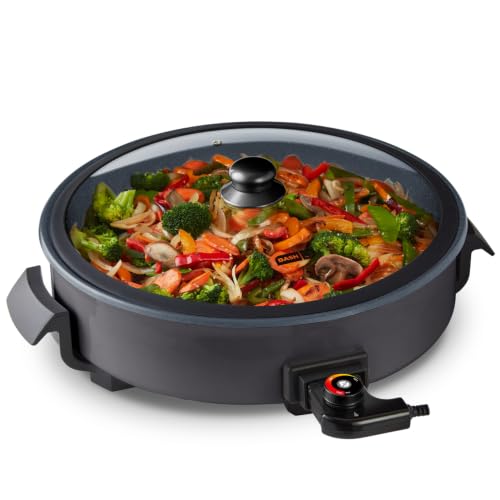 DASH Family Size Electric Skillet with Lid
- Large Electric Skillet for Family Meals: 14-inch cooking…
- CleanCoating Ceramic Nonstick: Durable ceramic nonstick Cooking Surface…
- Even Heat, Covered Cooking: The 14-inch surface heats…
 Chefman XL Electric Griddle with Removable Temperature
- The 10 x 20 inch indoor grill provides…
- Adjustable temperature control from 200-420°F allows for versatile…
- Cook healthier meals with the drip tray to…
| Product | Key specs | |
|---|---|---|
| Amazon Basics Electric Skillet and Frying Pan | 12 x 12 inch cooking area provides ample… Durable, safe ceramic coating ensures effortless food release… Precise temperature control from 200-400°F with removable temperature… | Check price |
| DASH Family Size Electric Skillet with Lid | Large Electric Skillet for Family Meals: 14-inch cooking… CleanCoating Ceramic Nonstick: Durable ceramic nonstick Cooking Surface… Even Heat, Covered Cooking: The 14-inch surface heats… | Check price |
| Chefman XL Electric Griddle with Removable Temperature | The 10 x 20 inch indoor grill provides… Adjustable temperature control from 200-420°F allows for versatile… Cook healthier meals with the drip tray to… | Check price |
 FOHERE 16-Inch Electric Skillet with Glass Cover FOHERE 16-Inch Electric Skillet with Glass Cover | 【16 Inch Electric Skillet with Huge Cooking Surface】This… 【Powerful 1500W Electric Skillet with Precision Control】Experience restaurant-grade… 【Versatile Multi-Function Electric Skillet】This truly multi-function electric skillet… | Check price |
As an Amazon Associate we earn from qualifying purchases at no extra cost to you.
Best electric skillets compared
| Type or example | Cooking surface | Power | Useful capacity | Lid and storage | Best for |
|---|---|---|---|---|---|
| Presto 06857 Foldaway | 16 × 12 inches; about 192 sq in | 1,500 watts | About 4–6 servings | Tempered glass lid; handles fold for storage | Most family meals and batch cooking |
| 12-inch rectangular electric skillet | Approximately 12 × 10 inches; about 120 sq in | 1,200–1,400 watts | About 2–4 servings | Usually glass lid; compact cabinet footprint | Small kitchens and couples |
| 14-inch family-size skillet | Approximately 14 × 12 inches; about 168 sq in | 1,400–1,500 watts | About 3–5 servings | Glass lid; handles generally remain attached | Regular family dinners |
| Premium ceramic electric skillet | Typically 12–16 inches; 140–190 sq in | 1,400–1,500 watts | About 3–6 servings | Glass lid; often less compact to store | Those prioritizing a ceramic cooking surface |
Surface measurements are more useful than the advertised quart capacity. A skillet measuring 16 by 12 inches provides roughly 192 square inches of cooking area, but the heating zone may not cover every corner equally. That area is enough for four large chicken breasts, a family-size stir-fry, or several grilled sandwiches. It also gives food room to brown instead of steam.
Why the Presto 06857 is the best overall choice
The Presto 06857 combines a genuinely useful surface with a relatively practical storage design. Its 16-inch rectangular shape is better suited to pancakes, bacon, chicken pieces, and one-pan casseroles than a small round pan. The 1,500-watt rating gives it enough heating power to recover after cold food is added, which matters when cooking several portions at once.
Its removable heat-control probe is a practical advantage. The pan can be separated from the electrical control for washing, while the foldaway handles reduce the space needed in a cabinet. The tempered-glass lid lets you monitor simmering food without lifting the cover and losing heat.
The main compromise is size. A 16-inch skillet needs a storage space at least slightly wider than the pan, and its long shape may not fit a narrow cupboard. It is also more cookware than a one- or two-person household may need.
Head-to-head: what matters more than the wattage number?
Cooking-surface area
Choose surface area according to the largest meal you regularly cook, not the number of people in your household alone. A 12-inch skillet is adequate for two servings of meat and vegetables, but four servings can become crowded. Crowding increases moisture and reduces browning.
A 14- to 16-inch model is more versatile for family cooking, but it needs a larger flat surface and more cabinet space. Rectangular pans are especially efficient for food arranged in rows, while round pans can be easier to fit on a small table or counter.
Temperature accuracy
Most electric skillets use a thermostatic dial rather than a precision digital controller. The dial setting is an approximate target, not a guarantee that every part of the surface is at that temperature. The best models cycle the heating element on and off to hold a reasonably stable range, but edge areas can still be cooler than the center.
For frying, look for a model with a clearly marked low-to-high range and a removable temperature probe that seats firmly. For simmering, a stable low setting matters more than a high maximum temperature. A separate infrared thermometer can reveal actual surface variation, although it is not necessary for ordinary cooking.
Wattage and recovery
Wattage affects how quickly a skillet heats and recovers after adding chilled ingredients. A 1,500-watt skillet draws approximately 12.5 amps on a 120-volt circuit, calculated as 1,500 ÷ 120. That is close enough to a typical 15-amp circuit’s practical limit that it should not share a heavily loaded outlet with another high-power appliance.
A 1,200-watt model may be perfectly adequate for eggs, grilled cheese, and small portions. For large batches of hash, meat, or stir-fry, 1,400 to 1,500 watts is preferable. More wattage does not automatically mean better temperature accuracy; it mainly improves heating speed and recovery.
Lid design
A tempered-glass lid is the most useful everyday choice because it allows visual checks and usually includes a steam vent. A vent helps prevent excessive pressure and reduces the chance of a lid rattling during simmering. Check whether the lid handle adds height that could prevent the skillet from fitting in its storage position.
Do not assume the lid is oven-safe just because the pan is advertised as versatile. Removable controls, plastic handles, and gasket components often limit oven use. Treat the skillet as a countertop appliance unless the manufacturer explicitly specifies otherwise.
Decision matrix for different households
| Your situation | Best choice | Why | What to avoid |
|---|---|---|---|
| One or two people, limited cabinets | 12-inch, 1,200–1,400-watt skillet | Enough area for small meals and easier to lift and store | Oversized family models |
| Family of four, frequent use | 14- or 16-inch, 1,400–1,500-watt skillet | Better batch capacity and faster recovery | Low-power compact models |
| Beginner cook | Dial-controlled skillet with glass lid | Simple controls and visible cooking progress | Unmarked dials or complicated presets |
| Small kitchen or shared housing | Foldaway-handle model | Reduced storage footprint | Fixed wide handles that cannot fit vertically |
| Frequent browning and meal prep | 1,500-watt model with a broad metal base | More room and better heat recovery | Very small cooking zones |
Nonstick durability and ownership realities
The nonstick coating is usually the first part of an electric skillet to show wear. Metal utensils, abrasive pads, high heat, cooking sprays that leave residue, and sudden temperature changes can shorten its useful life. Even a well-maintained coating may lose easy-release performance after several years of regular use.
Use silicone, wood, or nylon utensils. Let the pan cool before washing it, and use warm water with a soft sponge rather than scouring powder. Never immerse the electrical probe or allow water to enter its socket. If the pan is dishwasher-safe, check the instructions before using that option; repeated dishwasher cycles can dull finishes and affect attached components.
Replace the skillet if the cooking surface is extensively peeling, badly scratched, or no longer cleans without aggressive scrubbing. A few superficial marks do not necessarily make the appliance unusable, but they are a sign to stop using metal tools and avoid further damage. Since replacement costs for basic electric skillets are often in the general range of $35 to $100, buying a model with a removable control and accessible warranty support can matter more than paying for decorative features.
How to size and set up your skillet
-
Measure the cabinet or shelf first. Allow at least 2 inches of extra width and depth for handles, cords, and easy removal.
-
Check the outlet location. A 1,500-watt skillet can use most of a 120-volt, 15-amp circuit, so avoid plugging it into an overloaded power strip.
-
Wash the pan and lid according to the instructions, then dry the temperature-control socket completely.
-
Preheat before adding food. Give a large skillet roughly 5–10 minutes to reach a cooking temperature, depending on its design and setting.
-
Add food in a single layer where possible. If ingredients cover the entire surface several layers deep, cook in batches for better browning.
-
Cool the pan before cleaning and store the lid slightly separated if moisture tends to collect inside.
Final verdict
For most homes, the Presto 06857 16-Inch Foldaway is the best electric skillet for home cooking because it balances cooking area, 1,500-watt performance, a see-through lid, removable controls, and more manageable storage than many full-size designs. Choose a 12-inch model if cabinet space and small portions matter more than batch capacity. Choose a premium ceramic skillet only if its surface and finish justify the added cost for your cooking habits, since no nonstick coating is maintenance-free.








Write Your Review
No reviews yet. Be the first to share your experience!