

Best Ceramic Baking Dish for Casseroles
The best ceramic baking dish for casseroles is a 9-by-13-inch, roughly 3.5- to 4-quart stoneware or porcelain baker with even walls, comfortable handles, and a lid that is rated for both the oven and refrigerator.
That size suits most family casseroles: baked pasta, enchiladas, lasagna, gratins, cobblers, and layered rice dishes. For the best overall balance, choose a medium-thick ceramic dish rather than the heaviest available model. It should retain heat well without becoming so thick that it heats slowly or feels difficult to lift when full.
Our top picks
 DOWAN Casserole Dish
- Meet Your Daily Needs: DOWAN larger and deeper…
- Durable and Safe: Made from lead-free and pro-grade…
- Easy to Hold: With its double-handled design, the…
 MALACASA Casserole Dishes for Oven
- 【3 SIZES TO MEET ALL NEEDS】(Including handles size)…
- 【MADE OF DURABLE CERAMIC】A type of premium LEAD-FREE,…
- 【ELEGANT DESIGN】The TARA series features a unique sesame…
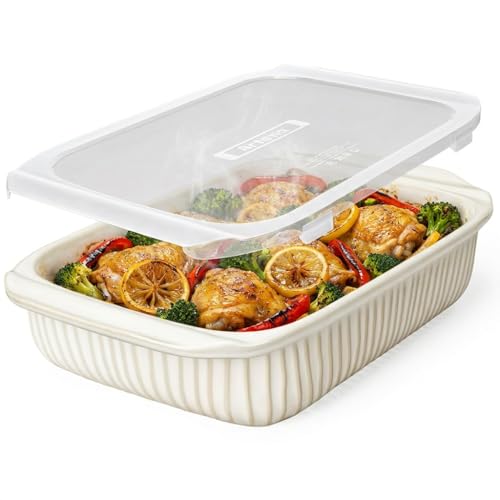 Artena Baking Dish 5.1 Quarts
- Convenient Lid Made With Durable, Certified-safe PP for…
- Spacious 5.1 Quart Capacity for Family Feasts -…
- Secure Wide Handles for Effortless Handling - Featuring…
| Product | Key specs | |
|---|---|---|
| DOWAN Casserole Dish | Meet Your Daily Needs: DOWAN larger and deeper… Durable and Safe: Made from lead-free and pro-grade… Easy to Hold: With its double-handled design, the… | Check price |
| MALACASA Casserole Dishes for Oven | 【3 SIZES TO MEET ALL NEEDS】(Including handles size)… 【MADE OF DURABLE CERAMIC】A type of premium LEAD-FREE,… 【ELEGANT DESIGN】The TARA series features a unique sesame… | Check price |
| Artena Baking Dish 5.1 Quarts | Convenient Lid Made With Durable, Certified-safe PP for… Spacious 5.1 Quart Capacity for Family Feasts -… Secure Wide Handles for Effortless Handling - Featuring… | Check price |
 MALACASA Casserole Dishes for Oven MALACASA Casserole Dishes for Oven | 【MADE OF DURABLE PORCELAIN】A type of premium LEAD-FREE… 【4 SIZES TO MEET ALL NEEDS】(Including handles size)… 【TEXTURED DESIGN】The rectangular baking dish with convenient handles… | Check price |
As an Amazon Associate we earn from qualifying purchases at no extra cost to you.
What matters most when choosing a casserole dish
Size and usable capacity
A nominal 9-by-13-inch measurement does not always mean the same internal capacity. Sloped sides, rounded corners, and thick walls can reduce the amount of food the dish holds. For family-size casseroles, look for approximately 3.5 to 4 quarts of usable capacity and at least 2 inches of interior depth.
A shallow 9-by-13-inch dish is useful for browning and serving dishes with a crunchy topping. A deeper dish is better for lasagna, stuffed shells, and casseroles with several layers, but it may leave the center slower to cook. If you regularly cook for two to four people, an 8-by-8-inch or 9-inch square dish in the 2- to 2.5-quart range is less wasteful.
Ceramic thickness and heat retention
Thicker stoneware holds heat longer, which helps keep a casserole warm at the table and supports gentle, even cooking. The trade-off is weight and slower temperature changes. Very thick ceramic can also be more vulnerable to cracking if it is moved directly from a refrigerator into a hot oven.
Porcelain is generally lighter and less porous than traditional earthenware, while stoneware usually offers greater thermal mass. Neither label alone guarantees durability. Even wall thickness, a smooth glaze, and the manufacturer’s thermal-shock instructions matter more than the word “ceramic” on the packaging.
Lids: convenient, but not always oven-safe
A lid is valuable for storing leftovers and transporting a casserole, but many lids are made from plastic, silicone, or glass with a lower heat limit than the ceramic base. A dish with a lid should clearly state whether the lid is oven-safe, microwave-safe, dishwasher-safe, and safe for use under a broiler.
For baked dishes, a ceramic base with a separate storage lid is often more practical than a heavy ceramic lid. Ceramic lids retain heat, but they add weight and can limit browning. A vented plastic lid is usually intended for refrigeration and reheating, not for baking.
Best ceramic baking dishes by situation
| Situation | Recommended format | Useful specifications | Why it fits |
|---|---|---|---|
| Most families | Rectangular stoneware baker | 9 x 13 inches; 3.5–4 quarts; about 5–8 pounds empty | Handles full-size casseroles and common recipe quantities |
| Two to four servings | Square ceramic baker | 8 x 8 inches; 2–2.5 quarts; about 3–5 pounds empty | Reduces leftovers and fits smaller ovens |
| Deep layered dishes | Deep rectangular baker | 9 x 13 inches; 4–5 quarts; 2.5–3.5 inches deep | Provides room for lasagna, pasta, and substantial fillings |
| Transport and storage | Covered ceramic baker | 3–4 quarts; oven-safe base; lid rated to at least 400°F if oven use is intended | Reduces foil use and makes leftovers easier to store |
| Frequent browning or broiling | Low-profile porcelain or stoneware dish | 9 x 13 inches; 2–3 quarts; sides about 2 inches high | Exposes more surface area to heat and encourages a crisp topping |
Head-to-head: the main ceramic styles
Standard rectangular stoneware
This is the strongest all-purpose choice for most households. It offers good heat retention, a stable base, and enough depth for everyday casseroles. It is typically heavier than porcelain and may cost approximately $30 to $90, depending on glazing, handles, and whether a lid is included.
Choose it when you cook casseroles weekly and want a dish that can move from oven to table. Check that the handles do not make the outside dimensions too large for your oven or dishwasher.
Porcelain or vitrified ceramic
Porcelain-style baking dishes are often smoother, lighter, and more resistant to absorbing cooking odors. They are a good choice for cooks who want easier cleanup or who frequently prepare acidic foods such as tomato-based pasta bakes.
They may not retain heat quite as long as a very thick stoneware dish, but the difference is modest in normal home cooking. A well-made porcelain baker is especially useful when weight is a concern.
Heavy covered ceramic baker
A covered baker is convenient for transporting food, keeping a casserole warm, and storing leftovers in the refrigerator. Its disadvantages are cost, weight, and reduced browning when the lid is used during baking. Expect approximately $60 to $150 for a substantial covered ceramic baker from an established cookware manufacturer.
Before buying, confirm the lid’s temperature limit. Some covered dishes have an oven-safe ceramic base but a lid that must be removed before baking.
Small individual or compact dishes
Small ceramic dishes, generally 12 to 24 ounces each, are useful for portioning shepherd’s pie, macaroni and cheese, or fruit crisps. They offer attractive serving presentation but require more storage space and more washing. They are not a replacement for a family-size baker unless you specifically prefer individual portions.
Thermal-shock resistance: the rule that prevents most breakage
Ceramic baking dishes are damaged less often by normal oven heat than by sudden temperature changes. Do not place a cold ceramic dish directly into a fully heated oven unless the manufacturer explicitly permits that use. Likewise, do not set a hot dish on a wet countertop, chilled stone surface, or directly into cold water.
- Let a refrigerated dish stand at room temperature according to the manufacturer’s instructions before baking.
- Place hot ceramic on a dry wooden board, trivet, or folded towel.
- Never pour cold liquid into a hot dish.
- Avoid using a ceramic baker on a stovetop, grill, or open flame unless it is specifically designed for that purpose.
- Inspect for hairline cracks, chips, or glaze damage before each use.
Thermal-shock resistance is not identical to maximum oven temperature. A dish may tolerate 500°F in a stable oven yet still crack when transferred abruptly from a cold refrigerator to high heat.
How to size a dish for a recipe
A useful rule is to select a dish whose usable capacity is at least 25 percent greater than the recipe’s food volume. This leaves room for bubbling sauces and prevents overflow.
For example, if a casserole contains approximately 3 quarts of ingredients, a 4-quart dish provides a 1-quart buffer. That buffer equals about 33 percent of the ingredient volume, enough for expansion and stirring without sacrificing too much surface area. A 3-quart dish may technically hold the same food, but it is more likely to bubble over and leave a thick, slow-cooking center.
For a recipe written for a 9-by-13-inch pan, avoid transferring it to a smaller dish without reducing the quantity. A smaller base makes the casserole deeper, which can extend cooking time and leave the middle underdone while the edges overcook.
Ownership realities: what wears out first
The glaze and handles usually determine a ceramic dish’s useful life. Small rim chips can occur when the dish hits a sink or metal rack. They are more than cosmetic if the exposed ceramic becomes rough or continues to flake. Retire a dish with a spreading crack, significant chip, or visible separation under the glaze.
Nonstick performance is not a permanent feature of most ceramic-glazed dishes. Baked-on cheese and starch can still adhere, especially when the dish is overheated or allowed to dry out. Soak it in warm water, use a nonabrasive sponge, and avoid metal utensils. If the manufacturer permits dishwasher cleaning, place the dish where it will not strike other cookware.
Do not assume that a decorative exterior, metallic trim, or storage lid is microwave-safe. Follow the markings on the specific product, since ceramic bodies, glazes, lids, and handles can have different limits.
Final recommendation
For the majority of family kitchens, choose a 9-by-13-inch stoneware or porcelain baking dish holding about 3.5 to 4 quarts, with medium-thick walls, integrated handles, a smooth light-colored interior, and a separate storage lid. Prioritize clear thermal-shock guidance over extra weight, and choose a deep 4- to 5-quart model only if you regularly make tall layered casseroles. A smaller 8-by-8-inch dish is the better value for smaller households because it reduces overcooking and leftover waste.








Write Your Review
No reviews yet. Be the first to share your experience!