

Key takeaways
- Preheat gradually. Use medium or medium-low heat for most tasks. A thick pan retains heat, so turning the burner to high can overshoot the desired temperature.
- Dry food before searing. Surface moisture cools the pan and encourages sticking. Pat meat or vegetables dry, preheat, then add oil.
- Do not add cold water to a hot pan. Sudden temperature changes can contribute to warping, especially if the pan is overheated.
- Soak rather than scrape aggressively. For browned residue, add warm water and a little dish soap, simmer briefly, and use a non-abrasive pad.
- Expect discoloration. Blue, bronze, or rainbow marks are usually heat tint, not structural damage. A stainless-steel cleaner can remove them, but abrasive steel wool may leave scratches.
- Check dishwasher guidance. Stainless cookware may survive dishwasher cycles, but detergent and drying heat can dull the finish and leave water marks. Hand-washing usually preserves the appearance longer.
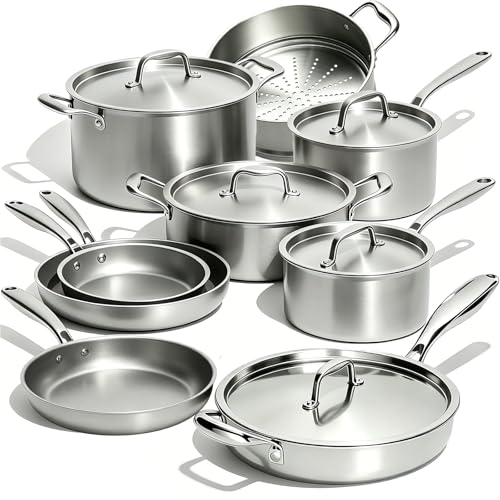
The best 5 ply stainless steel cookware sets are All-Clad D5 for proven all-round performance, Made In 5-Ply for a strong value-to-piece balance, Demeyere Industry 5 for powerful induction cooking, and Heritage Steel 5-ply for shoppers who want a smaller American-made lineup.
Five-ply cookware is built from five bonded metal layers, usually stainless steel on the cooking surface and exterior with alternating aluminum layers inside. The stainless steel provides durability and a non-reactive cooking surface; aluminum spreads heat quickly. Compared with thinner tri-ply pans, a good 5-ply set generally offers more even heating and better resistance to warping, but it also costs more and can be noticeably heavier.
Our top picks


As an Amazon Associate we earn from qualifying purchases at no extra cost to you. Ratings are shown as listed on Amazon.
Best 5-ply cookware sets by cooking style
| Best for | Recommended set type | Why it fits | Main compromise |
|---|---|---|---|
| Most home kitchens | All-Clad D5 | Balanced heating, broad availability, durable stainless construction, and useful everyday sizes | Premium pricing and heavier handling |
| More pieces for the money | Made In 5-Ply | Often includes both small and large skillets plus a useful stockpot | Large sets may include pieces some cooks rarely use |
| Induction and high-output stovetops | Demeyere Industry 5 | Thick construction, flat stability, and induction-compatible stainless steel | Substantial weight and a higher market price |
| Smaller, carefully chosen collection | Heritage Steel 5-ply | Practical open-stock approach and American-made construction | Fewer oversized boxed-set options |
| Frequent sautéing and sauce work | A 10-inch and 12-inch 5-ply skillet pair | Gives enough surface area for browning without crowding | Costs more than buying one skillet |
What five-ply construction changes in daily cooking
The layer count alone does not guarantee superior performance. The important questions are where the aluminum sits, how thick the pan is, whether the base extends across the full cooking surface, and how flat the pan remains when heated.
Most high-quality 5-ply cookware uses an aluminum core between stainless-steel layers. Some designs use several thin aluminum layers; others use a thicker central aluminum layer combined with stainless steel. More conductive aluminum improves lateral heat distribution, while stainless steel contributes strength and durability. Copper may also appear in premium cookware, but a copper-containing design is not automatically better for every kitchen.
In practical terms, 5-ply pans are less prone to a hot ring directly over the burner than inexpensive single-layer stainless steel. They are still not nonstick: food can stick if the pan is cold, the heat is excessive, or the surface is not adequately oiled. Their advantage is control, not effortless release.
Head-to-head comparison of leading options
| Set or line | Typical construction | Useful included pieces | Typical market range | Best reason to choose it |
|---|---|---|---|---|
| All-Clad D5 | 5-ply stainless steel and aluminum | 8-inch and 10-inch skillets, 1.5- to 3-quart saucepans, 3- to 4-quart sauté pan, 6- to 8-quart stockpot depending on set | About $500–$1,500 for boxed sets | Reliable, versatile baseline for long-term ownership |
| Made In 5-Ply | 5-ply stainless steel with aluminum layers | Common combinations include 8- and 10-inch skillets, 2- and 3-quart saucepans, a 3-quart sauté pan, and an 8-quart stockpot | About $400–$1,200 | Strong piece selection for cooks who want larger cookware |
| Demeyere Industry 5 | 5-layer stainless steel construction | Usually purchased as individual pans or smaller sets; 9.4- to 11-inch skillets and 2- to 4-quart saucepans are common sizes | About $150–$500 per pan; higher for sets | Excellent fit for induction users and demanding stovetop work |
| Heritage Steel 5-ply | 5-ply stainless steel and aluminum | Common essentials include 8- and 10-inch skillets, 2- and 3-quart saucepans, and a 6- or 8-quart stockpot | About $400–$1,100 | Buy only the useful pieces instead of accepting filler items |
Set contents and pricing change frequently, so compare the actual diameter and capacity rather than the number of pieces. A “12-piece” set may count lids and steamer inserts, while an eight-piece set may contain more genuinely useful cookware.
How to choose the right sizes
For two to four people, the most useful core is usually a 10-inch skillet, 2-quart saucepan, 3- or 4-quart sauté pan, and 6-quart stockpot. A 12-inch skillet becomes worthwhile when you regularly cook four or more portions, sear several pieces of meat, or make large stir-fries. A 1.5-quart saucepan is convenient for reheating sauces but is not essential if cabinet space is limited.
Check the cooking-surface diameter, not only the rim measurement. A wide flared rim can make a pan look larger while leaving less flat area for browning. Also measure your storage space: a 12-inch skillet with a long handle may require roughly 20 inches of horizontal clearance, and a large stockpot can occupy an entire shelf.
A simple value calculation
Suppose a $900 set contains six cookware pieces you use regularly and lasts 12 years. At four uses per week, that is approximately 2,496 uses. The set cost works out to about $0.36 per use before energy and food costs. If three pieces remain unused, however, the effective cost of the cookware you actually use is closer to $0.60 per use. This is why a smaller set or open-stock purchase can be better value than the largest bundle.
Handle comfort matters more than the fifth layer
Look for handles that stay securely attached, offer enough clearance from the pan wall, and provide a stable grip when the pan is full. Riveted handles are durable, but food can collect around the rivets and make cleaning slower. A long, straight handle is comfortable for tossing food but takes more storage space. Handles with a pronounced upward angle save room and keep your hand farther from a hot burner, though they can feel less natural for oven-to-table lifting.
Weight is another practical issue. A 10-inch 5-ply skillet commonly weighs about 3 to 4 pounds empty, while a large sauté pan or stockpot may weigh 5 to 8 pounds before food and liquid are added. If wrist strength or cabinet lifting is a concern, choose fewer pieces and consider a lighter 3-ply skillet for tasks such as eggs while reserving 5-ply pans for searing and braising.
Ownership realities: cleaning, heat, and durability
- Preheat gradually. Use medium or medium-low heat for most tasks. A thick pan retains heat, so turning the burner to high can overshoot the desired temperature.
- Dry food before searing. Surface moisture cools the pan and encourages sticking. Pat meat or vegetables dry, preheat, then add oil.
- Do not add cold water to a hot pan. Sudden temperature changes can contribute to warping, especially if the pan is overheated.
- Soak rather than scrape aggressively. For browned residue, add warm water and a little dish soap, simmer briefly, and use a non-abrasive pad.
- Expect discoloration. Blue, bronze, or rainbow marks are usually heat tint, not structural damage. A stainless-steel cleaner can remove them, but abrasive steel wool may leave scratches.
- Check dishwasher guidance. Stainless cookware may survive dishwasher cycles, but detergent and drying heat can dull the finish and leave water marks. Hand-washing usually preserves the appearance longer.
The cooking surface is usually the longest-lasting part. Handles, rivets, lid knobs, and exterior finish are more likely to become annoying before the metal body fails. Lids can also be a hidden source of cost: replacing a lost or damaged lid may be difficult if the brand does not sell components individually.
Final buying decision
Choose All-Clad D5 if you want the safest all-purpose premium choice and value a mature product line. Choose Made In 5-Ply when a larger skillet, sauté pan, or stockpot matters and the current set provides the pieces you will actually use. Choose Demeyere Industry 5 for a particularly solid induction setup and do not mind extra weight. Choose Heritage Steel when you prefer to assemble a focused collection rather than pay for filler pieces.
For most households, the best purchase is not the biggest set. Start with a 10-inch skillet, 2-quart saucepan, 3- or 4-quart sauté pan, and 6-quart stockpot; add a 12-inch skillet only when your cooking volume justifies it. That combination captures the even-heating benefits of 5-ply construction while keeping cost, storage, and lifting manageable.





Write Your Review
No reviews yet. Be the first to share your experience!