

The best music stands depend on where and how you play: choose the Manhasset Symphony Series 48 for a stable home or orchestral stand, the K&M 10700 for a sturdier folding option, and a lightweight folding stand such as the Peak Music Stands SMS-20 for travel.
Our top picks
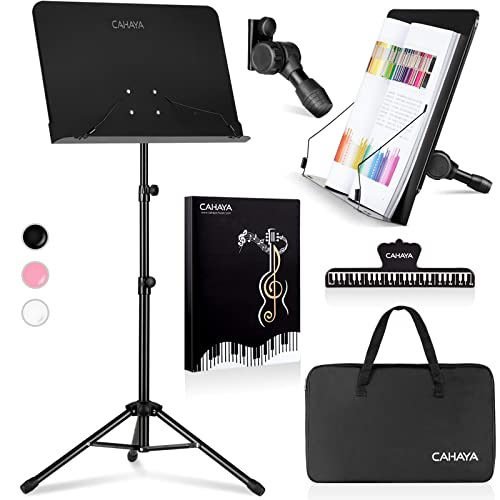 CAHAYA Sheet Music Stand Dual-use Convert to
- 2" deep tray fits thick music books
- Tray tilts up to 180° for flat or…
- Adjusts from 31.4" to 57" for seated or…
 GLEAM Sheet Music Stand
- 【SPACIOUS & SECURE HOLDING TRAY】 Our deep 2-inch…
- 【FULL 180° ANGLE ADJUSTMENT】 Tilt the tray to…
- 【EXTENDED HEIGHT RANGE FOR ALL MUSICIANS】 With a…
 K KASONIC Music Stand
- Collapsible design with height adjustment from 28.7 inches…
- there is no need to worry about the…
- this music stand is ultra-lightweight style and the…
| Product | Key specs | |
|---|---|---|
| CAHAYA Sheet Music Stand Dual-use Convert to | 2" deep tray fits thick music books Tray tilts up to 180° for flat or… Adjusts from 31.4" to 57" for seated or… | Check price |
| GLEAM Sheet Music Stand | 【SPACIOUS & SECURE HOLDING TRAY】 Our deep 2-inch… 【FULL 180° ANGLE ADJUSTMENT】 Tilt the tray to… 【EXTENDED HEIGHT RANGE FOR ALL MUSICIANS】 With a… | Check price |
| K KASONIC Music Stand | Collapsible design with height adjustment from 28.7 inches… there is no need to worry about the… this music stand is ultra-lightweight style and the… | Check price |
 Mdvora 3 Pack Adjustable Sheet Music Stand Mdvora 3 Pack Adjustable Sheet Music Stand | 【Package Include】- Package includes 3 pack sheet music… 【Adjustable Height】- The height of the instrument music… 【Adjustable Angle】- The support plate of the sheet… | Check price |
As an Amazon Associate we earn from qualifying purchases at no extra cost to you.
Best music stands by situation
- Best for regular home practice: Manhasset Symphony Series 48
- Best for orchestra, ensemble, or frequent rehearsal: K&M 10700 or another heavy-duty folding orchestral stand
- Best for travel and occasional use: Peak Music Stands SMS-20
- Best budget-style choice: a basic folding stand with a 48-inch maximum height, perforated metal desk, and locking height joints
- Best for children or seated practice: a stand whose desk can descend to roughly 24–26 inches
Before buying, compare five practical specifications rather than relying on the word “portable”: usable height range, desk size, sheet capacity, folded size, and base stability. A stand that is light enough for an airplane may be frustrating for a full orchestral folder; a rigid stand that feels excellent at home may be awkward to carry.
Head-to-head comparison
The figures below are representative published specifications and can vary slightly by revision or regional packaging. They are useful for comparing the design priorities of each stand, not as a substitute for checking the current manufacturer specification.
| Stand | Height range | Desk size | Approx. weight | Foldability | Best use |
|---|---|---|---|---|---|
| Manhasset Symphony Series 48 | 26.5–48.5 in | 20 × 12.5 in | About 7.5 lb | Desk and shaft stay assembled; base nests for storage | Home practice, school, orchestra |
| K&M 10700 | About 24.8–48.8 in | About 19.3 × 13.4 in | About 6.8 lb | Folding shaft and desk | Rehearsal, performance, transport by car |
| Peak Music Stands SMS-20 | About 25–48 in | About 19 × 13 in | About 2 lb | Fully folding tripod and desk | Travel, lessons, occasional practice |
| Basic tubular folding stand | About 24–48 in | 18–20 × 12–13 in | About 2–4 lb | Fully folding | Low-cost backup or light music |
Manhasset Symphony Series 48: the stable everyday choice
The Symphony Series 48 uses a solid metal desk and a broad, non-collapsing base. Its main advantage is stability: page turns are less likely to move the stand, and the desk is less prone to vibrating when a nearby door closes or a floor is bumped. The roughly 20-inch-wide desk accommodates two standard pages side by side, with room for ordinary sheet music rather than only a single loose page.
Its drawback is transport. This is not the stand to put in a small suitcase, and its assembled format takes more storage space than a conventional three-section folding stand. Choose it when the stand will remain in one room, move only between rehearsals by car, or serve several years of daily practice.
K&M 10700: folding without becoming flimsy
The K&M 10700 is a useful middle ground. It folds for transport but generally feels more substantial than the lightest tubular stands. A broad desk and adjustable height make it suitable for orchestral parts, choir folders, and conducting or ensemble work where a stand may need to support more than two thin pages.
Its additional hardware adds weight. If you walk to lessons or need to carry the stand with an instrument, the difference between roughly 7 pounds and roughly 2 pounds becomes noticeable. For car-based rehearsals, school music rooms, and repeated setup, the extra mass is usually a benefit rather than a penalty.
Peak SMS-20: the travel-first option
The Peak SMS-20 prioritizes low carrying weight and compact folding. That makes it convenient for lessons, hotel rooms, auditions, and musicians who already have a heavy stand at home. A desk around 19 inches wide can hold two normal pages, but the stand has less reserve against wind, thick books, or an enthusiastic page turn.
Lightweight stands work best when their feet are fully spread and placed on a level surface. They are not automatically unsuitable for performance, but they demand more care: avoid placing them beside a speaker, open stage door, or walking route, and use page clips when the music is loose.
How much sheet music can a stand hold?
Desk width is only part of capacity. For two standard letter- or A4-sized pages, allow roughly 17–19 inches of usable width. A 19- or 20-inch desk normally handles a two-page spread, while a narrow portable desk may technically fit two pages but leave little margin for clips.
Weight matters as much as area. A thin score of loose pages is easy for most stands. A spiral-bound songbook, orchestra folder, tablet, or multiple photocopies creates a forward load that can make a small tripod tilt. If you use a tablet, check the desk lip and maximum load rather than assuming a music stand is a tablet stand. A separate clamp can also shift the center of gravity.
Decision matrix: match the stand to your routine
| Your situation | Priority | Recommended type | Why |
|---|---|---|---|
| Daily practice in one room | Stability and long service life | Solid-base stand | Fewer folding joints to loosen; faster setup every day |
| Weekly orchestra rehearsal by car | Desk capacity and controlled folding | Heavy-duty folding stand | Supports folders while still fitting in a vehicle |
| Walking to lessons or flying | Low weight and small folded size | Light tubular folding stand | Less carrying fatigue and easier luggage storage |
| Beginner with a small budget | Useful adjustment and replaceable parts | Midweight folding stand | More forgiving than the cheapest stand without the cost of a professional solid-base model |
| Child or seated player | Low minimum height | Stand reaching 24–26 inches | Prevents raising the desk excessively and improves sightline |
Height: set it for the instrument, not the standing player
For seated practice, adjust the desk so the music is high enough to read without bending the neck, but not so high that it blocks the instrument or forces the shoulders upward. For standing playing, the desk is commonly around chest height, although the correct position depends on the instrument, posture, and whether you must see a conductor.
Measure before buying if the player is unusually tall, short, or primarily seated. Many stands advertise a maximum height near 48 inches, but that measurement may refer to the top of the desk or the music shelf. The actual reading height can differ by several inches.
Stability and durability: what wears first?
- Tripod knobs and threaded joints: Repeated over-tightening can damage plastic threads or crush tubing. Tighten until secure, not until the joint cannot move.
- Desk hinges: On folding stands, the desk hinge is often the first place to develop play. Avoid carrying the stand by the desk when it is open.
- Rubber feet: Missing or hardened feet reduce grip and can make a stand rock. Replace them if the manufacturer sells spares, or use compatible protective caps.
- Surface finish: Wipe dust and perspiration from metal with a soft, slightly damp cloth. Do not soak joints or use abrasive cleaners.
- Folding habits: Fully collapse each section before placing the stand in a bag. Forcing a partially locked joint is a common cause of bent tubing.
For outdoor use, stability improves when the legs are spread completely and the desk is kept lower. A small clip or two can prevent wind from catching pages, but clips cannot compensate for a narrow base supporting a heavy book.
What should you spend?
Basic folding stands commonly occupy the lower market range, roughly $20–$40. Better-finished portable and midweight models often fall around $40–$90, while established solid-base or professional orchestral stands frequently cost about $80–$160 or more. Prices change by country and seller, so treat these as broad 2026 market ranges.
A simple ownership calculation helps. Suppose a $25 stand lasts two years and is used twice a week: 2 uses × 52 weeks × 2 years equals 208 uses, or about 12 cents per use before replacement. A $100 stand used five times a week for five years equals 1,300 uses, or under 8 cents per use. The more expensive stand is not automatically better, but frequent musicians can justify paying for stronger joints, a more stable base, and available replacement parts.
Bottom line
Buy the Manhasset Symphony Series 48 when stability and daily use matter most. Choose the K&M 10700 when you need a substantial desk that still folds for rehearsal transport. Choose the Peak SMS-20 or a similar lightweight tubular stand when every pound and inch of luggage space matters. Whichever type you select, confirm the minimum height, usable desk width, folded dimensions, and replacement-part availability before ordering; those details determine whether the stand remains useful after the first few weeks.








Write Your Review
No reviews yet. Be the first to share your experience!