
Our Short List of 3

- Best for: Campers and kit builders who want one knife that can baton firewood all season.
- Blade: 5.25 in 1095 Cro-Van steel, drop point
- Blade thickness: 0.25 in
- Construction: full tang
- Overall length: 10.5 in
- Best for: Preparedness kits and hard-use campers who want SERE-pattern toughness.
- Blade: 5.25 in 1095 carbon steel, drop point, saber grind
- Hardness: 55-57 RC
- Blade thickness: 0.25 in
- Finish: textured powder coat

- Best for: Vehicle and go-bag kits where electrical insulation and a spear option matter.
- Model: 22-41463N, Coyote Brown
- Blade: 4.84 in 420HC, partially serrated
- Overall length: 10.59 in
- Weight: 11.67 oz (knife only)
All 4 Picks at a Glance
| Product | Specs | Action |
|---|---|---|
| KA-BAR Becker BK2 Campanion |
| Check price on Amazon |
| ESEE-5 |
| Check price on Amazon |
| Gerber LMF II Infantry |
| Check price on Amazon |
 SOG SEAL Pup Elite |
| Check price on Amazon |
Key takeaways
- Four best fixed blade survival knives with tough carbon and stainless blades, secure handles and rugged sheaths for camp, trail and emergency kits.
Choosing a fixed blade survival knife is really a decision about how much abuse one tool has to absorb when nothing else is within reach. Blade steel, thickness and tang construction decide whether the knife can split firewood, pry and cut cordage day after day, or whether it fails at the worst possible moment. Weight matters too, because a knife left in the truck helps nobody on the trail.
This roundup suits campers who want one heavy-duty belt knife, preparedness-minded buyers building a go-bag, and outdoor workers who need a blade that shrugs off rough use. Every pick below was chosen from the names and specifications printed on its Amazon product page: full-size fixed blades from KA-BAR, ESEE, Gerber and SOG, all in the five-inch class, all built around thick stock and working sheaths rather than display polish.
Quick Picks
As an Amazon Associate we earn from qualifying purchases.
| Product | Best for | Key spec |
|---|---|---|
| KA-BAR Becker BK2 Campanion | Heavy camp work and batoning | 5.25 in 1095 Cro-Van blade, 0.25 in thick |
| ESEE-5 | Hard-use survival and emergency kits | 5.25 in 1095 blade, 55-57 RC, Kydex sheath |
| Gerber LMF II Infantry | Vehicle kits and military-pattern use | 4.84 in 420HC partially serrated blade |
| SOG SEAL Pup Elite | Wet conditions and light carry | AUS-8 stainless blade, 5.4 oz |
How to Choose
Blade steel and heat treatment
Carbon steels such as 1095 dominate this class because they sharpen easily in the field and tolerate the twisting loads of batoning and prying. The trade-off is corrosion: an uncoated carbon edge will rust in a damp pack, so coated blades and a light oil habit matter. Stainless options like AUS-8 give up a little toughness for far easier care around water, salt and food prep. Hardness ratings help too — a blade in the mid-50s RC bends before it chips, which is exactly the behaviour you want when the knife becomes a lever.
Tang construction and blade thickness
A full tang, where the steel runs the entire length of the handle, is the strongest construction for a survival knife and the easiest to trust under batoning. Stock thickness matters just as much: blades around a quarter inch thick resist snapping at the tip and split wood without flexing, though they add real weight. Partial tangs and insulated handles exist for good reasons — electrical safety, for example — but they trade away some prying strength, so match the construction to the work you honestly expect.
Handle grip and sheath carry
A survival knife is only useful if it stays in your hand when conditions turn wet, cold or bloody. Textured synthetic handles and canvas Micarta both keep their grip with gloves on, while smooth polished scales can twist under torque. The sheath deserves equal attention: look for positive retention, a drain path for water, and carry options that suit your belt, pack or vehicle mount. Kydex gives a firm click-in hold, nylon rides softer and quieter, and a built-in sharpener keeps a working edge without extra kit.
Blade shape, edge style and length
Drop points are the safest all-round shape here, putting a strong tip low enough for controlled cuts yet stout enough for drilling and prying. Plain edges sharpen faster and carve cleaner, while partial serrations chew through rope, webbing and seatbelt material that would skate off a plain edge. Length is a balance: blades near five inches split kindling and clear brush without becoming awkward at camp-kitchen tasks. Much longer and food prep suffers; much shorter and the knife stops being a wood-processing tool altogether.
The 4 Best Options
KA-BAR Becker BK2 Campanion
- Best for: Campers and kit builders who want one knife that can baton firewood all season.
- Blade: 5.25 in 1095 Cro-Van steel, drop point
- Blade thickness: 0.25 in
- Construction: full tang
- Overall length: 10.5 in
Campers and kit builders who want one knife that can baton firewood all season.
One reproduced listing summary prints the blade at 5.5 in; the maker’s figure is 5.25 in, so check the product page details before ordering.
The Becker BK2 Campanion is the heavy hammer of this group, built around a quarter-inch-thick slab of 1095 Cro-Van steel that splits firewood and shrugs off prying without complaint. Its drop-point blade runs 5.25 inches, the full tang keeps everything in one piece under batoning, and the Ultramid handle fills the hand securely even with gloves. At a full pound it is no ultralight companion, but for camp chores, shelter building and emergency kits that live in a truck or cabin, that mass is the point.
Watch out for: One reproduced listing summary prints the blade at 5.5 in; the maker’s figure is 5.25 in, so check the product page details before ordering.
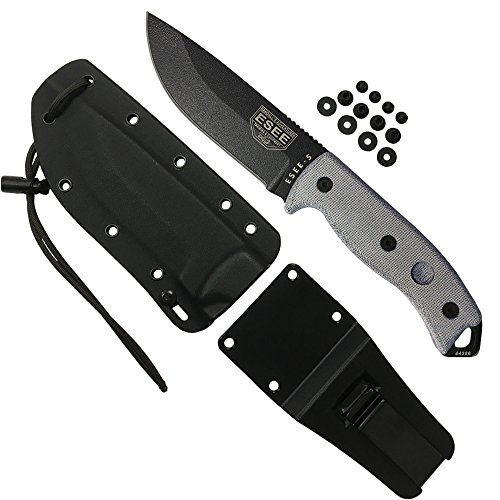
ESEE-5
- Best for: Preparedness kits and hard-use campers who want SERE-pattern toughness.
- Blade: 5.25 in 1095 carbon steel, drop point, saber grind
- Hardness: 55-57 RC
- Blade thickness: 0.25 in
- Finish: textured powder coat
Preparedness kits and hard-use campers who want SERE-pattern toughness.
Confirm a live featured offer for the exact ASIN B079NLST5R before ordering, and make sure the listing is the black blade with canvas Micarta — the ESEE-5 sells under many colour and handle variants with different ASINs, and their specs are not interchangeable.
Designed with input from SERE instructors, the ESEE-5 is a survival knife first and a camp knife second. Its 5.25-inch 1095 carbon steel blade carries a saber grind and a textured powder coat, runs a full quarter inch thick, and is hardened to 55-57 RC so the edge rolls rather than chips under abuse. Canvas Micarta scales stay grippy when wet, and the ambidextrous Kydex sheath holds the knife positively on a belt or pack. Buyers who want one blade for a serious emergency kit will find the brief well covered here.
Watch out for: Confirm a live featured offer for the exact ASIN B079NLST5R before ordering, and make sure the listing is the black blade with canvas Micarta — the ESEE-5 sells under many colour and handle variants with different ASINs, and their specs are not interchangeable.
Gerber LMF II Infantry
- Best for: Vehicle and go-bag kits where electrical insulation and a spear option matter.
- Model: 22-41463N, Coyote Brown
- Blade: 4.84 in 420HC, partially serrated
- Overall length: 10.59 in
- Weight: 11.67 oz (knife only)
Vehicle and go-bag kits where electrical insulation and a spear option matter.
A listing block for this model line flags it as discontinued by the manufacturer even though a current tracker price exists — confirm a live featured offer for the exact ASIN B000G0HP5M before ordering.
The Gerber LMF II Infantry was designed for aircrew survival, and its priorities show. The 4.84-inch 420HC blade is partially serrated for cutting webbing and cordage, while the glass-filled nylon handle with TPV overmold is electrically insulated from the blade and absorbs hammering shocks through the pommel. Lashing holes let the knife convert into a spear, and the MOLLE-compatible sheath carries a built-in sharpener. At 11.67 ounces for the knife alone, it rides lighter than the quarter-inch bruisers above while keeping genuine emergency credentials.
Watch out for: A listing block for this model line flags it as discontinued by the manufacturer even though a current tracker price exists — confirm a live featured offer for the exact ASIN B000G0HP5M before ordering.
SOG SEAL Pup Elite
- Best for: Wet climates, coastal users and anyone who wants a light stainless survival blade.
- Blade: AUS-8 stainless, black TiNi finish, partially serrated
- Blade length: about 4.8 in (the listing title prints 4.85 in; its own details table prints 4.75 in)
- Heat treatment: cryogenic
- Handle: glass-reinforced nylon
Wet climates, coastal users and anyone who wants a light stainless survival blade.
Confirm a live featured offer for the exact ASIN B0017HZ0O6 before ordering — this is the least firmly verified pick here, and the listing itself prints the blade length two different ways, so re-check the details table on the product page.
The SOG SEAL Pup Elite trades raw mass for corrosion resistance and easy carry. Its AUS-8 stainless blade wears a black TiNi finish and receives a cryogenic heat treatment, so it shrugs off rain, sweat and coastal air that would spot a carbon blade overnight. The glass-reinforced nylon handle keeps weight down to 5.4 ounces, and the partially serrated edge handles rope and synthetic line well. One caution: the listing’s own figures disagree on blade length, so treat the size as approximate rather than exact.
Watch out for: Confirm a live featured offer for the exact ASIN B0017HZ0O6 before ordering — this is the least firmly verified pick here, and the listing itself prints the blade length two different ways, so re-check the details table on the product page.
Which One Fits Your Situation
Your camp knife also has to process firewood
Pick the KA-BAR Becker BK2 Campanion. Its quarter-inch 1095 Cro-Van blade and full tang are built for batoning logs and prying bark, and the weight that slows it on long hikes becomes an asset at a fixed camp. The polyester sheath is basic, but the knife itself is the strongest wood-processing tool in this group.
You are building a serious emergency or go-bag kit
Choose the ESEE-5. The SERE-influenced design, saber grind and 55-57 RC hardness favour a blade that survives prying, digging and shelter work, while the canvas Micarta handle and Kydex sheath keep it secure and grippy in bad weather. It is heavy for casual camping, but a kit you hope never to use should favour durability over comfort.
Your kit lives in a vehicle or near electrical hazards
The Gerber LMF II Infantry fits best. Its handle is electrically insulated from the blade, the pommel is built to absorb hammering, and the partially serrated edge cuts seatbelts and webbing quickly. The sheath’s built-in sharpener and MOLLE mounting suit a truck console bag or an aircraft-style survival vest equally well.
You hike in rain, humidity or coastal air
Take the SOG SEAL Pup Elite. AUS-8 stainless with a TiNi finish resists the rust that attacks carbon blades in damp packs, and at 5.4 ounces it disappears on a belt during long, wet miles. You give up batoning mass, so pair it with a folding saw if firewood processing is on the plan.
Common Mistakes
- Buying the thickest blade available, then leaving it behind because the weight makes belt carry miserable on long hikes.
- Assuming every fixed blade is full tang; insulated and partial-tang designs have different prying limits.
- Ignoring variant ASINs and ordering a different colour, handle or edge than the one reviewed.
- Storing a carbon steel blade wet in its sheath, then blaming the steel for the rust.
- Choosing serrations for everything, then struggling to carve wood or sharpen the edge in the field.
Frequently Asked Questions
Is a five-inch blade long enough for survival use?
For most users, yes. A blade around five inches splits kindling, carves feather sticks, prepares food and clears light brush while staying controllable for detail work. Longer blades chop better but handle worse at camp tasks, and shorter blades lose wood-processing ability. All four knives here sit in or near that five-inch class for exactly that balance.
Carbon steel or stainless steel: which is better?
Neither wins everywhere. Carbon steels like 1095 sharpen easily, tolerate batoning and cost less to produce, but they rust without oiling and drying. Stainless steels like AUS-8 need far less care in rain and coastal air, though they can be harder to resharpen on a basic stone. Choose based on your climate and maintenance habits.
Do I need a full tang for a survival knife?
A full tang is the safest default because the steel runs the whole handle, giving the best resistance to snapping under prying or batoning. It is not the only workable design: the Gerber LMF II deliberately insulates its handle from the blade for electrical safety. Just respect each design’s limits instead of assuming all fixed blades take identical abuse.
How do I keep a survival knife ready in storage?
Clean and dry the blade before sheathing it, add a thin coat of oil to carbon steel, and store the knife somewhere dry rather than sealed in a damp pack. Check the edge every few months, touch it up before it goes fully dull, and inspect synthetic sheaths for grit that can scratch coatings and dull the edge.
More from Amazon
Programs that pair well with the guide above. Offers and eligibility are set by Amazon and may change.
Set up recurring deliveries of everyday items on eligible products. Terms and savings are set by Amazon.
Explore Subscribe & SaveCollect the home and kitchen items you want in one registry that guests can shop from.
Create a wedding registryFree shipping on eligible items, Prime Video and more. Eligible new members can start with a free trial.
Start a Prime free trialAudiobooks and podcasts to listen to on the go. Eligible new members can start with a free trial.
Try Audible freeAs an Amazon Associate we earn from qualifying purchases.
Write Your Review
No reviews yet. Be the first to share your experience!