
Our Short List of 3

- Best for: Hunters who want one simple, lightweight fixed-blade skinner for big game.
- Fixed blade length: 4.0 inches
- Blade style: Gut-hook skinner with a deep belly
- Blade material: Stainless steel
- Handle: Rubberized TPR, non-slip
- Best for: Hunters who want one complete kit that covers skinning, caping, and boning in a single case.
- Set contents: Gut hook skinning knife, caping knife, boning and fillet knife, sharpener, gloves, hard-side case
- Blade material: Heat-treated 420J2 stainless steel
- Skinning knife blade: 4.0-inch gut-hook skinner
- Caping knife blade: 2.5 inches

- Best for: Hunters who want a two-knife system for skinning and detail work without buying a full processing set.
- Set contents: 7-inch gut hook knife and 6.4-inch caping knife, nylon sheath
- Gut hook knife blade: 4 inches
- Caping knife blade: 3.3 inches
- Blade material: 3Cr13MoV stainless steel
All 5 Picks at a Glance
| Product | Specs | Action |
|---|---|---|
| OUTDOOR EDGE WildSkin |
| Check price on Amazon |
| OUTDOOR EDGE WildLite 6-Piece Set |
| Check price on Amazon |
| Elk Ridge ER-300 2-Piece Set |
| Check price on Amazon |
 Benchmade Saddle Mountain Skinner 15002 |
| Check price on Amazon |
 OUTDOOR EDGE WildPair |
| Check price on Amazon |
Key takeaways
- Find the best elk skinning knife for clean, controlled cuts through thick elk hide. Compare five fixed-blade skinners, gut hooks, and field sets.
Skinning an elk is not like skinning a deer. The hide is thicker, the animal is far larger, and the job takes longer, so the knife in your hand matters through the whole job. A blade that is too long catches on the hide, a slick handle costs you control, and an edge that dulls halfway through a hindquarter turns a steady job into a struggle. The real decision is which knife keeps a keen edge, stays put in a wet grip, and works close to the hide without nicking meat.
This guide is for elk hunters who field dress and skin their own animals, for backcountry hunters who need a knife that earns its place in a loaded pack, and for anyone buying a first dedicated skinner after years with a general-purpose blade. Every knife below is a fixed-blade skinner or field-dressing set with a real Amazon listing, and the details come from the specifications on those listings.
Quick Picks
As an Amazon Associate we earn from qualifying purchases.
| Product | Best for | Key spec from title |
|---|---|---|
| OUTDOOR EDGE WildSkin | A simple fixed-blade skinner with a gut hook | 4.0-inch fixed blade gut-hook skinning knife |
| OUTDOOR EDGE WildLite 6-Piece Set | Hunters who want a full field-to-freezer kit | 6-piece set with gut hook skinning knife and caping knife |
| Elk Ridge ER-300 2-Piece Set | A two-knife system on a modest budget | 2-piece fixed blade set with gut hook and caping knife |
| Benchmade Saddle Mountain Skinner 15002 | Big-game hunters who want premium steel | 4.2-inch CPM-S30V drop point blade |
| OUTDOOR EDGE WildPair | A compact two-knife skinning and caping pair | Fixed blade set with gut-hook skinning and caping knives |
How to Choose
Blade Shape and Length
An elk hide rewards a short, deep-bellied blade more than a long one. A blade around four inches gives you enough cutting edge for long sweeping strokes along the hide while keeping the tip close enough to control around joints, the brisket, and the neck. A drop point or a wide skinner profile lets the belly of the blade do the work, with the flat of the blade riding against the carcass. Avoid a narrow, pointed blade for the main skinning work, since the tip is more likely to poke through the hide or nick the meat underneath. If the knife also carries a gut hook, that hook should sit where you can use it without changing your grip mid-cut.
Steel and Edge Retention
Elk hide is tough, and it carries dirt, grit, and dried blood that wear an edge down faster than clean deer hide does. Stainless steel is the practical choice for a knife that will spend hours wet and bloody, because it resists corrosion when you cannot dry it properly in the field. A higher-grade stainless holds its edge longer through a whole animal, which matters most when you work alone and cannot stop to resharpen. Softer stainless sharpens quickly, so it suits hunters who carry a small sharpener for touch-ups between quarters. Decide which side of that trade you sit on before you buy, because it shapes how the knife behaves on the second half of the animal.
Handle Grip When Wet
A skinning knife handle will be wet, bloody, and cold, often all three at once, so grip is a safety feature rather than a comfort feature. Rubberized or textured handles stay in the hand when smooth wood or polished metal would not, and a bright handle color helps you find the knife if you set it down in grass or leaf litter. The handle should fill your palm without forcing your fingers into one fixed position, because skinning calls for several grips: a full grip for long pulls, a choked-up grip for close work, and a reverse grip underneath. Check that the guard or handle swell keeps your hand from sliding forward onto the edge when you pull hard.
Sheath and Carry
A skinner is only useful if it is on your belt or in your pack when the animal is down, so the sheath deserves as much attention as the blade. A nylon belt sheath is light, dries fast, and usually carries a second knife in the same package, which suits hunters who want one pouch for the whole job. A leather sheath is quieter and tougher over years of use, but it needs drying after a wet day or it will hold moisture against the blade. Whichever style you choose, confirm that the knife seats firmly and cannot slip out when you bend, climb, or crawl, and that you can draw and re-sheath it one-handed with gloves on.
The 5 Best Options
OUTDOOR EDGE WildSkin
- Best for: Hunters who want one simple, lightweight fixed-blade skinner for big game.
- Fixed blade length: 4.0 inches
- Blade style: Gut-hook skinner with a deep belly
- Blade material: Stainless steel
- Handle: Rubberized TPR, non-slip
Hunters who want one simple, lightweight fixed-blade skinner for big game.
The blade is on the shorter side, so very tall hunters may prefer a longer blade for the longest strokes across a bull elk.
The WildSkin is the straightforward choice in this guide: one fixed blade, one job, and nothing extra to manage. Its four-inch blade carries a deep belly and a built-in gut hook, so you can open the hide with the hook and then switch to long skinning strokes without reaching for a second tool. The rubberized handle is bright and easy to spot if you set the knife down in the grass, and it stays grippy when your hands are wet. This is the knife for a hunter who wants a dedicated skinner that packs light and does not ask for much in return.
Watch out for: The blade is on the shorter side, so very tall hunters may prefer a longer blade for the longest strokes across a bull elk.
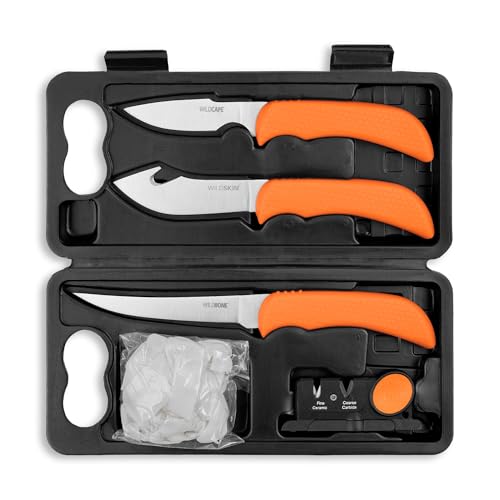
OUTDOOR EDGE WildLite 6-Piece Set
- Best for: Hunters who want one complete kit that covers skinning, caping, and boning in a single case.
- Set contents: Gut hook skinning knife, caping knife, boning and fillet knife, sharpener, gloves, hard-side case
- Blade material: Heat-treated 420J2 stainless steel
- Skinning knife blade: 4.0-inch gut-hook skinner
- Caping knife blade: 2.5 inches
Hunters who want one complete kit that covers skinning, caping, and boning in a single case.
The case adds bulk to a pack, so backcountry hunters who count every ounce may prefer a single knife and a belt sheath instead.
The WildLite is a full field-to-freezer set for hunters who would rather carry one case than assemble a kit piece by piece. It holds a gut-hook skinning knife, a caping knife, and a boning and fillet knife, plus a sharpener and gloves, all in a hard-side carry case. The skinning knife handles the hide, the caping knife takes over for the close detail work around the head and joints, and the boning knife finishes the job when the meat comes off the bone. Heat-treated stainless blades keep the set working through a whole animal, and the bright handles are easy to find on a tailgate or a tarp.
Watch out for: The case adds bulk to a pack, so backcountry hunters who count every ounce may prefer a single knife and a belt sheath instead.
Elk Ridge ER-300 2-Piece Set
- Best for: Hunters who want a two-knife system for skinning and detail work without buying a full processing set.
- Set contents: 7-inch gut hook knife and 6.4-inch caping knife, nylon sheath
- Gut hook knife blade: 4 inches
- Caping knife blade: 3.3 inches
- Blade material: 3Cr13MoV stainless steel
Hunters who want a two-knife system for skinning and detail work without buying a full processing set.
The set is sold in several handle colors, so confirm the color and model on the listing before ordering, since the variants share the same set name.
The ER-300 pairs two fixed blades in one nylon sheath, which gives you a skinning knife and a detail knife without the weight or cost of a full set. The larger knife is a seven-inch gut-hook blade built for opening the animal and starting the hide, while the smaller caping knife handles the careful cuts around joints and the head. Both blades use full tang construction, so the steel runs the full length of the handle and the knives stand up to the twisting force that heavy hide puts on a blade. The wood handles give the set a traditional look and a warm grip on cold mornings.
Watch out for: The set is sold in several handle colors, so confirm the color and model on the listing before ordering, since the variants share the same set name.
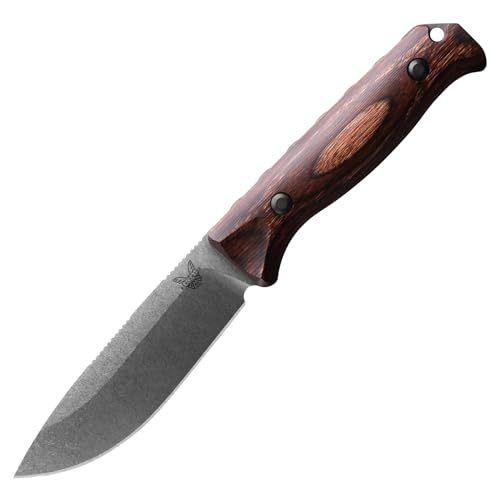
Benchmade Saddle Mountain Skinner 15002
- Best for: Serious elk hunters who want a premium fixed-blade skinner with long edge retention and a lifetime resharpening service.
- Blade length: 4.2 inches
- Blade style: Drop point skinner
- Blade material: CPM-S30V stainless steel
- Overall length: 8.7 inches
Serious elk hunters who want a premium fixed-blade skinner with long edge retention and a lifetime resharpening service.
The Saddle Mountain Skinner is also sold in a different steel and handle combination, so confirm the listing shows the S30V blade and wood handle before ordering.
The Saddle Mountain Skinner is the premium pick in this guide, and it is built around one idea: a blade that stays sharp through a whole elk. Its CPM-S30V stainless steel drop point blade holds an edge far longer than budget stainless, which matters when you are skinning alone and cannot stop to sharpen. The stabilized wood handle is shaped for controlled skinning cuts, and the knife comes with a leather sheath that rides quietly on a belt. Benchmade also offers free factory resharpening for the life of the knife, so the edge can be restored to factory condition between seasons.
Watch out for: The Saddle Mountain Skinner is also sold in a different steel and handle combination, so confirm the listing shows the S30V blade and wood handle before ordering.
OUTDOOR EDGE WildPair
- Best for: Hunters who want a compact two-knife pair that handles skinning and caping without the bulk of a full set.
- Set contents: Gut-hook skinning knife and caping knife, nylon sheath
- Blade style: Deep-bellied gut-hook skinner and caping knife
- Blade material: 420J2 stainless steel
- Blade type: Fixed blade
Hunters who want a compact two-knife pair that handles skinning and caping without the bulk of a full set.
There is no boning knife or sharpener in the set, so hunters who process meat in the field will need to carry those separately.
The WildPair is a compact two-knife set that covers the two jobs an elk skinner faces most: removing the hide and doing the close work after it. The deep-bellied gut-hook skinner takes long strokes down the body, while the caping knife steps in for the tight cuts around the legs, neck, and head. Both blades are fixed, so there is no folding joint to clean out after a bloody job, and both ride in one Mossy Oak nylon sheath on your belt. It is a good middle ground between a single knife and a full processing set, with no extra pieces to keep track of in the field.
Watch out for: There is no boning knife or sharpener in the set, so hunters who process meat in the field will need to carry those separately.
Which One Fits Your Situation
You Hunt Elk Once a Year and Want One Knife
Pick the WildSkin. It is a single fixed blade with a gut hook, it packs light, and there is nothing to assemble or keep track of. The gut hook opens the hide cleanly, and the bright handle is easy to find if you set the knife down in the grass. Keep it sharp before the season, and it will carry you through a whole animal without fuss.
You Process the Whole Animal Yourself
Pick the WildLite 6-piece set. The skinning knife, caping knife, and boning knife each take a stage of the work, and the sharpener in the case lets you touch up an edge between quarters. The hard case keeps everything together from the truck to the table. It is the best choice when the work does not end at the kill and the meat still needs breaking down at home.
You Want Two Knives and Nothing More
Pick the WildPair or the Elk Ridge ER-300. Both give you a skinner and a detail knife in one sheath, so nothing extra rattles around in your pack. Choose the WildPair for a rubberized grip and a camo sheath, or the ER-300 for full tang construction and traditional wood handles.
You Skin Elk Every Season and Hate Resharpening Mid-Animal
Pick the Benchmade Saddle Mountain Skinner 15002. The CPM-S30V blade holds its edge through a full elk, the handle is built for controlled skinning cuts, and the lifetime resharpening service means the edge comes back to factory condition between seasons. That edge retention is the difference between finishing the animal on one edge and stopping to sharpen halfway through the hindquarter.
Common Mistakes
- Choosing a blade longer than five inches for skinning, which makes the tip harder to control around joints and the brisket.
- Picking a folding knife for skinning, since blood and hair collect in the joint and the lock adds a failure point under heavy pulling.
- Ignoring the sheath, then discovering the knife rides loose on a belt or cannot be drawn one-handed with gloves on.
- Buying a skinner with a smooth, polished handle that turns slick the moment it gets wet.
- Waiting until the animal is down to sharpen, instead of starting with a fresh edge and carrying a small sharpener for touch-ups.
Frequently Asked Questions
What blade length works best for skinning an elk?
A blade around four inches is the sweet spot for most hunters. It is long enough for smooth strokes along the hide and short enough to control around joints, the neck, and the brisket. Longer blades cover ground faster but catch more easily, while much shorter blades turn a big job into many small cuts.
Do I need a gut hook on an elk skinning knife?
A gut hook is useful but not required. It opens the hide cleanly without risking a puncture, which helps less experienced hunters and anyone working in the dark or in cold weather. If your knife has no gut hook, use short, shallow cuts with the tip angled away from the body cavity.
Fixed blade or folding knife for elk skinning?
A fixed blade is the better choice for skinning elk. It is stronger under the twisting force of heavy hide, easier to clean after a bloody job, and has no lock or joint to fail. A folder can work for small game, but the forces involved in an elk hide favor a solid, one-piece knife.
How do I keep my skinning knife sharp through a whole elk?
Start with a freshly sharpened edge before the hunt and carry a small sharpener in your pack or sheath. Touch up the edge between quarters rather than waiting until it is fully dull, and wipe the blade clean of hair and grit, which wear the edge faster than the hide itself does.
More from Amazon
Programs that pair well with the guide above. Offers and eligibility are set by Amazon and may change.
Set up recurring deliveries of everyday items on eligible products. Terms and savings are set by Amazon.
Explore Subscribe & SaveCollect the home and kitchen items you want in one registry that guests can shop from.
Create a wedding registryFree shipping on eligible items, Prime Video and more. Eligible new members can start with a free trial.
Start a Prime free trialAudiobooks and podcasts to listen to on the go. Eligible new members can start with a free trial.
Try Audible freeAs an Amazon Associate we earn from qualifying purchases.
Write Your Review
No reviews yet. Be the first to share your experience!