
Our Short List of 3

- Best for: Full-tang and hidden-tang handle glue-ups where alignment time and a toughened joint matter most.
- Brand: West System
- Contents: two 4 oz bottles, resin and hardener
- Mix ratio: 1:1 by volume, as stated for G/flex
- Pot life: 46 minutes, as stated in manufacturer data
- Best for: Clear glue lines on lighter scales, with a half-hour window to align and clamp.
- Brand: Bob Smith Industries
- Model: BSI-205 Slow-Cure
- Contents: 4.5 oz combined
- Colour: clear, as stated in the listing title

- Best for: Small, fast handle repairs and single-scale jobs you can position within a few minutes.
- Brand: J-B Weld
- Model: 50112 ClearWeld
- Contents: 25 ml syringe
- Mix ratio: 1:1, as stated in the listing
All 3 Picks at a Glance
| Product | Specs | Action |
|---|---|---|
| WEST SYSTEM G/flex Epoxy (2-4oz) |
| Check price on Amazon |
| Bob Smith Industries BSI-205 Slow-Cure Epoxy |
| Check price on Amazon |
| J-B Weld 50112 ClearWeld Epoxy Syringe |
| Check price on Amazon |
Key takeaways
- Epoxies for knife handles compared by working time, mix ratio and cured colour, from a long-open-time toughened epoxy to a fast clear syringe for small repairs.
Choosing an epoxy for a knife handle is really a decision about working time and failure mode. A handle joint lives with shock, vibration, water and hand oils, and it is made of two materials that move differently: a steel tang and a scale in wood, Micarta or a similar material. A fast, brittle epoxy can let go at the edges, while a slower, toughened one leaves a joint that flexes slightly instead of cracking.
This guide is for home knife makers gluing scales onto a first full-tang knife, and for anyone repairing a handle lifting at one corner. Every product below was chosen from its Amazon listing name and stated specifications: mix ratio, working or set time, cured colour and the materials the listing says it bonds. Read cure times as planning figures: a handle should not be shaped or used before the full cure the listing describes.
Quick Picks
As an Amazon Associate we earn from qualifying purchases
| Product | Best for | Key spec from title |
|---|---|---|
| WEST SYSTEM G/flex Epoxy (2-4oz) | Full handle glue-ups needing long alignment time | Toughened epoxy, two 4 oz bottles |
| Bob Smith Industries BSI-205 Slow-Cure Epoxy | Clear joints on lighter coloured scales | Slow-cure epoxy, 4.5 oz combined, clear |
| J-B Weld 50112 ClearWeld Epoxy Syringe | Small handle repairs you can position quickly | 5 minute set epoxy syringe, 25 ml, clear |
How to Choose
Working time decides how calm the glue-up feels
A knife handle glue-up has more steps than it looks: coat the tang, coat both scale backs, place the pins, align the scales, clamp evenly and wipe the squeeze-out. With a five-minute epoxy, that sequence has to be rehearsed and everything laid out before mixing. With a slow-cure or toughened epoxy, you can stop, check alignment against the spine and adjust. Match the working time in the listing to your experience honestly. A first handle belongs with the longest working time you can find, because a rushed joint that sets crooked cannot be un-clamped and corrected.
Toughened and flexible beats hard and brittle
A handle joint is struck, twisted and wetted in normal use. The G/flex listing describes a toughened epoxy, and toughened here means the cured glue keeps a degree of flexibility rather than behaving like glass. That matters most with wooden scales, which swell and shrink slightly with humidity while the steel tang does not. A rigid glue line concentrates that movement at the edge of the joint, which is where lifting starts. For a hard-used field knife, choose the epoxy whose listing talks about toughness and bonding difficult woods over one that only promises a fast set.
Cured colour shows on pale scales
Epoxy is visible as a thin line between tang and scale, and on a pale maple or light synthetic scale that line is part of the finished look. The G/flex manufacturer data describes an amber cured colour, which nearly disappears under dark wood but can read as a stripe under light scales. The two clear options in this guide suit pale materials and repair work where the joint should stay discreet. Decide before mixing, not after clamping: lay a scale against the tang in daylight and ask whether a dark or a clear line looks right on that knife.
Surface preparation matters more than brand
No epoxy in this guide can rescue a polished, oily tang. The listings describe bonds to metal, wood and other handle materials, but those bonds assume clean, roughened surfaces. Scuff the tang and the scale backs with coarse abrasive, degrease the metal, and keep fingers off the prepared faces. Oily tropical woods deserve an extra solvent wipe shortly before glue-up, as their surface oils can block a bond. Clamp firmly but not violently: crushing the joint squeezes glue out and can starve it. Good preparation is why two makers using the same epoxy get different results.
The 3 Best Options
WEST SYSTEM G/flex Epoxy (2-4oz)
- Best for: Full-tang and hidden-tang handle glue-ups where alignment time and a toughened joint matter most.
- Brand: West System
- Contents: two 4 oz bottles, resin and hardener
- Mix ratio: 1:1 by volume, as stated for G/flex
- Pot life: 46 minutes, as stated in manufacturer data
Full-tang and hidden-tang handle glue-ups where alignment time and a toughened joint matter most.
The cured colour is described as amber in manufacturer data, so test the glue line against pale scales before committing.
G/flex is the default recommendation for a complete handle glue-up, and the reason is time. The manufacturer data for the 650 version lists a 46-minute pot life and a 75-minute working time, which is enough to coat a tang, seat pins, align scales and clamp without rushing. The listing describes a toughened, liquid epoxy with a honey-like consistency for permanent waterproof bonding of fiberglass, ceramics, metals, plastics and damp or difficult-to-bond woods, which is exactly the mixed-material problem a knife handle presents. It is sold as two 4 oz bottles in a simple 1:1 mix.
Bob Smith Industries BSI-205 Slow-Cure Epoxy
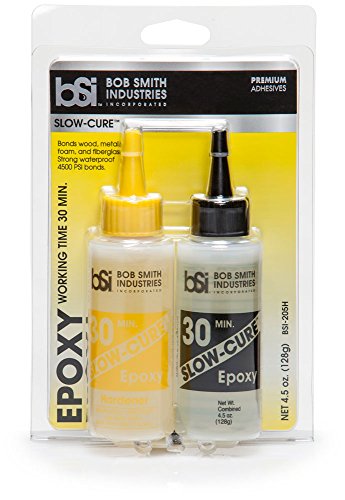
- Best for: Clear glue lines on lighter scales, with a half-hour window to align and clamp.
- Brand: Bob Smith Industries
- Model: BSI-205 Slow-Cure
- Contents: 4.5 oz combined
- Colour: clear, as stated in the listing title
Clear glue lines on lighter scales, with a half-hour window to align and clamp.
Thirty minutes passes quickly on a pinned handle, so dry-fit everything and lay out clamps before mixing.
The BSI-205 Slow-Cure is the clear, middle-speed option. Its listing title states a 30-minute working time and a clear finish in a 4.5 oz combined pack, which suits a maker who wants more control than a syringe epoxy gives but does not need the long open time of G/flex. It is listed for wood, fiberglass, metal and craft or structural repair work, covering the tang-and-scale pairing directly. For a kitchen knife handle in a light wood, that clear cured line is the main reason to choose it over the amber-curing option above.
J-B Weld 50112 ClearWeld Epoxy Syringe
- Best for: Small, fast handle repairs and single-scale jobs you can position within a few minutes.
- Brand: J-B Weld
- Model: 50112 ClearWeld
- Contents: 25 ml syringe
- Mix ratio: 1:1, as stated in the listing
Small, fast handle repairs and single-scale jobs you can position within a few minutes.
A five-minute set is unforgiving on a multi-pin glue-up, so do not choose it for your first full handle.
ClearWeld is the repair epoxy in this guide rather than a first choice for a full glue-up. The listing describes a quick-setting two-part epoxy in a re-sealable 25 ml syringe with a 1:1 mix, a five-minute set and a one-hour cure, curing clear at thin thicknesses. That speed is useful for re-seating a lifting scale corner, filling a small gap at a bolster or bonding a single scale you can hold in position by hand. The syringe format also suits occasional users, because the cap re-seals and the remaining epoxy stays usable for the next small job.
Which One Fits Your Situation
Your first full-tang knife
Choose WEST SYSTEM G/flex and use its long working time properly. Dry-fit the scales and pins, mark the alignment, mix only when the clamps are open and waiting, then coat both surfaces and assemble once. Leave the handle for the full cure stated in the manufacturer data before shaping, because early grinding heat and pressure are unkind to a young joint.
A pale wooden handle that should look clean
Choose the Bob Smith Industries BSI-205 Slow-Cure. The clear cured line is the deciding feature on maple, birch or light synthetic scales, and the 30-minute working time still allows a careful, pinned assembly. Work in a warm room, keep the mixed epoxy in a thin layer to avoid shortening its usable life, and wipe squeeze-out promptly so the clear line stays tidy.
One corner of a handle has started to lift
Choose J-B Weld ClearWeld. Clean out the gap, work a small amount of mixed epoxy into it with a thin spatula, clamp the corner and leave it for the cure time in the listing. A syringe suits this job because the amount needed is small and the rest can be re-sealed. If the whole scale is moving, though, remove it fully and re-glue with a slower epoxy instead.
A hard-used field knife in oily wood
Choose G/flex again, and spend the effort on preparation. The listing specifically names difficult-to-bond woods, which is the situation with oily tropical species. Scuff both surfaces, wipe the wood shortly before glue-up, use pins or bolts as mechanical insurance alongside the epoxy, and give the finished handle the full cure before it goes back into a sheath and out into wet weather.
Common Mistakes
- Mixing epoxy before the scales, pins and clamps are laid out, then losing the working time to preparation that should have happened first.
- Gluing to a polished or greasy tang, which gives even a strong epoxy nothing to grip.
- Clamping as hard as possible and squeezing the joint dry, instead of using firm, even pressure with a little squeeze-out.
- Shaping or using the knife before the full cure in the listing, because the surface felt hard to a fingernail.
- Choosing a five-minute epoxy for a first multi-pin handle, then discovering a misaligned scale after it has set.
Frequently Asked Questions
Is epoxy alone enough to hold knife scales?
Epoxy plus pins or bolts is the safer assembly for a knife that will be struck, twisted or used hard. The epoxy seals the joint against water and bonds the surfaces, while the pins provide mechanical insurance if the bond is ever shocked. For a light kitchen handle, a well-prepared epoxy joint with pins is the normal, sensible construction.
Why did my handle joint fail at one edge?
Edge failure usually traces back to preparation or movement: an oily or polished surface, a glue-starved joint from over-clamping, or a rigid epoxy between materials that move differently. Clean and scuff both faces, choose a toughened or slower epoxy for wooden scales, clamp evenly, and allow the full stated cure before use.
Can I use a five-minute epoxy for a whole handle?
You can, but it leaves very little time to coat the tang, place pins, align scales and clamp, and any mistake sets in place. Five-minute products in this guide suit repairs and small, simple assemblies. For a complete handle, a 30-minute or longer working time gives a calmer assembly and a better chance of a straight, fully seated joint.
Does the cured colour of epoxy matter?
Yes, on visible glue lines. An amber-curing epoxy can show as a dark stripe under pale scales, while a clear epoxy stays discreet on light materials and repairs. The listings and manufacturer data in this guide state the cured colour for each pick, so match that line to your scale material before you mix anything.
More from Amazon
Programs that pair well with the guide above. Offers and eligibility are set by Amazon and may change.
Set up recurring deliveries of everyday items on eligible products. Terms and savings are set by Amazon.
Explore Subscribe & SaveCollect the home and kitchen items you want in one registry that guests can shop from.
Create a wedding registryFree shipping on eligible items, Prime Video and more. Eligible new members can start with a free trial.
Start a Prime free trialAudiobooks and podcasts to listen to on the go. Eligible new members can start with a free trial.
Try Audible freeAs an Amazon Associate we earn from qualifying purchases.

Write Your Review
No reviews yet. Be the first to share your experience!