

Key takeaways
- [Touchless Kitchen Faucet Set] Turn on the sink…
- [Premium WEWE Kitchen Faucet Set] Elevate your kitchen…
- [Lead-Free & Durable Construction] Crafted from premium SUS…
Best Touchless Kitchen Faucets for Every Sink
The best touchless kitchen faucet for most homes is a single-handle model with a front or side motion sensor, a pull-down spray head, a 7- to 10-inch reach, and either standard batteries or an accessible AC adapter; the right choice depends mainly on your sink clearance, daily usage, installation confidence, and tolerance for replacing batteries.
Quick picks by sink setup
| Sink situation | Best fit | Why it suits the setup | Typical price range |
|---|---|---|---|
| Most kitchens and straightforward replacement | Moen Arbor MotionSense Wave | Single-handle design, pull-down spray head, reliable battery-powered installation, and a sensor positioned above the spout | $350–$550 |
| Large or deep sink with frequent pot washing | Kohler Sensate touchless faucet | Long pull-down hose, strong clearance, and a responsive sensor system suited to repeated use | $500–$800 |
| Existing Delta kitchen faucet or coordinated remodel | Delta Essa Touch2O.TO | Touchless activation with a familiar pull-down format and a broad selection of finishes | $400–$700 |
| Limited counter space or a compact sink | Compact touchless single-handle faucet | Choose a 7–8-inch reach and a sensor with a narrow activation zone to reduce accidental starts | $150–$350 |
| High-use household without a nearby outlet | Battery-powered commercial-style faucet | Battery access is simpler than routing an adapter cable, especially under a deep cabinet | $250–$600 |
Head-to-head comparison of leading designs
| Faucet or type | Sensor arrangement | Reach and clearance | Power option | Installation considerations |
|---|---|---|---|---|
| Moen Arbor MotionSense Wave | Wave sensor near the top/front of the faucet | About 8–9 inches of reach; pull-down head suitable for single- or double-bowl sinks | Typically six AA batteries; some versions support an AC adapter | Usually fits one-hole installations; deck plate may cover three-hole layouts |
| Kohler Sensate | Hands-free sensor near the spout plus manual handle | Roughly 9 inches of reach and approximately 9–10 inches of spout height, depending on version | Battery pack or optional power supply, depending on configuration | Check cabinet space carefully; control box and hose routing need room below the sink |
| Delta Essa Touchless | Hands-free activation integrated into the faucet body | Approximately 9 inches of reach; pull-down head handles normal cookware well | Commonly battery powered, with AC compatibility on selected versions | Best when the mounting hole and included deck plate match the existing sink |
| Compact touchless faucet | Usually a front-facing infrared sensor | About 7–8 inches of reach and 8–9 inches of height | Four AA batteries is common | May have shorter supply lines and a smaller control box; verify hose length |
| Commercial-style touchless faucet | Wide or forward-facing infrared sensor | Often 9–10 inches of reach with a high arch; may exceed 15 inches in total height | Four to six AA batteries or an AC adapter | Needs vertical clearance and a cabinet wide enough for the exposed spring and hose |
Dimensions vary by exact model and finish, so use these figures as planning ranges rather than substitutes for the installation diagram. The most important measurement is not the advertised reach alone: measure from the mounting hole to the nearest sink bowl edge. A long spout can be useful on a wide double-bowl sink but can splash badly if it projects beyond a small bowl.
Our top picks
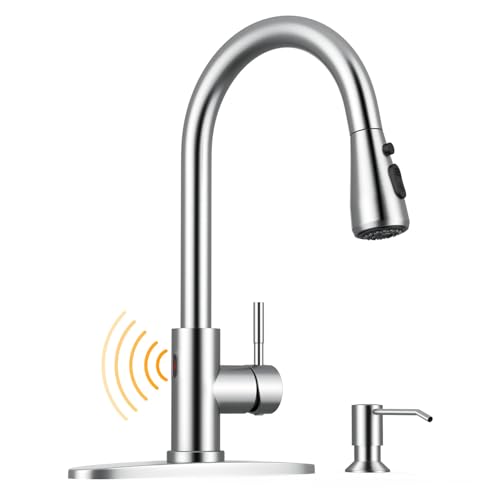 WEWE Touchless Kitchen Faucet with Soap Dispenser
- [Touchless Kitchen Faucet Set] Turn on the sink…
- [Premium WEWE Kitchen Faucet Set] Elevate your kitchen…
- [Lead-Free & Durable Construction] Crafted from premium SUS…
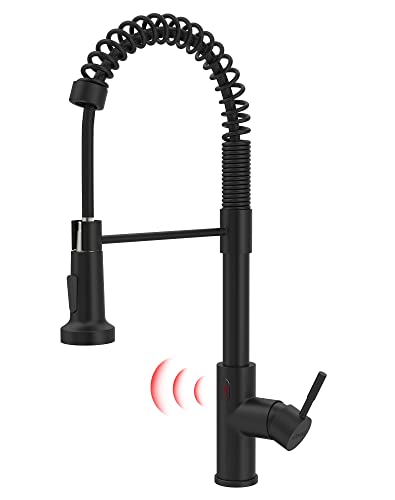 GIMILI Matte Black Touchless Kitchen Faucet with
- Touchless Technology: No need to touch the handle,…
- Reliable Quality: Forged from commercial-grade SUS 304 stainless…
- Multifunctional Sprayer: Pull out kitchen faucet with 2…
 OWOFAN Touchless Pull Down Kitchen Faucet LED
- START WATER WITH A WAVE: A responsive sensor…
- Toggle between a powerful high-pressure spray that blasts…
- DIY INSTALL IN MINUTES: An included deck plate…
| Product | Key specs | |
|---|---|---|
| WEWE Touchless Kitchen Faucet with Soap Dispenser | [Touchless Kitchen Faucet Set] Turn on the sink… [Premium WEWE Kitchen Faucet Set] Elevate your kitchen… [Lead-Free & Durable Construction] Crafted from premium SUS… | Check price |
| GIMILI Matte Black Touchless Kitchen Faucet with | Touchless Technology: No need to touch the handle,… Reliable Quality: Forged from commercial-grade SUS 304 stainless… Multifunctional Sprayer: Pull out kitchen faucet with 2… | Check price |
| OWOFAN Touchless Pull Down Kitchen Faucet LED | START WATER WITH A WAVE: A responsive sensor… Toggle between a powerful high-pressure spray that blasts… DIY INSTALL IN MINUTES: An included deck plate… | Check price |
 Moen 7594EWSRS Arbor Touchless Kitchen Faucet Moen 7594EWSRS Arbor Touchless Kitchen Faucet | The kitchen faucets touchless option includes 6 AA… Features Duralock quick connect system for easy installation | Check price |
As an Amazon Associate we earn from qualifying purchases at no extra cost to you.
How sensor responsiveness differs
Best for predictable activation: a top-mounted wave sensor
A sensor on the upper front of the faucet is easy to trigger while holding a plate, pan, or handful of vegetables. It generally requires a deliberate hand movement within roughly 2–4 inches of the sensor. This layout is a strong all-purpose choice because the sensor is visible and less likely to detect activity on the countertop.
Best for minimal movement: a broad front sensor
Some touchless faucets use a larger infrared window facing the user. These can start water quickly when your hands approach the sink, but a wide detection field may also respond to a moving dish towel or an object being placed beneath the spout. If your sink is beside a busy walkway, choose a narrower activation zone or a model with an easy manual override.
What “responsive” should mean
Look for activation in about half a second to one second, a clean shutoff when hands leave the field, and an override handle that works without electronics. Delayed activation is often caused by a dirty sensor window, low batteries, reflective objects, or a control box that has shifted under the cabinet. Sensor faucets should not require repeated waving.
Power: batteries versus an outlet
Battery operation is usually the easiest retrofit. It avoids an electrical connection and continues working during a power outage, although the battery pack takes up space under the sink. AC power eliminates routine battery replacement but requires a nearby outlet, a safe cable route, and protection from leaks. Never place a power adapter directly on the cabinet floor where a loose supply connection could wet it.
A practical runtime estimate illustrates the trade-off. Suppose a faucet uses six AA batteries rated at about 2,000 mAh and the electronics draw an average of 2 mA while idle and activate for a combined 10 minutes per day. The electronics may last many months, but real-world life is reduced by battery age, standby demand, and solenoid use. Planning for roughly 6–12 months between battery changes is more realistic than relying on the maximum laboratory figure. High-use households should keep a spare set in the kitchen.
For a household that activates the faucet 40 times per day, a 10-second hand-washing cycle uses about 6.7 minutes of water activation daily. That figure matters less for water cost than for battery wear: frequent short cycles and repeated sensor activations place more demand on the solenoid than occasional long fills.
Installation requirements that decide compatibility
- Mounting holes: Most touchless kitchen faucets use one hole. A three-hole sink can usually accept one with a deck plate, but confirm that the plate covers the outer holes.
- Under-sink clearance: Allow approximately 10–14 inches of vertical and horizontal working room for the control box, battery holder, hoses, and counterweight.
- Supply-line length: Measure from the faucet connection to the shutoff valves. Short lines may require extensions, while unsupported extra length can kink.
- Hose travel: Pull-down hoses need a clear path. A cleaning bottle, garbage-disposal cord, or water filter can block the counterweight and prevent the spray head from returning.
- Sink depth: A high-arc spout is useful for large pots, but a shallow sink may need a lower spout or a flow restrictor to reduce splash.
- Manual control: Confirm that the handle can set temperature and flow independently of the sensor. This is essential when batteries are depleted or electronics need cleaning.
For a confident DIY installer, the work is usually similar to replacing a standard faucet: shut off both valves, disconnect the supplies, clean the mounting surface, secure the faucet, connect the control box and hoses, insert batteries or the adapter, and test for leaks. A professional is worthwhile when the shutoff valves are seized, the cabinet is unusually tight, the sink is undermounted in a thick countertop, or an electrical outlet must be added.
Finish durability and cleaning
Stainless-looking finishes are not all the same. Physical vapor deposition, commonly labeled PVD, generally resists discoloration and light scratching better than basic painted or plated finishes. Chrome is often the easiest to clean and can tolerate regular wiping, while matte black shows dried mineral spots and fingerprints more readily. Brushed finishes hide minor marks but still need prompt removal of hard-water deposits.
Use a soft cloth with mild dish soap and water, then dry the faucet. Avoid abrasive pads, powdered cleaners, bleach, vinegar left on the surface, and concentrated descaling chemicals unless the manufacturer specifically permits them. Do not spray cleaner directly toward the sensor window, seams, or handle. Mineral buildup on the aerator can reduce flow; remove and soak the aerator according to the manual rather than immersing the electronic faucet body.
Decision matrix: which type makes sense?
| Your priority | Recommended configuration | Compromise to expect |
|---|---|---|
| Lowest purchase cost | Battery-powered compact faucet, chrome finish | Shorter reach, smaller spray head, and more basic sensor adjustment |
| Frequent cooking and large cookware | 9-inch pull-down faucet with a high arc and accessible manual handle | Greater cabinet clearance and a higher price |
| Small sink or narrow counter | 7–8-inch reach, low-to-medium arc, narrow sensor field | Less room for filling tall stockpots |
| Rental or simple retrofit | One-hole battery model with a deck plate | Battery replacement and possible unused holes beneath the plate |
| Hard water or heavy daily use | Chrome or quality PVD finish, replaceable aerator, clear sensor window | Higher initial cost, but easier long-term cleaning |
Ownership problems that appear later
The first parts to need attention are usually the batteries, aerator, pull-down hose, spray-head seal, and solenoid rather than the metal faucet body. A faucet that activates but will not shut off may have a blocked sensor, a misaligned control box, or a failing solenoid. A weak stream is more often an aerator or supply-valve problem than a sensor problem. If the spray head no longer docks firmly, inspect the hose weight and clean the docking area before replacing parts.
When comparing the best touchless kitchen faucets, prioritize the fit of the sink and the accessibility of service parts over extra spray modes. A well-sized faucet with a clear sensor, replaceable batteries, a durable finish, and a usable manual handle will usually be more satisfying than a feature-heavy model that cannot clear your cabinet or aim into the center of the bowl.








Write Your Review
No reviews yet. Be the first to share your experience!