

Key takeaways
- Compare six best charcoal chimney starters by size, material and handle design, with picks for kettles, small grills and kits that include fire cubes.
The best charcoal chimney starter for most backyard cooks is the Weber Rapidfire Standard: a full-size, vented, cone-grate design that lights enough coals for a 22-inch kettle with nothing but a fire cube and a match. A chimney starter is a metal cylinder that lets hot air rise through a pile of charcoal, so the whole load ignites in about 15 to 20 minutes without lighter fluid. If your grill is small or portable, the Kingsford Compact fits better, and if you want maximum capacity or a wide-body design, the other picks below fill those gaps.
Quick List
- Kingsford Compact – best for portable grills, hibachis and small kettles
- Weber Rapidfire Standard – best all-around starter for 22-inch kettles
- homenote Kit with Blower and Fire Cubes – best for cooks who want everything in one box
- Basics Galvanized Steel 6.6 lb Starter – best for simple, no-frills capacity
- E500 Large with 60 Starters – best for stocking up on fire starters along with the chimney
- Oklahoma Joe’s Halftime XL – best for a wide, short, fast-lighting design
Which One Is Right for You?
| If you… | Choose |
|---|---|
| Cook on a 22-inch kettle most weekends | Weber Rapidfire Standard |
| Want a wider, shorter chimney that airs well | Oklahoma Joe’s Halftime XL |
| Own a hibachi, tabletop or portable charcoal grill | Kingsford Compact |
| Need a starter and a pack of fire cubes bundled together | E500 Large with 60 Starters |
| Prefer a kit with a blower accessory to speed up lighting | homenote Kit with Blower and Fire Cubes |
| Want a plain, roomy galvanized steel chimney with a stated 6.6 lb capacity | Basics Galvanized Steel 6.6 lb Starter |
The deciding factor is the size of your grill. A chimney that is too small forces you to light two batches, while one that is too large wastes charcoal on a small cook. After size, handle comfort and the way you plan to light the coals (fire cubes, paper, or a blower) matter most.
All 6 Picks in Detail
The six chimneys below are listed in the same order as the catalog set. Three are straightforward single-purpose cylinders, two come with ignition extras, and one uses a wider, shorter shape. Because the listing names leave some specifications open, details that were not stated are marked for confirmation on the product page. Use the capacity and handle notes to match each one to your grill, not just to the label.
1. Kingsford Compact – Best for Small and Portable Grills
As an Amazon Associate we earn from qualifying purchases at no extra cost to you.

The Kingsford Compact is a scaled-down chimney for people who cook on a hibachi, a tabletop charcoal grill or a small kettle. The listing describes a quick-light zinc steel body with a heat shield and a stay-cool handle, and it arrives fully assembled. Kingsford itself notes that this is not a full-size chimney, which is the right way to think about it: it lights a modest load quickly rather than a kettle-sized pile.
Who it suits: campers, tailgaters, balcony cooks where local rules allow charcoal, and anyone who grills for one or two people. A smaller load of coals also means less leftover charcoal to dispose of after a quick burger night. If you ever upgrade to a larger kettle, this chimney can stay in the camping kit as a dedicated portable starter, which gives it a second life rather than making it obsolete.
- Listing dimensions of roughly 8.1 x 5.7 x 10 inches
- Zinc steel construction, according to the listing
- Heat shield plus stay-cool handle
- No assembly required
- Briquette capacity: confirm on the product page
Pros
- Fits small grills without over-lighting charcoal
- Light and easy to store in a cabinet or camping bin
Cons
- Too small to feed a large kettle in one pour
- Capacity is not spelled out in the listing name
Compared with the Weber Rapidfire, it trades capacity for a smaller footprint, so choose it only if your grill is genuinely small.
2. Weber Rapidfire Standard – Best for 22-Inch Kettles
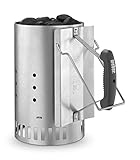
The Weber Rapidfire Standard is the reference design most people picture when they hear “chimney starter.” The listing calls it a fast-lighting starter for quick, even hot coals in durable silver metal. Weber’s own product pages describe a roughly 1.6-gallon size built from aluminized steel, with a cone-shaped bottom grate, a ventilated chamber for the fire starter, a heat shield and a flip-up helper handle for two-handed pouring. Weber designs it around the 22-inch kettle, and that is where it feels most at home.
Who it suits: anyone who wants one chimney that works with kettles, drum smokers and most barrel-style charcoal grills. It is also a sensible first purchase for a new charcoal owner because its operation is so widely documented: fill, place a fire cube underneath, light, wait for ash, pour. Experienced cooks often use it to start a small batch of lit coals that is then added to unlit charcoal for a long, low smoke.
- Standard size, silver finish, per the listing
- Aluminized steel body according to the manufacturer
- Cone-shaped grate and open bottom chamber for the fire cube
- Side handle with heat shield and a helper handle for pouring
- Stated charcoal capacity varies between sources, so confirm on the listing
Pros
- Proven, familiar design with two-handed pouring control
- Sized to feed a full kettle without a second batch
Cons
- Tall profile can be awkward to store
- Silver aluminized finish darkens and discolors with use
Against the Oklahoma Joe’s Halftime XL, the Weber is taller and narrower, while the Oklahoma Joe’s is shorter and wider.
3. homenote Chimney Starter Kit with Blower – Best All-in-One Kit

The homenote kit bundles a chimney starter with a blower and fire cubes, and the listing gives its size as 11.5 x 7 inches. For a newcomer, the appeal is obvious: one purchase covers the chimney, the ignition source and a way to speed the draw. Because the listing name does not state the metal, the blower’s power source or the number of fire cubes, check those details on the product page before ordering.
Who it suits: beginners who would rather not shop for separate parts, and gift buyers putting together a starter set for a new grill owner. The kit approach also appeals if you light your grill in breezy spots where a gentle push of air helps. If you already own fire cubes, the bundle matters less, and a plainer chimney may be the better fit.
- Chimney starter plus blower plus fire cubes in one kit
- Listed size: 11.5 x 7 inches
- Material and blower power source: confirm on listing
- Number of fire cubes included: confirm on listing
- Handle type: confirm on listing
Pros
- Everything needed to light coals arrives together
- A blower can help a slow-to-start pile when the air is still
Cons
- The blower is one more part that can wear out
- Kit accessories vary in quality, so read the listing details
Next to the E500 bundle, this kit leans on the blower, while the E500 leans on a larger stack of fire starters.
4. Basics Galvanized Steel 6.6 lb Starter – Best for Plain, Roomy Capacity

This house-brand chimney keeps things simple. The listing names galvanized steel, a 6.6-pound capacity, a heat-concentrating design and a silver finish. There are no extras in the name, which is exactly the point: you bring your own fire cubes or newspaper and get a roomy cylinder that will handle a standard weekend cook.
Who it suits: cooks who know what they want and value a clear number on the label. A stated 6.6-pound capacity lets you plan quantities: fill it partway for burgers, fill it to the top for a hot sear or a longer cook. It also works well as a second chimney for a household that runs both a grill and a smoker on the same day.
- Galvanized steel body
- 6.6 pound charcoal capacity, per the listing
- Heat-concentrating design
- Silver finish
- Handle and heat shield details: confirm on listing
Pros
- A stated capacity number makes sizing easy
- No bundled extras to sort through
Cons
- You need to supply your own fire cubes or paper
- Galvanized coatings can give off fumes on first heating, so burn it empty outdoors first
Compared with the Weber, it offers similar capacity on paper but fewer documented handling features.
5. E500 Large with 60 Starters – Best for Stocking Up

The E500 pairs a large chimney starter with 60 pieces of charcoal starter, which covers a long run of cookouts before you need to buy more ignition material. The listing name stops at “large,” so the exact capacity, material and handle design are details to confirm on the product page. If you cook on charcoal weekly, a built-in supply of starters is a practical convenience.
Who it suits: frequent charcoal grillers, and small groups that share a backyard setup, since 60 starters last a long time at one or two lights per week. Buyers who care about food flavor should check that the included starters are the clean-burning, odor-free type and let them fully ignite before adding food. Store the extras in a dry, sealed container so moisture does not make them hard to light.
- Large chimney size, per the listing
- 60 pieces of charcoal starter included
- Capacity in pounds: confirm on listing
- Body material: confirm on listing
- Handle and heat shield: confirm on listing
Pros
- A generous pack of starters comes in the box
- Large size suits full-size kettles and barrel grills
Cons
- The listing name gives few construction details
- Starter type matters; confirm they are food-safe, odorless cubes
Choose it over the homenote kit when you want a big pile of starters rather than a blower.
6. Oklahoma Joe’s Halftime XL – Best Wide, Short Design

The Halftime XL takes a different shape from the classic tall cylinder. Oklahoma Joe’s describes it as a wider-diameter, shorter-height stainless steel starter with a cool-touch handle, holding on the order of 100 briquettes. The manufacturer claims it heats up about twice as fast as a standard chimney because the wider body promotes airflow, though that is a maker claim rather than a verified figure.
Who it suits: cooks with storage limits, anyone who finds tall chimneys top-heavy, and people who light lump charcoal often. The shorter body also makes it less likely to tip when you set it down on a grate. Because the shape differs from the classic cylinder, take a practice run with a small load so you learn how the handle balances before you pour a full batch.
- Stainless steel construction, per the manufacturer
- Wide, short body designed for airflow
- Cool-touch handle
- Roughly 100 briquettes of capacity, according to the maker
- Weighs about 3 pounds on the manufacturer page
Pros
- Shorter profile is easier to store and pour from
- Stainless steel resists the flaking that plain finishes can develop
Cons
- The wide footprint needs room on the lighting surface
- Handles are positioned differently from a tall chimney, so pouring feels different at first
Next to the Weber Rapidfire, it is the more modern take; the Weber remains the safer familiar choice.
Specs Compared
| Product | Material | Capacity / Size | Handle / Heat Protection | Extras |
|---|---|---|---|---|
| Kingsford Compact | Zinc steel | About 8.1 x 5.7 x 10 in; capacity confirm on listing | Heat shield, stay-cool handle | None listed |
| Weber Rapidfire Standard | Aluminized steel (maker page) | About 1.6 gal; confirm pounds on listing | Heat shield, helper handle | Cone grate |
| homenote Kit | Confirm on listing | 11.5 x 7 in | Confirm on listing | Blower and fire cubes |
| Basics Galvanized 6.6 lb | Galvanized steel | 6.6 lb capacity | Confirm on listing | None listed |
| E500 Large | Confirm on listing | Large; confirm on listing | Confirm on listing | 60 charcoal starters |
| Oklahoma Joe’s Halftime XL | Stainless steel (maker page) | About 100 briquettes (maker page) | Cool-touch handle | None listed |
Read the table as a shortlist filter. If a cell says to confirm on the listing, that detail was not stated in the product name we worked from, and it is worth checking before you buy. Capacity and handle design are the two columns most likely to change your decision, since they decide how many batches you light and how safely you pour.
How We Chose These
We compared six chimney starters by reading each listing name, manufacturer product pages and published specifications. We looked at stated capacity, construction material, handle and heat-shield features, bundled accessories and how well each design matches common grill sizes. Where a listing did not state a number, we marked it “confirm on listing” rather than guessing. We also weighed how each design handles pouring, how much ignition material comes with it, and whether the shape suits storage in a typical garage. This is a research-based comparison built from published information, so treat the notes as a starting point and check current details on each product page.
What to Look For
Capacity and grill size
Chimney size is the single most important choice. Full-size chimneys hold roughly 5 to 7 pounds of briquettes, which is about the amount a 22-inch kettle uses for a two-zone fire. Compact versions hold noticeably less and suit hibachis, 14-inch portables and tabletop grills. As a rule of thumb, match the chimney to the grill: if one full load of coals would flood your grill, you want the smaller size; if you cook for a crowd and want a big sear zone, choose the larger.
A worked example: say you cook on a 22-inch kettle and plan a two-zone setup. You pour a full chimney of coals onto one side and leave the other side empty. That gives you a hot sear side and a cooler indirect side. If you only own a compact chimney, you would need a second batch of coals, and the grill would not hit the same heat in the same time.
Materials and finish
Aluminized steel, galvanized steel, zinc-plated steel and stainless steel all show up in this category. Stainless steel resists corrosion best but can be pricier to make. Galvanized and zinc coatings are effective but can release fumes the first time they get very hot, so it is smart to light a first load outdoors, away from people, pets and food. Plain painted finishes tend to discolor, which is cosmetic but still a sign of heavy use.
Handle and heat protection
A chimney full of lit coals gets extremely hot, and the handle is your only safe grip. Look for a handle that stands off from the body, a heat shield between your hand and the metal, and ideally a second helper handle on the opposite side for controlled pouring. Wear leather or heat-resistant gloves anyway. Never carry a lit chimney near children, and set it down only on bare metal grates, concrete or stone, not on a wooden deck or a plastic table.
Ventilation and lighting method
The cone or flat bottom grate separates the coals from a lower chamber where fire cubes or crumpled newspaper sit. Plenty of side vents let the fire pull air from below, which is what produces the chimney effect. Blowers speed this up in still air, but a well-vented chimney lights fine without one. Always use natural fire cubes, newspaper or a similar low-odor ignition source; avoid lighter fluid, which can leave a chemical taste and flare up.
Briquettes versus lump charcoal
Briquettes are uniform, so a chimney filled to the top delivers a predictable amount of heat and burns for a long, steady stretch. Lump charcoal is irregular, lights a little faster and burns hotter, but it also burns out sooner and varies from bag to bag. A chimney holds less lump by weight than briquettes because the pieces do not pack as tightly. If you switch fuels, expect to adjust how much you load and how long you wait for the top coals to ash over.
Care, storage and lifespan
A chimney lives in a harsh environment, so rust and warping are the normal wear patterns. Always let it cool completely, shake out ash, and store it dry. A cover or a hook in a garage keeps rain away. If you notice a handle rattling, tighten the fasteners before the next cook, because a loose handle on a full chimney is a hazard. A chimney that has warped badly, shows holes, or has a handle that no longer sits solidly should be replaced rather than patched.
Safety checklist
Light the chimney outdoors only, because charcoal produces carbon monoxide. Keep it on a non-flammable surface and away from walls, fences and overhanging branches. Pour the coals only when the top layer is covered in gray ash, which usually takes around 15 to 20 minutes. Let an empty chimney cool completely before you store it.
Questions
How long does a chimney starter take to light charcoal?
Most charcoal is ready in roughly 15 to 20 minutes, when the top layer of coals shows a coat of gray ash. Cold weather, damp charcoal and very light wind can add a few minutes. Overfilling beyond the manufacturer capacity can also slow the process, since air has to travel farther through the pile.
Can I use a chimney starter on a gas grill?
No. A chimney starter is for lighting charcoal that will then be poured into a charcoal grill, kettle or smoker. It has no role with propane or natural gas burners.
Is lighter fluid still necessary?
No, and a chimney is a clean way to avoid it. A single fire cube or a loose sheet of newspaper under the cylinder is enough to ignite a full load, and the food does not pick up any chemical flavor. Let the cube burn out or settle before you put food on, so you are cooking over clean coals.
Which fuel works better, briquettes or lump charcoal?
Both work in a chimney. Briquettes burn evenly and predictably, while lump lights faster and burns hotter but can vary in size. Always follow the capacity notes on the product page, since a chimney holds less lump by weight than briquettes.
How do I clean a chimney starter?
Tap out loose ash, then wipe the exterior with a dry cloth once the metal is fully cool. Avoid soaking galvanized or coated steel, since moisture speeds up rust, and keep it in a dry place.
Is a chimney with a blower better?
A blower can help in still air but is not essential, because a good chimney already draws air from below. If you buy a kit with one, confirm what powers it and keep it clear of ash and heat.
Update History
- October 20, 2026 – Initial publication; product set drawn from current catalog listings.
- Check the product page for current specifications and availability before buying.
Sources
- Manufacturer product and specification pages for Weber, Oklahoma Joe’s and Kingsford
- Retailer listing titles and specification fields for each product named above



Write Your Review
No reviews yet. Be the first to share your experience!